
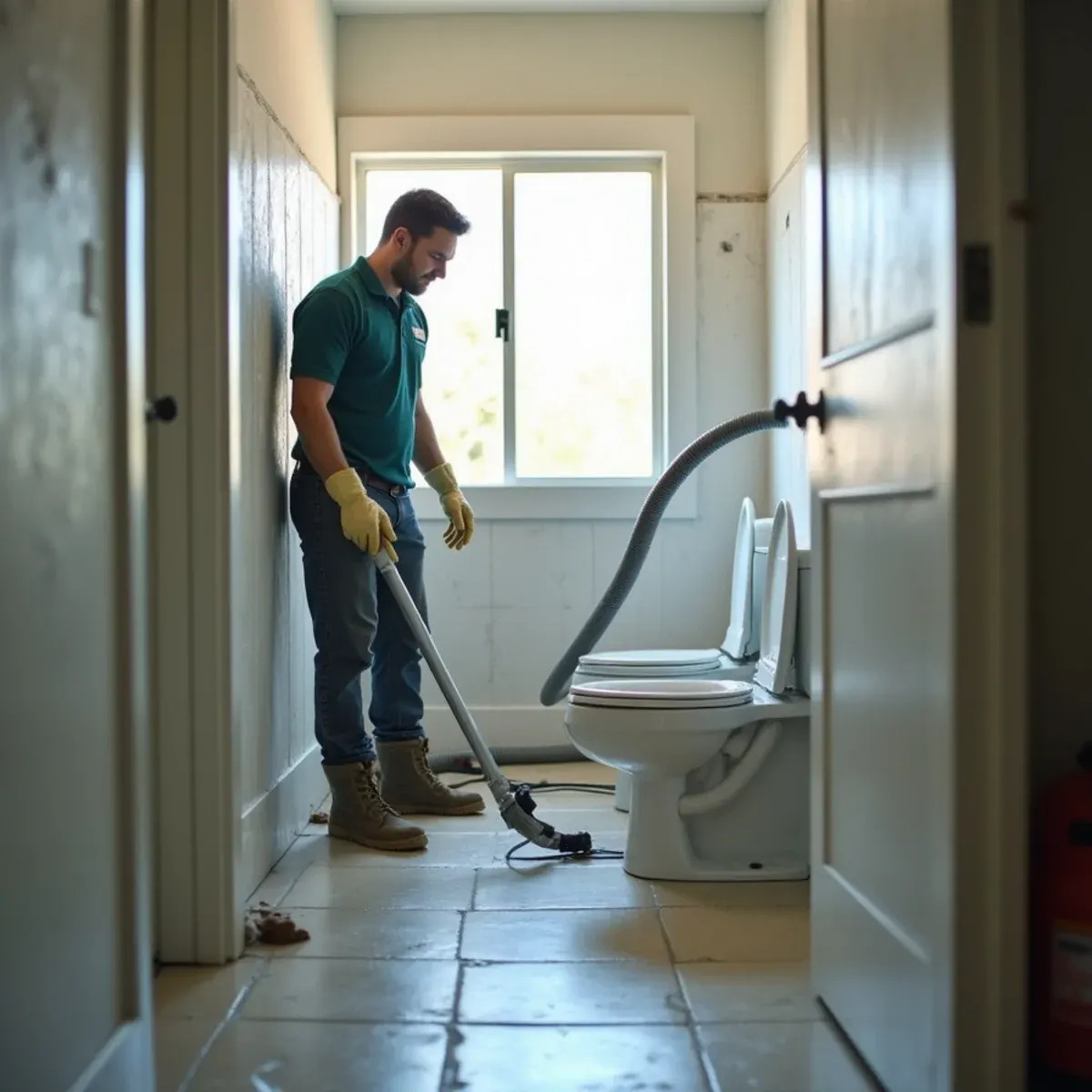
Jean Vandruff's Cinderella Homes are the reason we do more low-demolition drying in Downey than in most cities. The turrets, the pointed rooflines, the scalloped gingerbread trim and the diamond-paned windows aren't reproducible — nobody mills that profile anymore, and the salvage market is thin. Underneath all of it, though, is an ordinary 1950s slab house with galvanized supply and drain lines of the same age. The detailing is irreplaceable. The plumbing is exactly as tired as the neighbors'.
That combination shapes how we work here. Downey filled in between roughly 1950 and 1965 — the same window that produced the oldest surviving McDonald's on Lakewood Boulevard and the aerospace campus that became the Columbia Memorial Space Center. Bathrooms in these houses are small, tiled, and open onto hallways lined with original millwork. When a toilet backs up, the water reaches that trim within a minute or two, and what happens in the first hours decides whether it stays.
What Downey Changes About Toilet Overflow
1Millwork we can often save
Solid wood trim and door casings splashed by Category 3 water can frequently be cleaned, sanitized and dried in place if we get to them before they swell and the finish lifts. Where access demands removal, we take each piece off carefully, label it, and put it back. Painted MDF replacements are not the same house, and neither is a guessed-at reproduction profile.
2Drywall and pad come out anyway
Sympathy for a historic house doesn't change the category. Sewage-contaminated drywall, insulation, carpet and pad are porous, and they leave, no matter how charming the room is. We'd rather say that plainly than take your money pretending to dry something that can't be restored. The savings on a Downey job come from the trim and the hardwood, not the gypsum.
3Seventy-year-old lines under identical tracts
Downey's postwar streets went up quickly and uniformly, and the drain lines beneath them are the same age block to block. Root intrusion and scale build on similar schedules, which is why we sometimes see two backups on one street within a season. If your neighbor just had one, that's a good reason to have your line scoped now.
How the Work Runs
The method is the same one we use on every toilet overflow job, documented to the IICRC S500:2025 standard. Here it is in short — the full toilet overflow cleanup process explains each stage in detail.
- Stop the water, stabilize the room
- Determine the category before scoping
- Extract, then remove only what must go
- Pull the toilet, inspect the flange
- Dry the subfloor and the ceiling below
- Disinfect to category, verify, reset
The Downey Background Worth Knowing
The instinct on a wet wall is to open it, and sometimes that is correct. But IICRC S500:2025 is built around restoring rather than replacing wherever the drying goals can genuinely be met, and on a house with original arched casings and applied gingerbread, meeting those goals is worth some patience. We would rather spend three extra days with equipment running than pull a run of trim that would have to be milled from scratch to come back. The standard supports that choice and so does the arithmetic on the estimate, because custom millwork is not cheap and matching a fifties profile is not quick.
There is more on the housing stock, drainage and plumbing history of this city on our water damage restoration in Downey page.
Downey at a glance
- Dominant construction era
- 1950–1965
- Foundation type
- slab on grade
- Supply piping found here
- galvanized steel, under-slab copper
- Drain line materials
- cast iron
- Terrain and water table
- flat, moderate water table
- Most common local failure
- 1950s slab and galvanized failures in houses whose decorative woodwork makes careful, low-demolition drying worth paying for
- Highest-value local prevention
- drying in place wherever readings allow, because the trim and detailing on these houses cannot be bought
What It Costs in Downey
We do not quote a number over the phone before seeing the property — anyone who does is guessing. The variables that actually move the price on a toilet overflow job are the category of the water, how far it traveled from the base, what your floor is built from, and they are broken down in full on the toilet overflow cleanup page. The assessment and the written estimate are free anywhere in Downey, day or night, with no obligation.
Toilet Overflow Questions from Downey Homeowners
Usually not all of it. We often remove the baseboard and lower casing sections to get airflow into the wall cavity, which is far less destructive than cutting drywall from the top down. Every piece is numbered and stored dry, and it goes back when the cavity reads clean. If a piece has swollen, delaminated, or drawn contaminated water up through end grain, we'll show you why before anything is thrown away.
Clear water lowers the health risk, not the drying requirement. Clean water still soaks into carpet pad, particle board, and the cut edge of subfloor around the flange, and it still causes swelling and mold growth if it stays. What clean water does change is the scope: no containment, no PPE, usually no demolition. If it stayed on sealed tile and you got it up quickly, you may genuinely be fine. If it reached anything porous, it needs real drying.
Three checks. Did the water rise in the bowl without anyone flushing it? Does another fixture gurgle, drain slowly, or fill up when you run water elsewhere in the house? Is there visible soil or a sewer odor in what came out? Any one of those points at the main line. A stuck fill valve, by contrast, gives you clear water, a bowl that overflows steadily, and a tank you can hear running continuously.
Usually, yes. We go into the wall cavity through small ports low on the wall, hidden behind shoe molding or inside a closet, and dry from the inside out rather than taking the finished face off. That takes longer and needs more equipment than gutting the wall would, which is exactly the trade we think is worth making on a house with millwork that cannot be bought. Where it will not work, we tell you early.