
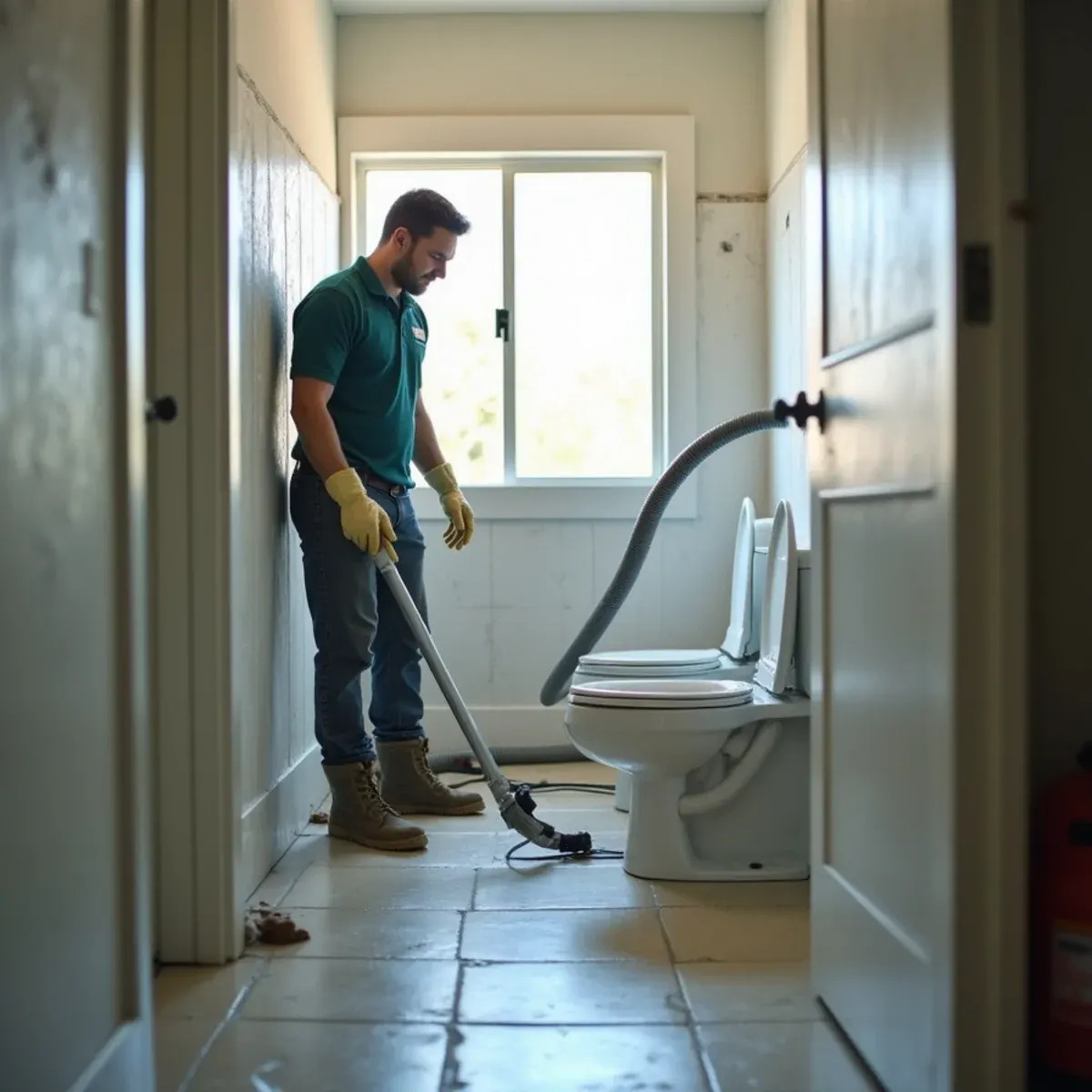
The marine layer is why this job takes longer in Costa Mesa than it does inland. Eastside is small 1920s through 1940s cottages on raised foundations under a heavy tree canopy, and the crawl spaces beneath them stay cool and humid most of the year. When a toilet overflows in one of those houses, the water goes through the floor into a space where the air is already close to saturated. Nothing dries down there on its own. It just waits.
The rest of the city varies. Mesa Verde is 1960s slab tract, where the same overflow spreads flat across tile and into hall carpet. The Westside mixes housing with light industrial, and the stacked units near the arts district and South Coast Plaza turn one tenant's overflow into a downstairs neighbor's ceiling. Add a shallow water table across the whole city and the Santa Ana River channel along the western edge, and the drying targets we can honestly promise shift by neighborhood.
What Costa Mesa Changes About Toilet Overflow
1Marine air slows crawl-space drying
Under an Eastside cottage, ambient humidity does most of the fighting against us. Open venting doesn't help when the outside air is wetter than the space. We seal, dehumidify and warm the crawl space rather than fan it, and we're honest that it takes longer than the same job in Placentia or Yorba Linda. Rushing it leaves you with an odor problem in three months.
2Shallow groundwater sets a floor on dryness
Costa Mesa's water table is close enough to the surface that crawl-space soil never reaches the readings you'd get in a hillside city. We dry to a defensible standard measured against a control reading taken in an unaffected part of the same house, not to a number from a textbook. Anyone promising bone-dry soil under an Eastside cottage is describing somewhere else.
3Stacked units make it two claims
In the apartments and duplexes near the arts district, an upstairs overflow reaches a downstairs ceiling within minutes. Two occupants, often two policies, sometimes an association in between. We document the source unit and the receiving unit separately from the first walkthrough, so nobody spends a month arguing about which scope belongs to whom.
How the Work Runs
The method is the same one we use on every toilet overflow job, documented to the IICRC S500:2025 standard. Here it is in short — the full toilet overflow cleanup process explains each stage in detail.
- Stop the water, stabilize the room
- Determine the category before scoping
- Extract, then remove only what must go
- Pull the toilet, inspect the flange
- Dry the subfloor and the ceiling below
- Disinfect to category, verify, reset
The Costa Mesa Background Worth Knowing
Under a raised Eastside cottage there is bare soil, and that soil is supposed to stay dry because the foundation vents exchange air with the outside. That system depends on the outside air being drier than the space under the house. For a good part of the year in Costa Mesa it is not. The marine layer holds humidity high through the night and well into the morning, so the crawl space never gets the dry stretch it needs, and moisture that arrives from a plumbing drip, a downspout, or an irrigation line just accumulates.
There is more on the housing stock, drainage and plumbing history of this city on our water damage restoration in Costa Mesa page.
Costa Mesa at a glance
- Dominant construction era
- 1920–1980
- Foundation type
- mixed on grade
- Supply piping found here
- original 1920s–1940s piping on the Eastside, galvanized steel, under-slab copper
- Drain line materials
- cast iron, clay
- Terrain and water table
- coastal-flat, shallow water table
- Most common local failure
- crawl-space moisture under Eastside cottages, held in by a marine layer that slows every natural drying process
- Highest-value local prevention
- confirming crawl-space vents are actually open and that the ground under the house is dry
What It Costs in Costa Mesa
We do not quote a number over the phone before seeing the property — anyone who does is guessing. The variables that actually move the price on a toilet overflow job are the category of the water, how far it traveled from the base, what your floor is built from, and they are broken down in full on the toilet overflow cleanup page. The assessment and the written estimate are free anywhere in Costa Mesa, day or night, with no obligation.
Toilet Overflow Questions from Costa Mesa Homeowners
Longer than you want, and longer than the same job would take in a slab house a few miles inland. Between the marine layer, the tree canopy and a shallow water table, we're working against ambient conditions the whole time. We contain and dehumidify the space rather than ventilate it, and we take daily readings against a control point. We'll give you a real number after the first full day of data, not before it.
Clear water lowers the health risk, not the drying requirement. Clean water still soaks into carpet pad, particle board, and the cut edge of subfloor around the flange, and it still causes swelling and mold growth if it stays. What clean water does change is the scope: no containment, no PPE, usually no demolition. If it stayed on sealed tile and you got it up quickly, you may genuinely be fine. If it reached anything porous, it needs real drying.
Three checks. Did the water rise in the bowl without anyone flushing it? Does another fixture gurgle, drain slowly, or fill up when you run water elsewhere in the house? Is there visible soil or a sewer odor in what came out? Any one of those points at the main line. A stuck fill valve, by contrast, gives you clear water, a bowl that overflows steadily, and a tank you can hear running continuously.
Almost always the crawl space. On these raised 1920s to 1940s houses the soil under the floor stays damp when the foundation vents are blocked and the marine layer keeps outside air humid overnight. That moisture moves up through the subfloor and into the rooms above it. Before assuming anything, walk your perimeter and see whether a planter, a poured patio or landscaping has covered the vents that are supposed to be breathing.