
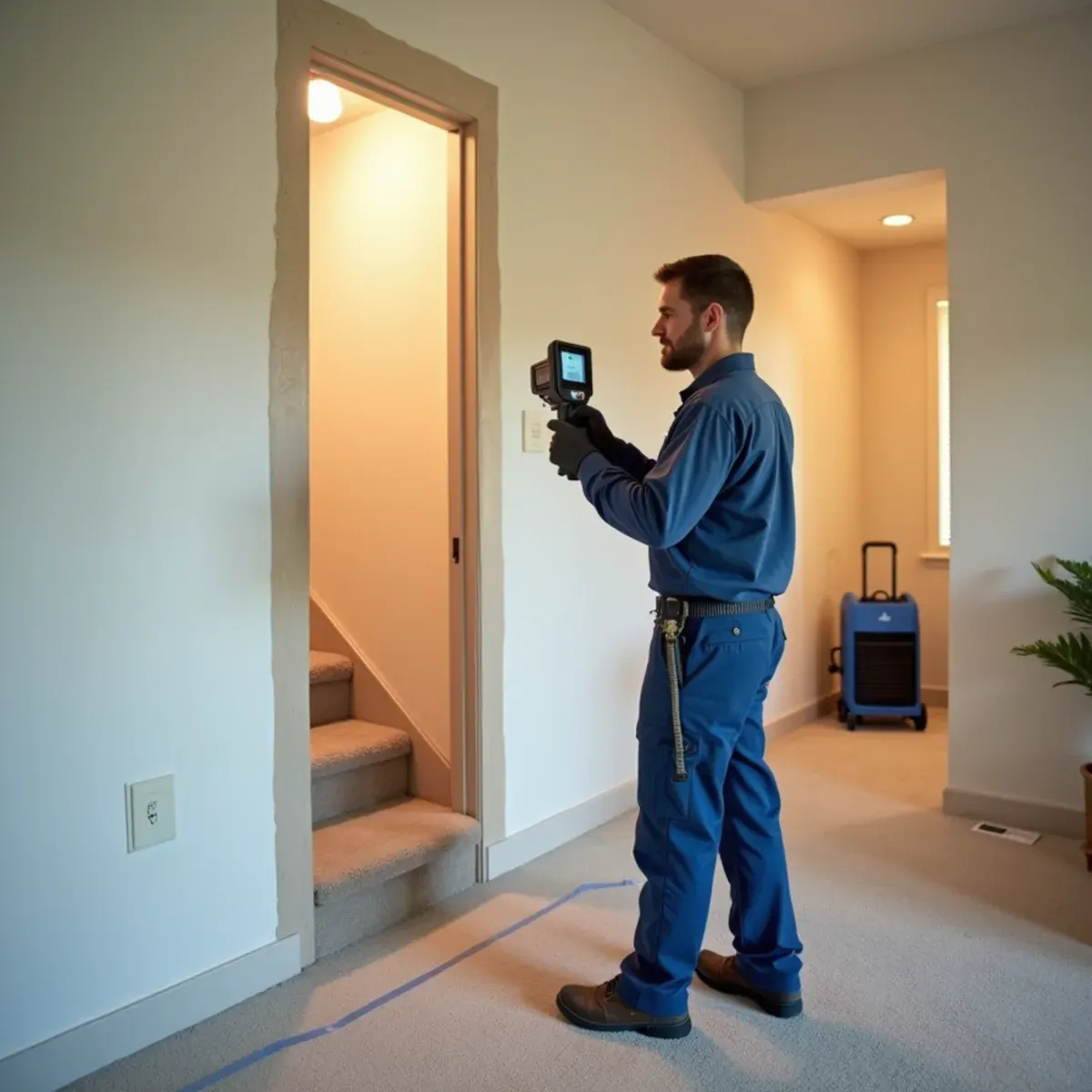
In Leisure World the wall you want opened is often not entirely yours. There are roughly 9,000 attached units from the early sixties here, with a mutual and a management company standing between a resident and any cut into a shared wall. That is a step rather than an obstacle. We document the damage, scope the opening, and get the approval in place instead of cutting a party wall and explaining afterward. When water crosses into the neighboring unit, which it regularly does, two residents and two policies are involved from the first hour.
Old Town is a different animal on the same peninsula. Dense lots, construction running from the twenties through the fifties, mixed foundations, plaster in some of the older houses and board in the rest. And the marine layer touches every job in this city. Ambient humidity this close to the water slows in-place drying, stretches the wait before we can tape and texture, and adds time before paint cures properly. We dehumidify the work area rather than pretending coastal air will cooperate, and we give the longer timeline up front instead of missing a shorter one.
What Seal Beach Changes About Drywall Repair
1Shared walls need approval before cutting
Leisure World units are attached, and the wall between two of them is governed by the mutual and the management company rather than by whoever lives on one side. We document, scope and submit before opening anything. Residents who have a contractor cut first tend to spend the following month untangling it, and the repair stalls while the paperwork catches up.
2Marine air stretches every drying day
This close to the water, ambient humidity works against you at every stage. Cavity drying takes longer, joint compound takes longer to set hard enough to sand, and paint stays soft. We run dehumidification on the work area and quote the real number of days rather than the inland one. A texture coat rushed in coastal damp is a texture coat that has to be redone.
3Old Town plaster among the board
Old Town has houses from the twenties and thirties, and some still carry original plaster over lath. It holds far more water than gypsum board and releases it slowly, so it needs a different drying plan and a different repair. We check the material at the first opening rather than assuming that a 1950s neighbor two doors down means the same wall here.
How the Work Runs
The method is the same one we use on every drywall repair job, documented to the IICRC S500:2025 standard. Here it is in short — the full drywall water damage repair process explains each stage in detail.
- Meter the wall first
- Decide dry-in-place or remove
- Open the cavity, not the wall
- Cut to a stud and a seam line
- Clear the cavity and dry the framing
- Tape, texture, prime, paint
The Seal Beach Background Worth Knowing
Structural drying works by creating a vapor pressure differential — dry air pulls moisture out of wet materials. When the surrounding air is already carrying a heavy moisture load, that differential shrinks and everything slows down.
There is more on the housing stock, drainage and plumbing history of this city on our water damage restoration in Seal Beach page.
Seal Beach at a glance
- Dominant construction era
- 1920–1965
- Foundation type
- mixed on grade
- Supply piping found here
- galvanized steel, copper, shared community mains
- Drain line materials
- cast iron, clay
- Terrain and water table
- coastal-flat, shallow water table
- Most common local failure
- losses that cross shared walls between attached units, involving several policies and a mutual at once
- Highest-value local prevention
- documenting each affected unit separately from the first hour
What It Costs in Seal Beach
We do not quote a number over the phone before seeing the property — anyone who does is guessing. The variables that actually move the price on a drywall repair job are how much board comes out, cut height and seam count, texture type and match difficulty, and they are broken down in full on the drywall water damage repair page. The assessment and the written estimate are free anywhere in Seal Beach, day or night, with no obligation.
Drywall Repair Questions from Seal Beach Homeowners
In practice, three parties. The mutual and management company control any opening in the shared wall and their approval comes first. Your policy and your neighbor's each cover their own side, so we document the two units separately with their own readings, photographs and itemized scopes even though it is one event. We can carry both scopes and bill the carriers directly, but we do not cut a party wall until the written approval is in hand.
No, and that assumption is why a lot of walls come out that did not need to. Gypsum board that got clean water, still reads firm under thumb pressure, and is coming down in moisture content day over day can usually be dried in place through the cavity. What forces removal is contaminated water, a core that has softened or swelled, visible growth on the paper, or insulation behind it that holds moisture against the board. We take readings before we answer that question.
Usually two feet or four feet above the floor, measured level across the whole run rather than following the stain. Board comes in four-foot widths, so a cut at either height lands the new seam where a factory edge would sit, which is far easier to hide than a seam floating mid-wall. The cut also has to end at the center of a stud on each side, so the patch has something to fasten to. Cutting to the shape of the damage looks thrifty and finishes badly.
Coastal marine layer conditions keep ambient humidity high for extended periods, which reduces the vapor pressure differential that drives drying. Jobs near the water need sealed chambers and more dehumidification capacity than an equivalent loss inland, and the equipment stays on longer.