
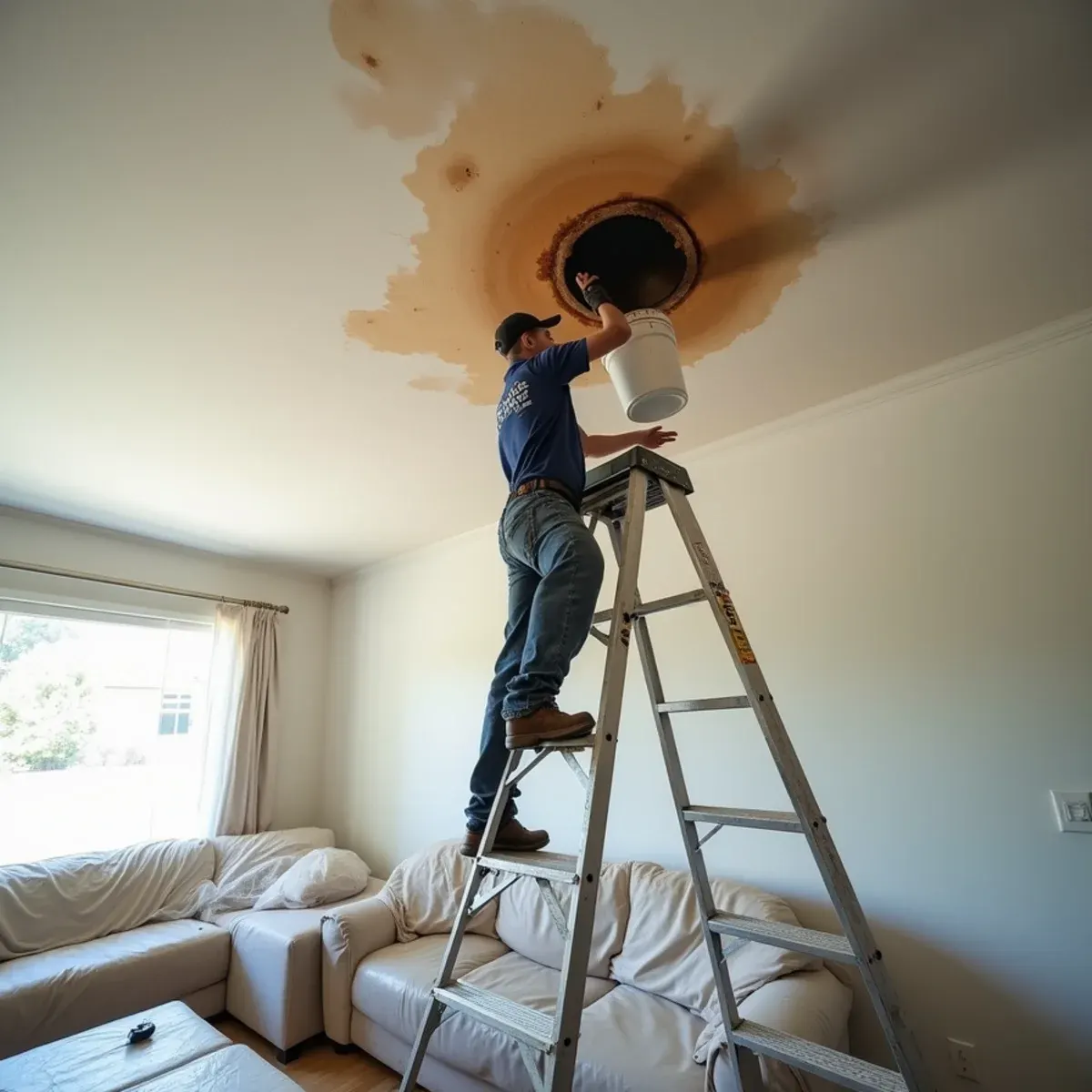
A ceiling stain is a poor map in almost any house, and in Villa Park it is a worse one than usual. These are large custom homes on half-acre lots, built between 1962 and the mid-1980s, and the roofs show it: multiple planes, long valleys, crickets behind chimneys, dormers, skylights added in the 1970s, and framing runs that can carry water thirty or forty feet before it finds a low point to drop from. So we do not start under the stain. We start in the attic above it and work uphill along the framing until we find the wet line.
The attics match the houses. They are big, they are warm, and drying one properly takes more air movement and more dehumidification than a typical tract attic. It also takes electrical capacity that the circuits nearest the hatch may not have, so we plan power before we plan equipment rather than tripping breakers at midnight. The canopy that gives these streets their character works against the roofs. Trees planted with the tracts off Center Drive and Santiago Boulevard are sixty years old now and sit directly over roof planes.
What Villa Park Changes About Ceiling & Roof Leaks
1Long framing runs hide the entry point
Custom floor plans mean long rafters, stepped ceiling heights and framing that carries water well away from where it came in. We have opened ceilings in Villa Park where the entry was two rooms from the stain. Tracing from the attic side with a moisture meter and a light, following the dark line on the sheathing back to daylight, is the only reliable way through a roof this complicated.
2Big attics need real drying capacity
An attic over four thousand square feet of house does not dry with one fan. We size the equipment to the cubic volume and the wet material, run dehumidification rather than relying on outside air, and check the panel first because the receptacles near a Villa Park attic hatch are often on one shared circuit. Undersized drying looks cheaper for three days and then costs a ceiling.
3Sixty-year-old trees over the roof plane
Half-acre lots got planted generously when these houses were new, and those trees now overhang roof planes rather than lawns. Constant litter in valleys, limbs abrading shingle, and heavy shade that keeps one slope damp all winter are all common here. When we find a leak under an overhanging limb, trimming back is part of the repair, not an upsell.
How the Work Runs
The method is the same one we use on every ceiling & roof leaks job, documented to the IICRC S500:2025 standard. Here it is in short — the full ceiling & roof leak water damage process explains each stage in detail.
- Emergency tarping or temporary dry-in
- Controlled relief of trapped water
- Trace the intrusion to its real source
- Remove wet insulation and compromised drywall
- Dry the attic and the ceiling assembly
- Restore the ceiling completely
The Villa Park Background Worth Knowing
In a tract, the plumbing sits where it sat in the last four houses we worked on. In Villa Park it is wherever the plan put it in 1974, and there is rarely a drawing left to consult. That is why locating a leak here can take longer than a homeowner expects. Water from a pinhole travels the path of least resistance under the slab and surfaces wherever the soil and the concrete let it, which on a plan this size can be an entire room away from the break. Guessing at the wet spot is how people end up cutting the wrong floor.
There is more on the housing stock, drainage and plumbing history of this city on our water damage restoration in Villa Park page.
Villa Park at a glance
- Dominant construction era
- 1962–1985
- Foundation type
- slab on grade
- Supply piping found here
- under-slab copper
- Drain line materials
- cast iron, ABS
- Terrain and water table
- rolling, moderate water table
- Most common local failure
- long under-slab runs in large custom floor plans, where a leak can sit far from any fixture and take longer to locate
- Highest-value local prevention
- separating irrigation from the domestic meter so a leak test actually means something
What It Costs in Villa Park
We do not quote a number over the phone before seeing the property — anyone who does is guessing. The variables that actually move the price on a ceiling & roof leaks job are how long the leak has been active, ceiling texture and finish, attic access and insulation type, and they are broken down in full on the ceiling & roof leak water damage page. The assessment and the written estimate are free anywhere in Villa Park, day or night, with no obligation.
Ceiling & Roof Leaks Questions from Villa Park Homeowners
Because on a house this size the water is rarely directly above the mark. We follow the wet trail across the attic framing back to the entry, and the wet drywall usually extends well past the visible stain, since paint and texture hide moisture until it is significant. Small openings placed where the meter reads wet let us dry the cavity from inside and confirm the perimeter is dry. It means fewer openings overall, not more, and a repair that does not come back.
Clear the room and keep everyone out from underneath it, including pets. Move furniture if you can do it from the side. Put a bucket down if you can place it safely without standing under the bulge. Then call us — we relieve it deliberately, which is safer and preserves much more of the ceiling than letting it fail on its own.
We tarp immediately to stop the intrusion and coordinate the roofing repair with a licensed roofer, then handle all the interior restoration ourselves. You get one point of contact and one schedule instead of managing two trades during a storm week.
Start by taking irrigation out of the equation, because on a half-acre lot it is the largest variable you have. Shut the controller off for a full day, then read the meter twice with nothing running in the house. If the leak indicator is still moving, the loss is on the domestic side and worth locating. If it stops, you have a landscape valve or lateral line problem, which is a different and much cheaper trade.