
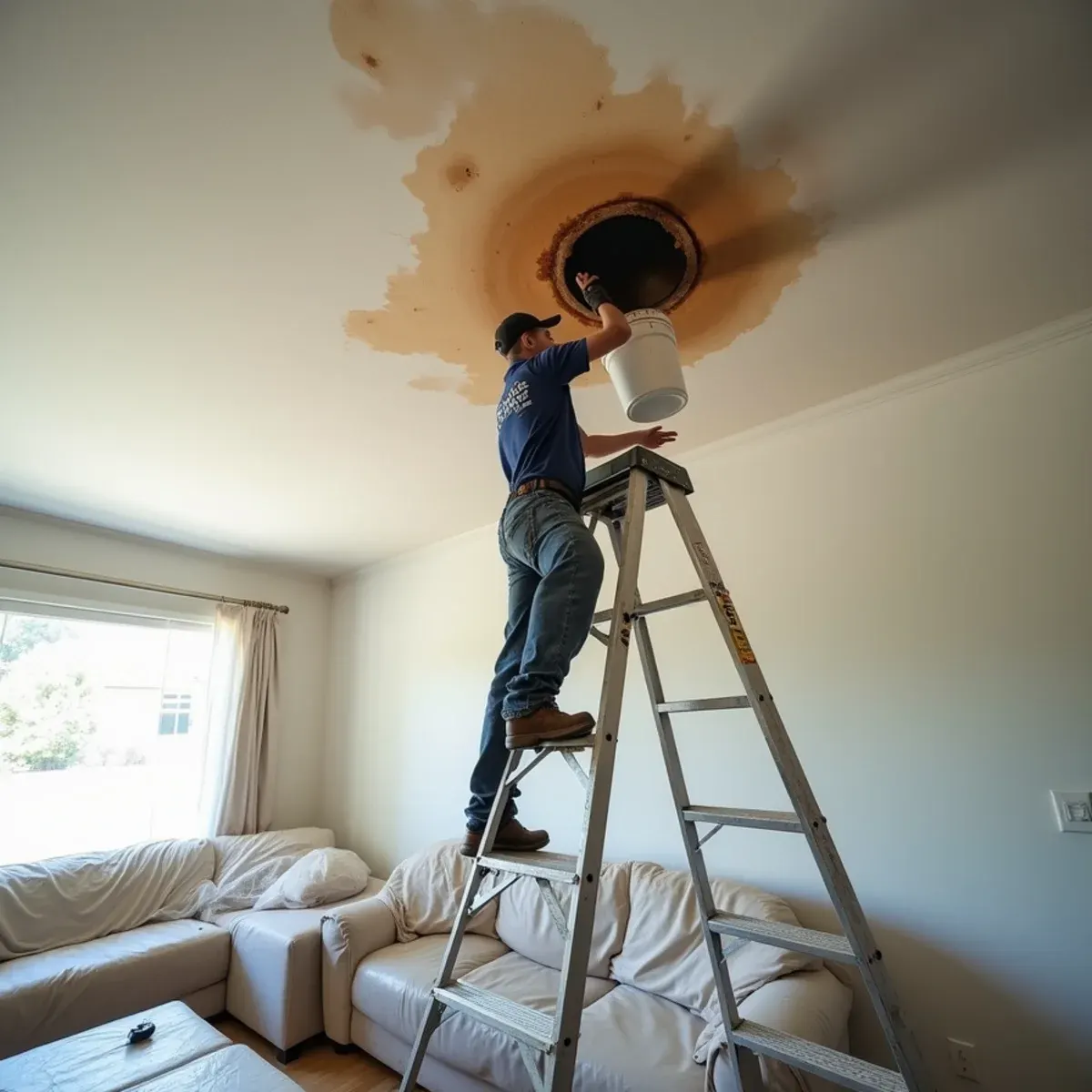
On top of the hill there is nothing between your house and the weather. Signal Hill rises three hundred sixty-five feet out of the middle of Long Beach with no ridge behind it and little canopy to slow anything down, so storm wind hits roof edges, rake ends and vertical walls at angles a flat-ground house never sees. A meaningful share of what people here call a roof leak actually enters at a window head flashing, a rake edge or a stucco crack, then runs down inside the wall cavity and shows up on the ceiling below. Chasing the shingle field on those calls wastes everyone's time.
The stock splits sharply. Older single-family from the 1920s sits on the slopes with original framing, original piping and roofs that have been patched by many hands. Then there are the 1990s and 2000s townhomes and condos built on former oil-field land, on steep engineered lots with retaining walls, tuck-under garages and shared roofs over attached units. On those, an early question is where the association's roof responsibility ends and your ceiling begins, because that line decides which carrier covers what and who authorizes the work.
What Signal Hill Changes About Ceiling & Roof Leaks
1Wind-driven rain enters above the roofline
Exposure at this elevation means water is pushed at vertical surfaces, not just dropped on horizontal ones. Head flashing over windows, rake edges, and hairline stucco cracks all become entry points in a strong storm. We test directionally rather than spraying the roof field, and we open at the wall top when the meter reads wet down the cavity instead of at the ceiling center.
2Shared roofs, split responsibility
In the hillside townhome and condo developments built on former oil land, the roof usually belongs to the association and the interior finishes belong to you. That means two carriers, two adjusters and two scopes for one leak. We document the intrusion point and the interior damage separately so each side gets what it needs, and we keep the drying moving while that gets sorted rather than waiting on paperwork.
3Steep lots make tarping a rigging job
Terraced yards, retaining walls and tuck-under garages leave very little flat ground to set a ladder on, and the wind that caused the problem is often still blowing. We plan the approach from the uphill side where we can, use ballasted coverage rather than fighting a tarp in gusts, and are honest when a roof face has to wait for the wind to drop before anyone goes up.
How the Work Runs
The method is the same one we use on every ceiling & roof leaks job, documented to the IICRC S500:2025 standard. Here it is in short — the full ceiling & roof leak water damage process explains each stage in detail.
- Emergency tarping or temporary dry-in
- Controlled relief of trapped water
- Trace the intrusion to its real source
- Remove wet insulation and compromised drywall
- Dry the attic and the ceiling assembly
- Restore the ceiling completely
The Signal Hill Background Worth Knowing
On these lots the drainage is engineered rather than natural. Terrace drains catch water partway down a slope, v-ditches carry it around a pad instead of across it, and retaining walls have weep holes with a gravel drain behind them so pressure never builds in the soil. All of that works until something clogs. Then a retaining wall stops being a wall and starts being a dam, and saturated soil pushes water through the joints and into whatever sits on the other side, which is usually a garage, a storage room, or the back of a lower level.
There is more on the housing stock, drainage and plumbing history of this city on our water damage restoration in Signal Hill page.
Signal Hill at a glance
- Dominant construction era
- 1920–2005
- Foundation type
- mixed on grade
- Supply piping found here
- original 1920s piping, galvanized steel, modern PEX in newer hillside builds
- Drain line materials
- cast iron, ABS
- Terrain and water table
- hillside-mixed, deep water table
- Most common local failure
- slope drainage and retaining-wall failures on steep lots, where water arrives with velocity rather than ponding
- Highest-value local prevention
- keeping terrace drains, v-ditches and retaining-wall weeps clear before the first storm
What It Costs in Signal Hill
We do not quote a number over the phone before seeing the property — anyone who does is guessing. The variables that actually move the price on a ceiling & roof leaks job are how long the leak has been active, ceiling texture and finish, attic access and insulation type, and they are broken down in full on the ceiling & roof leak water damage page. The assessment and the written estimate are free anywhere in Signal Hill, day or night, with no obligation.
Ceiling & Roof Leaks Questions from Signal Hill Homeowners
Up here that usually means it is not entering through the roof field at all. On an exposed hilltop, wind drives rain against walls and window heads hard enough to get past flashing and stucco cracks, and the water then travels down the wall cavity and out along a ceiling framing member. From inside it looks exactly like a roof leak. We meter the wall from the top plate down and test with directional water at the suspected elevation, which finds these when a roof walk cannot.
Clear the room and keep everyone out from underneath it, including pets. Move furniture if you can do it from the side. Put a bucket down if you can place it safely without standing under the bulge. Then call us — we relieve it deliberately, which is safer and preserves much more of the ceiling than letting it fail on its own.
We tarp immediately to stop the intrusion and coordinate the roofing repair with a licensed roofer, then handle all the interior restoration ourselves. You get one point of contact and one schedule instead of managing two trades during a storm week.
Start uphill. On this hill the cause is almost never at the place the water got in. Walk the slope above your pad and check the terrace drains, the v-ditch and the retaining wall weep holes. A weep that has been painted or stuccoed over is common and completely disables the drain behind the wall. Then look at where the uphill property discharges. Fixing the entry point without finding the redirect just moves the problem a few feet.