
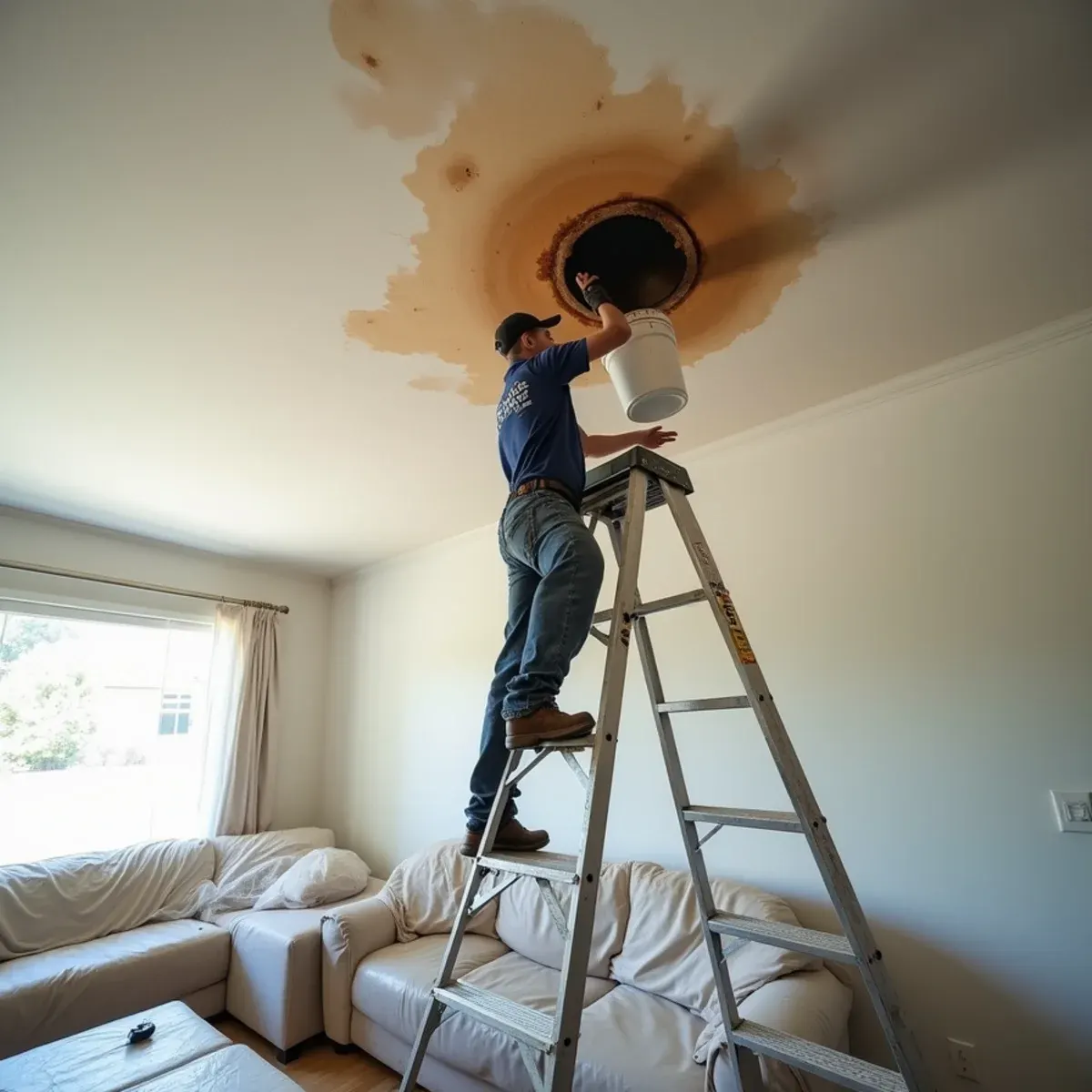
Before you call a roofer, check the calendar. If the stain on your hallway ceiling appeared in July and the last real rain was in March, the water almost certainly came from your own attic. Fountain Valley's 1960s and 1970s tracts put the furnace and air handler up there, with a primary condensate line, a secondary pan and a float switch that was supposed to catch a blockage. The line plugs with biological growth, the pan rusts through or was never sloped, the switch has been sitting untested for years, and the result stains a ceiling in exactly the way a roof leak does.
This city's uniformity works in your favor here. The tracts around Mile Square and along Brookhurst were built to a small set of plans, so we generally know where the attic unit sits relative to your hallway and where the pan will have overflowed before we go up. When it genuinely is the roof, the entry is most often at a low-slope transition over a patio enclosure or an addition, or in a valley loaded with leaf litter from the mature canopy these neighborhoods have grown since the tracts went in over the old Gospel Swamp ground.
What Fountain Valley Changes About Ceiling & Roof Leaks
1Attic air handlers and blocked condensate lines
An air conditioner running through an Orange County summer pulls a real volume of water out of the air, and all of it is supposed to leave through a small drain line. When that line blocks, the overflow goes into a pan directly above your ceiling. The tell is a stain that appears and grows in hot weather and stops entirely when the system is off.
2Same tract, predictable equipment placement
Because these neighborhoods repeat a handful of plans, the mechanical closet, the attic platform and the duct runs sit in the same places house to house. That means we can go straight to the likely source instead of crawling the whole attic, which matters when the insulation is deep and the framing is tight over the bedroom wing.
3Mature canopy over low-slope transitions
The trees planted with these tracts are now full size and they shed into valleys and onto the near-flat roofs over patio enclosures. Debris holds water on a surface that was never designed to hold any, and it backs up under the shingle at the transition. Clearing those areas before the season is cheap. Opening a ceiling afterward is not.
How the Work Runs
The method is the same one we use on every ceiling & roof leaks job, documented to the IICRC S500:2025 standard. Here it is in short — the full ceiling & roof leak water damage process explains each stage in detail.
- Emergency tarping or temporary dry-in
- Controlled relief of trapped water
- Trace the intrusion to its real source
- Remove wet insulation and compromised drywall
- Dry the attic and the ceiling assembly
- Restore the ceiling completely
The Fountain Valley Background Worth Knowing
Groundwater beneath Fountain Valley sits close enough to the surface that moisture vapor migration up through concrete slabs is a routine background condition rather than an anomaly. Homeowners here regularly describe a slab that feels cool and damp, or a closet on an exterior wall that never quite feels dry, without any leak at all.
There is more on the housing stock, drainage and plumbing history of this city on our water damage restoration in Fountain Valley page.
Fountain Valley at a glance
- Dominant construction era
- 1960–1980
- Foundation type
- slab on grade
- Supply piping found here
- under-slab copper
- Drain line materials
- cast iron
- Terrain and water table
- flat, shallow water table
- Most common local failure
- slab vapor emission mistaken for a leak, and flooring failures caused by installing over an untested slab
- Highest-value local prevention
- clearing the yard and area drains before the season, because a blocked drain on dead-flat ground ponds water against the house
What It Costs in Fountain Valley
We do not quote a number over the phone before seeing the property — anyone who does is guessing. The variables that actually move the price on a ceiling & roof leaks job are how long the leak has been active, ceiling texture and finish, attic access and insulation type, and they are broken down in full on the ceiling & roof leak water damage page. The assessment and the written estimate are free anywhere in Fountain Valley, day or night, with no obligation.
Ceiling & Roof Leaks Questions from Fountain Valley Homeowners
In a Fountain Valley home with the air handler in the attic, that is the condensate system until proven otherwise. The primary drain clogs, the secondary pan takes the overflow, and once the pan fails or fills, water lands on the ceiling below. The float switch that should have shut the system down often does not, because it has never been tested. We meter the ceiling, check the pan and the line, and confirm the roof is not involved before anyone opens drywall.
Clear the room and keep everyone out from underneath it, including pets. Move furniture if you can do it from the side. Put a bucket down if you can place it safely without standing under the bulge. Then call us — we relieve it deliberately, which is safer and preserves much more of the ceiling than letting it fail on its own.
We tarp immediately to stop the intrusion and coordinate the roofing repair with a licensed roofer, then handle all the interior restoration ourselves. You get one point of contact and one schedule instead of managing two trades during a storm week.
The city sits on former wetland with one of the shallowest water tables in Orange County, so moisture vapor migrating up through slabs is a normal background condition here rather than a defect. It matters most when installing flooring over the slab, which is why we test with in-situ RH probes before anything goes back down.