
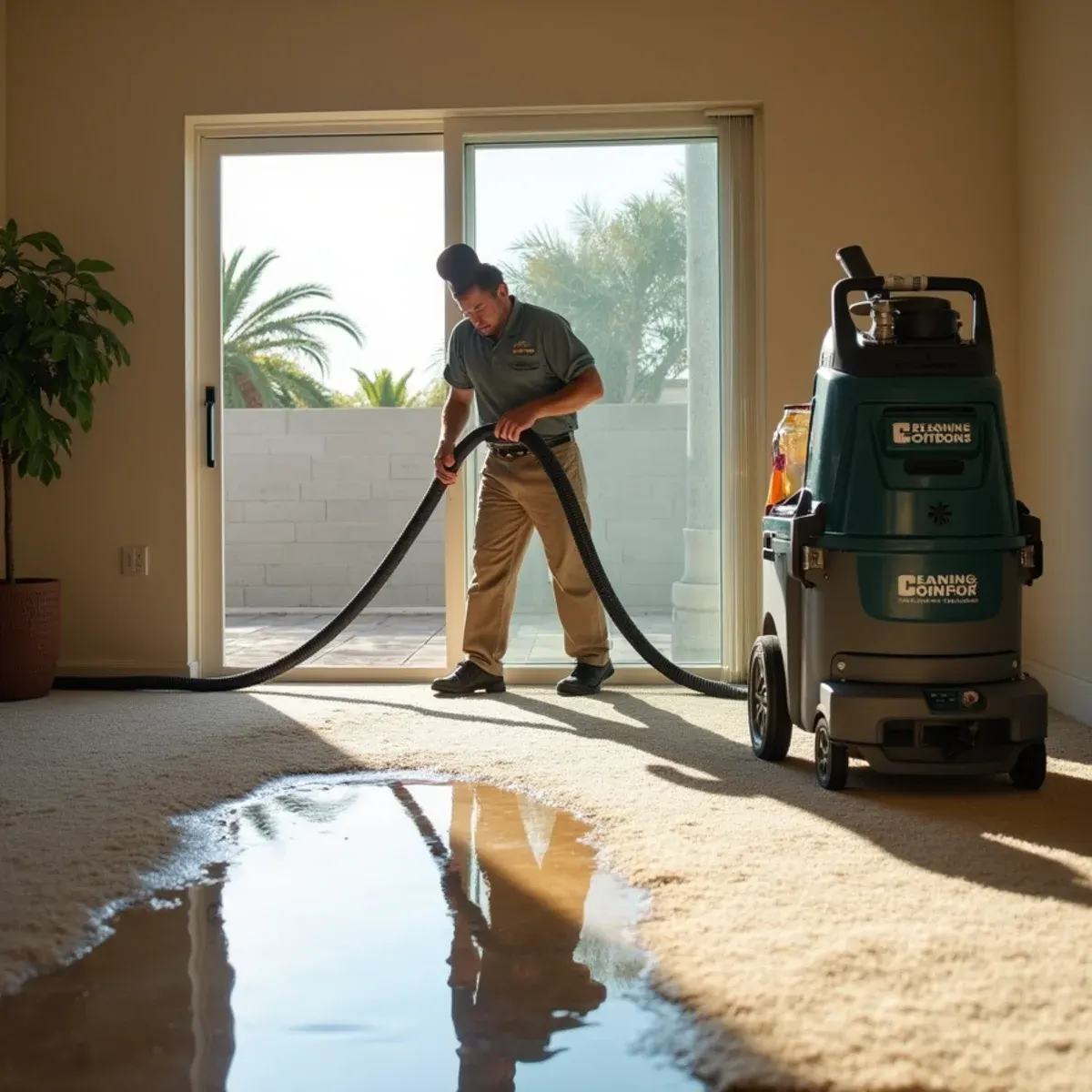
A damp patch in the middle of a Villa Park living room, nothing above it, no fixture within twenty feet. That is the call we get here more than anywhere else we cover. Orange County's smallest city is zoned almost entirely single-family on lots averaging half an acre, and the large custom homes built between 1962 and the mid eighties have plumbing runs to match. A line can fail a long way from the bathroom it serves, then travel along the slab until the carpet finds it for you.
Two things make that harder here than in a tract. First, the carpet. Big custom floor plans run continuous carpet through living rooms, halls and bedrooms with no doorway break, so one wet corner is a single drying zone the size of most people's whole house. Second, the landscape. Half-acre lots carry heavy irrigation, and saturated perimeter soil muddies any attempt to read whether the moisture came from inside or outside. We shut the irrigation down before we test, or the test tells us nothing worth acting on.
What Villa Park Changes About Carpet Drying
1Leak sits far from any fixture
Long under-slab runs are the defining condition here. Checking near fixtures finds nothing, so we moisture-map the whole slab, follow the gradient, and often bring a plumber in for line isolation rather than guessing. Every hour that search takes is an hour the pad keeps wicking, so we start extraction on the known wet area while the search continues.
2Continuous carpet, one drying zone
There are no seams to isolate in most Villa Park floor plans. Carpet runs uninterrupted from the entry through the hall and into bedrooms, which means the wet edge is wherever the meter says, not where the doorway is. We stage weighted extraction across the run and float from the wettest end so water is not driven into dry pad downstream.
3Irrigation clouds every moisture reading
Half an acre of landscape on timers keeps perimeter soil wet year round. That matters when we are deciding whether carpet at an exterior wall got wet from the inside or the outside, and the answer decides whether the pad is saved. We ask for the controller to be off during testing, and we take exterior readings rather than relying on interior numbers alone.
How the Work Runs
The method is the same one we use on every carpet drying job, documented to the IICRC S500:2025 standard. Here it is in short — the full carpet water damage & drying process explains each stage in detail.
- Map the real wet perimeter
- Identify the pad and the category
- Weighted extraction, pass after pass
- Float the carpet or pull the pad
- Dry the slab or subfloor
- New pad, re-stretch, reinstall
The Villa Park Background Worth Knowing
In a tract, the plumbing sits where it sat in the last four houses we worked on. In Villa Park it is wherever the plan put it in 1974, and there is rarely a drawing left to consult. That is why locating a leak here can take longer than a homeowner expects. Water from a pinhole travels the path of least resistance under the slab and surfaces wherever the soil and the concrete let it, which on a plan this size can be an entire room away from the break. Guessing at the wet spot is how people end up cutting the wrong floor.
There is more on the housing stock, drainage and plumbing history of this city on our water damage restoration in Villa Park page.
Villa Park at a glance
- Dominant construction era
- 1962–1985
- Foundation type
- slab on grade
- Supply piping found here
- under-slab copper
- Drain line materials
- cast iron, ABS
- Terrain and water table
- rolling, moderate water table
- Most common local failure
- long under-slab runs in large custom floor plans, where a leak can sit far from any fixture and take longer to locate
- Highest-value local prevention
- separating irrigation from the domestic meter so a leak test actually means something
What It Costs in Villa Park
We do not quote a number over the phone before seeing the property — anyone who does is guessing. The variables that actually move the price on a carpet drying job are whether the pad is salvageable, square footage and equipment days, what sits under the pad, and they are broken down in full on the carpet water damage & drying page. The assessment and the written estimate are free anywhere in Villa Park, day or night, with no obligation.
Carpet Drying Questions from Villa Park Homeowners
No. In Villa Park that pattern usually means an under-slab run passing through the middle of a room. We map moisture across the slab to find the wettest point, which narrows the plumber's search to a small area instead of a room. Pad comes up over the wet zone, carpet is detached, floated and dried, then re-stretched. On a clean-water line caught early we are usually saving the carpet and replacing pad only.
Frequently it can be saved. The deciding factors are water category, how many hours it sat, and whether the backing has delaminated. Clean supply-line water caught within a day, on carpet that was in decent shape beforehand, usually means we replace the pad and keep the carpet. Anything past Category 1, or carpet that has come apart at the backing, is a different answer. We take the readings and check the backing before saying either way.
No, but it does more often than not. On a clean-water loss we reach quickly, we can float the carpet, push dry air into the pad space, and dry it in place. Moisture-barrier pad, dense slab rubber, and anything that sat overnight in gray water comes out. S500:2025 treats pad as non-restorable once contamination is involved, and field experience supports that. It is inexpensive material against a real risk.
Start by taking irrigation out of the equation, because on a half-acre lot it is the largest variable you have. Shut the controller off for a full day, then read the meter twice with nothing running in the house. If the leak indicator is still moving, the loss is on the domestic side and worth locating. If it stops, you have a landscape valve or lateral line problem, which is a different and much cheaper trade.