
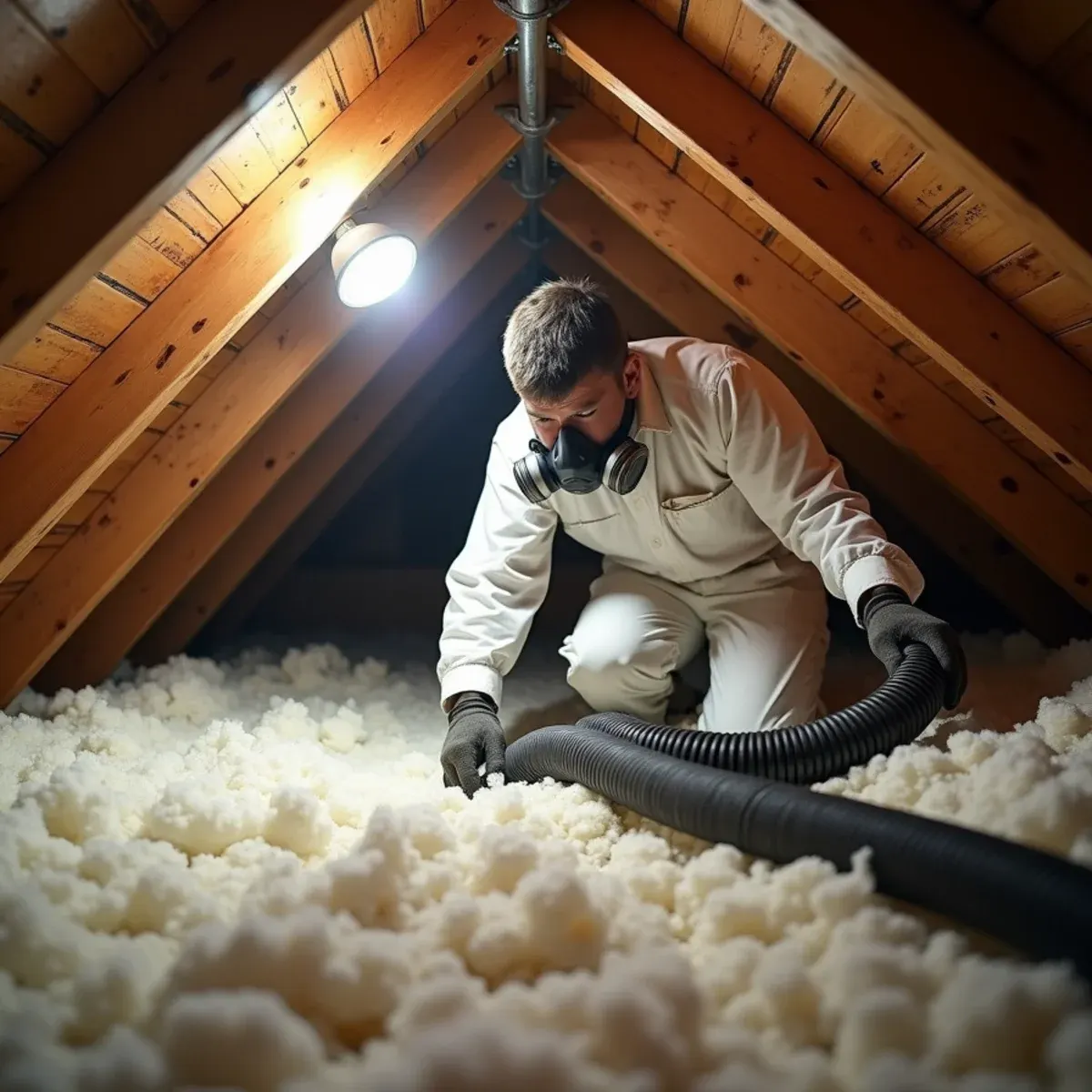
La Palma has more two-story houses than any of its neighbors, and that changes where attic water shows up. The attic only covers the upstairs footprint, so the same gallon of water concentrates over a smaller area, usually a bedroom ceiling. But the ducts and the condensate line don't stay up there. They drop through interior chases to serve the first floor, and water that follows a duct or a drain line downstairs surfaces in a hallway ceiling nowhere near the leak.
These are well-kept houses. Owners here tend to stay for decades, and it shows in the finishes. That matters on an attic job because every bag of saturated insulation has to come down a hatch that's usually in an upstairs hall or closet, then down a staircase, then out through the front of a house somebody has maintained for thirty years. We bag inside the attic, run the vacuum hose out a window or a gable when we can, and cover the stair run before anything moves.
What La Palma Changes About Attic & Insulation
1Half the footprint, twice the stairs
A two-story La Palma attic covers only the upper floor, so there's less insulation to remove than in a single-story house the same size. The catch is getting it out. The hatch is usually in an upstairs hall, the bags have to come down a staircase, and there's no side door to shortcut. We plan the removal path before we open anything.
2Original systems in original houses
Owners here stay for decades and the houses show it, but a well-kept house can still have a drain pan as old as the last time the system was replaced. Rust perforates the primary pan, the secondary pan is missing or was never plumbed to daylight, and the overflow soaks the insulation directly beneath it. We check the pan, the float switch and the condensate line on every attic call in La Palma.
3Repeating plans shorten the search
La Palma is small and its tracts repeat, so once you've been in a few of these attics you know where the air handler sits, which bays the ducts cross and where the baffles get crushed against the eave. That saves time on the front end. It doesn't replace metering, since we still map moisture room by room, but it means fewer exploratory holes in your ceiling.
How the Work Runs
The method is the same one we use on every attic & insulation job, documented to the IICRC S500:2025 standard. Here it is in short — the full attic water damage & insulation replacement process explains each stage in detail.
- Map the wet area before touching it
- Contain the hatch and protect the path
- Vacuum out the saturated insulation
- HEPA vacuum and treat the plane
- Dry the deck, joists, and top plates
- Reinstall insulation and check the details
The La Palma Background Worth Knowing
There is a pattern we see repeatedly in La Palma. A homeowner has taken excellent care of a house for thirty years — new roof, dual-pane windows, updated electrical panel, remodeled kitchen. Then a slab leak runs for eight months under the living room and nobody catches it, because there was never anything to see.
There is more on the housing stock, drainage and plumbing history of this city on our water damage restoration in La Palma page.
La Palma at a glance
- Dominant construction era
- 1960–1980
- Foundation type
- slab on grade
- Supply piping found here
- under-slab copper
- Drain line materials
- cast iron, ABS
- Terrain and water table
- flat, moderate water table
- Most common local failure
- second-floor supply and fixture failures that travel through the floor assembly into the ceiling below
- Highest-value local prevention
- knowing where the main shutoff is and confirming it still turns, because two-story losses double in size in minutes
What It Costs in La Palma
We do not quote a number over the phone before seeing the property — anyone who does is guessing. The variables that actually move the price on a attic & insulation job are how much of the attic got wet, clearance, access, and layout, the type of insulation up there, and they are broken down in full on the attic water damage & insulation replacement page. The assessment and the written estimate are free anywhere in La Palma, day or night, with no obligation.
Attic & Insulation Questions from La Palma Homeowners
Often, yes, and it's usually a small opening downstairs rather than a rebuild. Water that leaves a two-story attic follows the duct chase or the condensate line down to the first-floor ceiling, wetting insulation, framing and drywall on the way. We meter the chase from top to bottom and open only where the readings say to. If the downstairs cavity is dry, we leave it alone and say so.
Only the affected area plus a margin back to dry, lofted material. If the wet section covers a small part of the attic, that is all that comes out. Once it reaches roughly half the plane, replacing the whole field usually costs less than blending old and new to an even depth, and it leaves you with one consistent R-value instead of a patchwork ceiling that performs unevenly room to room.
Most attics take a few days once the wet insulation is out, but we will not promise a number on day one, and you should be careful with anyone who does. Plywood sheathing dries at a different rate than old plank decking, a sealed attic dries faster than a heavily vented one, and marine-layer mornings slow everything down. The daily readings decide when equipment leaves, not the calendar.
Typically fifteen to twenty minutes. La Palma borders Cypress directly to the north, so it is one of the fastest calls we run and the 60-minute commitment applies in full.