
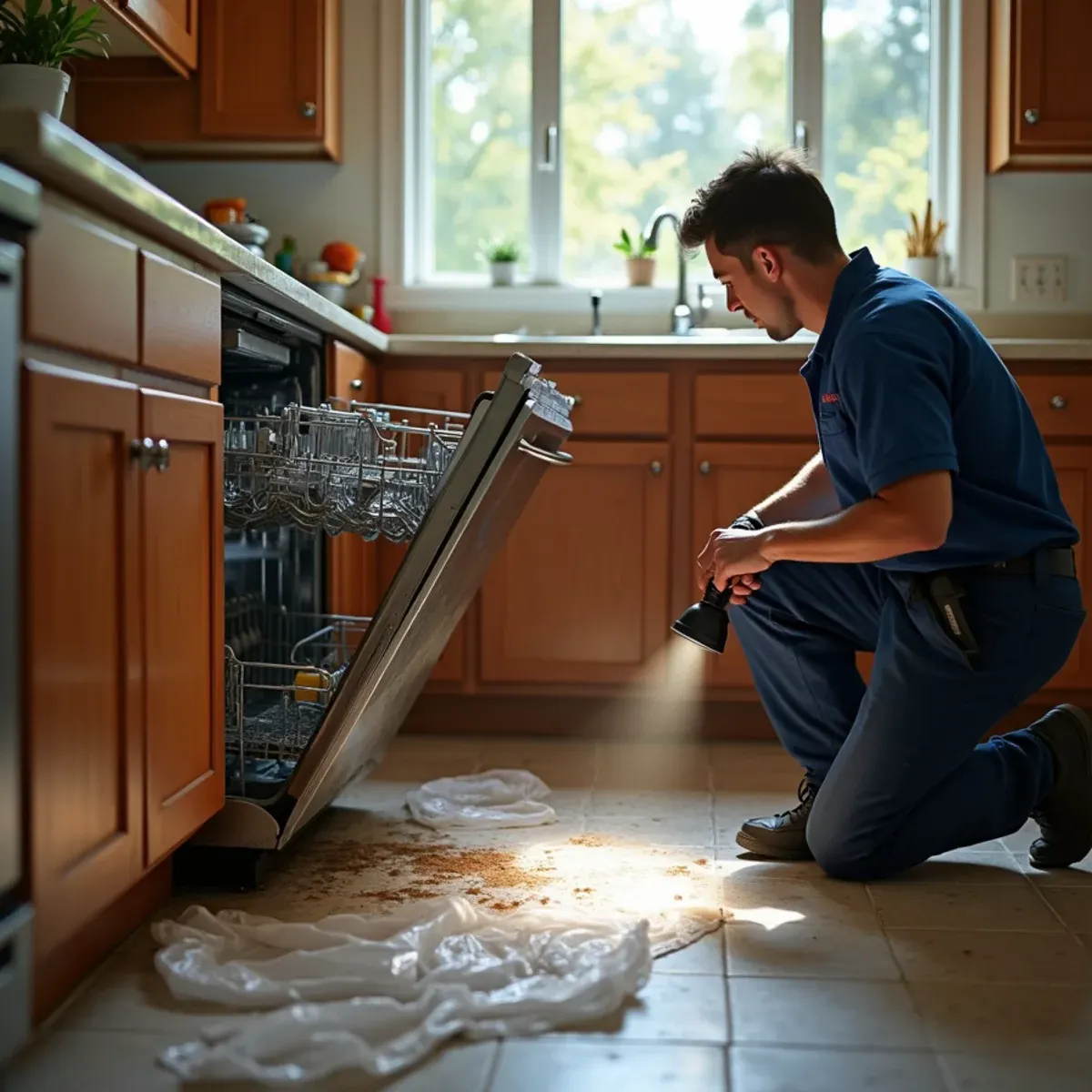
Downey changes what a good outcome looks like. Jean Vandruff's Cinderella Homes put diamond-pane windows, scalloped bargeboard, arched doorways and shaped trim onto ordinary 1950s tract houses, and plenty of those kitchens still have their original birch cabinets and detailing. None of it is available at a supply house. So when a dishwasher has been wetting a cabinet run for a week, the question is not how fast we can demolish it. The question is whether the readings let us dry the toe-kick and cabinet base in place and leave the face frames alone.
Underneath the millwork it is standard mid-century construction. Slab on grade, galvanized supply lines, cast-iron drains, houses built between 1950 and 1965 through Orange Estates, Rancho Estates and Northeast Downey. That gives the same failure pattern as any tract of that age: a corroded supply stub, an ice-maker line pinched behind the refrigerator, a water heater that goes overnight in the garage. What is different here is the finish work sitting above it, so we carry enough equipment to run slower, gentler drying cycles. We are about seventeen minutes southeast in Cypress.
What Downey Changes About Appliance Leaks
1Drying original cabinets instead of demolishing them
Cabinet bases in these houses are often plywood rather than the particleboard used later, which means they tolerate a wetting if we get to them quickly. We drill the toe-kick out of sight, inject dry air into the enclosed base, pull the drawer boxes and monitor daily. It is slower than tearing the run out and it saves woodwork that a modern shop can only approximate.
2Ice-maker lines behind 1950s kitchen walls
These kitchens have a tight refrigerator alcove and the water line usually runs through the wall from an adjacent bathroom or laundry. Copper compression fittings from a 1970s or 1980s ice-maker installation weep at a rate the floor absorbs quietly. If the flooring in front of the refrigerator has lifted or the baseboard shows a shadow line, that fitting is the first place we look.
3Documenting irreplaceable finishes for the adjuster
An adjuster working from a standard line-item scope will price replacement, not restoration, unless somebody makes the case. We photograph the original trim, cabinetry and detailing before work starts, record daily moisture readings, and reference the IICRC S500:2025 drying goals in the file. That documentation is often the difference between drying a Cinderella kitchen in place and getting handed a check for stock cabinets.
How the Work Runs
The method is the same one we use on every appliance leaks job, documented to the IICRC S500:2025 standard. Here it is in short — the full appliance leak water damage cleanup process explains each stage in detail.
- Isolate the supply
- Pull the appliance and read behind it
- Open cabinet bases where needed
- Extract and remove unsalvageable material
- Targeted drying of the enclosed spaces
- Rebuild and reinstall
The Downey Background Worth Knowing
The instinct on a wet wall is to open it, and sometimes that is correct. But IICRC S500:2025 is built around restoring rather than replacing wherever the drying goals can genuinely be met, and on a house with original arched casings and applied gingerbread, meeting those goals is worth some patience. We would rather spend three extra days with equipment running than pull a run of trim that would have to be milled from scratch to come back. The standard supports that choice and so does the arithmetic on the estimate, because custom millwork is not cheap and matching a fifties profile is not quick.
There is more on the housing stock, drainage and plumbing history of this city on our water damage restoration in Downey page.
Downey at a glance
- Dominant construction era
- 1950–1965
- Foundation type
- slab on grade
- Supply piping found here
- galvanized steel, under-slab copper
- Drain line materials
- cast iron
- Terrain and water table
- flat, moderate water table
- Most common local failure
- 1950s slab and galvanized failures in houses whose decorative woodwork makes careful, low-demolition drying worth paying for
- Highest-value local prevention
- drying in place wherever readings allow, because the trim and detailing on these houses cannot be bought
What It Costs in Downey
We do not quote a number over the phone before seeing the property — anyone who does is guessing. The variables that actually move the price on a appliance leaks job are slow leak versus sudden failure, how much cabinetry is affected, subfloor condition, and they are broken down in full on the appliance leak water damage cleanup page. The assessment and the written estimate are free anywhere in Downey, day or night, with no obligation.
Appliance Leaks Questions from Downey Homeowners
Sometimes, and it depends almost entirely on how long the water sat and where it came from. Clean supply water caught within a couple of days, on plywood cabinet bases, is a good candidate for in-place drying. Water that ran for weeks, or came from a drain line, changes the category and usually the answer. We will give you a straight assessment on the first visit rather than starting a drying plan we already doubt.
Yes. Dishwasher leaks run backward and sideways under the unit into the cabinet bases and subfloor, which is why the visible floor often looks untouched. A free moisture reading takes twenty minutes and will tell you definitively whether anything behind or beneath is wet.
Often only the affected base or toe-kick, not the whole box. Particleboard bottoms that have swollen and delaminated have to be replaced, but the cabinet frame, doors, and countertop can usually stay. We repair at the smallest reasonable scope.
Usually, yes. We go into the wall cavity through small ports low on the wall, hidden behind shoe molding or inside a closet, and dry from the inside out rather than taking the finished face off. That takes longer and needs more equipment than gutting the wall would, which is exactly the trade we think is worth making on a house with millwork that cannot be bought. Where it will not work, we tell you early.