
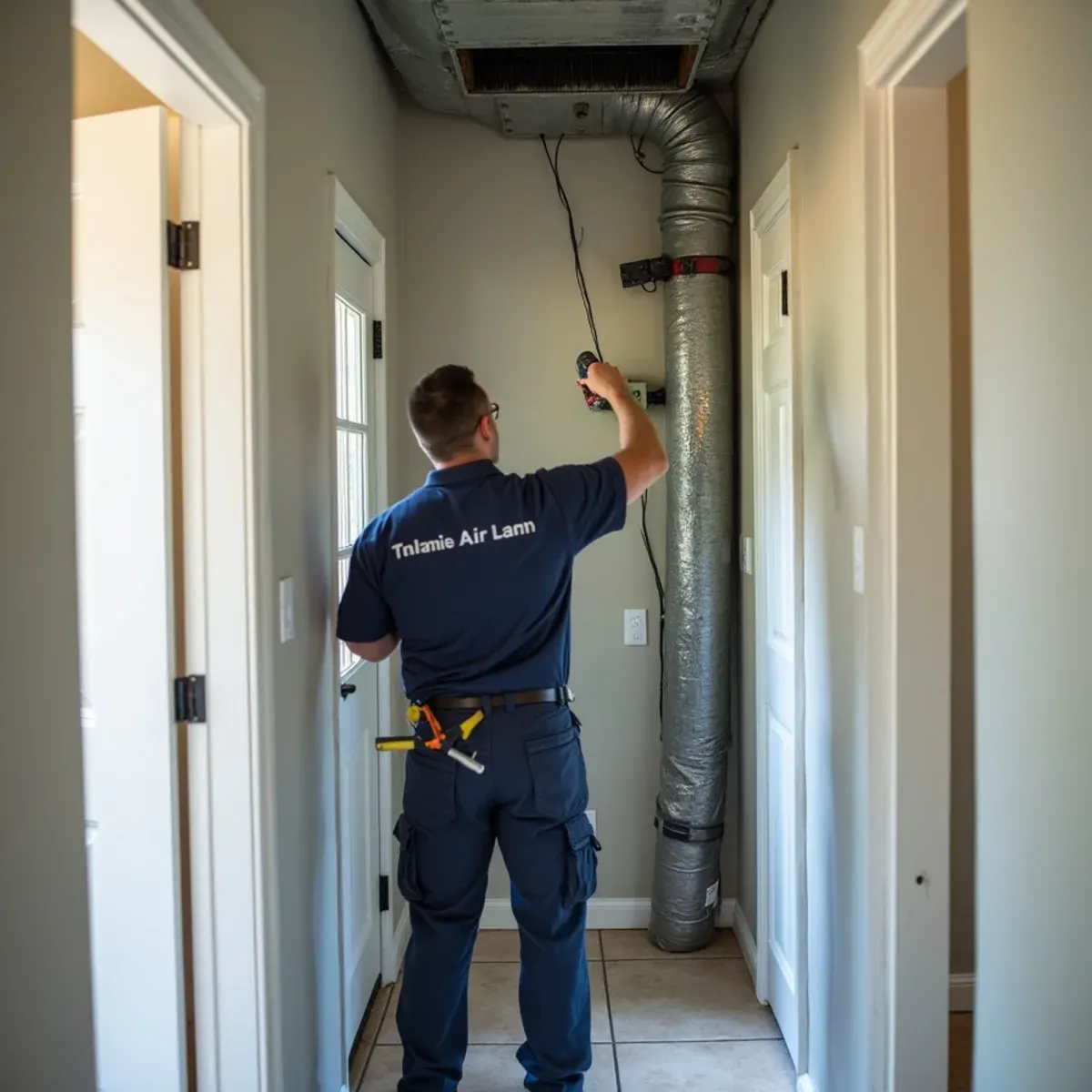
A sprinkler head lets go over a racked aisle at two in the morning, and by the time anyone arrives several thousand gallons have crossed an open warehouse floor and pushed into the front office suite. That's the Santa Fe Springs job. This is one of the most industrial cities in this part of LA County — a warehouse, manufacturing and distribution base that dwarfs the residential footprint, sitting on old oil-field ground — and the HVAC involved is rooftop packaged equipment and office ducting, not attic flex over a tract house.
The detail that catches owners is the ceiling plenum. In a lot of these front-office build-outs, the space above the lay-in tile is the return path itself rather than a duct, so sprinkler water lands directly in the air stream and soaks tile, insulation and the top of the grid. Everything downstream inherits it. We isolate zones, pull affected tile, clean or replace the flex drops, and get the rooftop unit's blower, coil and filter section handled before that system is allowed to run again.
What Santa Fe Springs Changes About Air Ducts & HVAC
1Lay-in ceiling plenums used as returns
When the plenum is the return, there's no liner protecting the air path — wet tile, wet insulation and wet grid are the air path. Cleaning ducts while leaving a saturated plenum in place accomplishes nothing. Affected tile comes out, the deck and structure above get dried and cleaned, and the return is verified before the unit is restarted.
2Rooftop units, curbs and roof-side access
Almost all of this work happens on the roof. Packaged units hold the blower, coil, filters and economizer in one cabinet on a curb, and after a loss below they still need service because they've been circulating that air. Curb flashing and the duct penetration are inspected at the same time, since a roof-side leak and a sprinkler discharge can present identically from inside.
3Staged shutdowns around racked inventory
You can't shut a distribution building down because the office got wet. We sequence by zone, work around racking and forklift lanes, and coordinate air handling so pressure differences don't carry contamination into clean product areas. Documenting that sequence matters for the carrier and for any customer of yours asking what happened to their goods.
How the Work Runs
The method is the same one we use on every air ducts & hvac job, documented to the IICRC S500:2025 standard. Here it is in short — the full air duct cleaning & hvac restoration process explains each stage in detail.
- Inspect before we quote
- Contain and seal the system
- Clean or replace the ducting
- Clean the air handler and coil
- Replace filters and treat surfaces
- Seal, balance, and verify
The Santa Fe Springs Background Worth Knowing
The water sitting in a wet-pipe sprinkler system has been there for years. It is stagnant, it has been in contact with black steel and scale that whole time, and some systems carry corrosion inhibitors or antifreeze as well. When a head discharges, that is what lands on your floor and soaks into your product. Under IICRC S500:2025 water gets categorized on the evidence in front of us, and sprinkler discharge that has run across a warehouse floor almost never stays in Category 1. That decision drives what we dry in place, what comes out, and how the crew works.
There is more on the housing stock, drainage and plumbing history of this city on our water damage restoration in Santa Fe Springs page.
Santa Fe Springs at a glance
- Dominant construction era
- 1950–1975
- Foundation type
- slab on grade
- Supply piping found here
- galvanized steel, copper, commercial-grade systems
- Drain line materials
- cast iron, commercial waste lines
- Terrain and water table
- flat, moderate water table
- Most common local failure
- fire-sprinkler discharge and commercial supply failures across large open-plan warehouse and manufacturing floors
- Highest-value local prevention
- keeping current building access and shutoff information on file before an after-hours failure
What It Costs in Santa Fe Springs
We do not quote a number over the phone before seeing the property — anyone who does is guessing. The variables that actually move the price on a air ducts & hvac job are cleaning versus replacing flex duct, number of supply runs and returns, what kind of contamination it is, and they are broken down in full on the air duct cleaning & hvac restoration page. The assessment and the written estimate are free anywhere in Santa Fe Springs, day or night, with no obligation.
Air Ducts & HVAC Questions from Santa Fe Springs Homeowners
Usually yes, in stages. Most Santa Fe Springs buildings have separate zones for the office suite and the warehouse floor, so the affected zone can be isolated and put under containment while the rest keeps running. We work around racking and dock schedules, and where a rooftop unit has to come offline we schedule it against your operating hours. What we won't do is restart a unit that's still circulating through a wet plenum, because that spreads the problem building-wide.
Fair question, and often it is an upsell. The honest answer depends on whether contamination actually reached the system. If the HVAC ran during the loss or the demolition, if water got into the attic where the ducting lives, or if the loss involved sewage or fire, the system is in scope. If none of that happened, it probably is not. We run a camera and show you before you decide anything.
It depends on where the moisture is. If the inner liner got damp and the fiberglass behind it stayed dry, cleaning and drying the run works. If water got through a torn jacket into the insulation, that fiberglass is porous, it holds moisture and growth, and there is no reliable way to clean it or verify it is clean. Those runs get replaced. We show you which is which rather than guessing on your behalf.
No. Water that has sat in a wet-pipe system for years picks up scale, rust and whatever inhibitors are in the system, and once it runs across a warehouse floor it collects everything on that floor too. We categorize on the evidence per IICRC S500:2025, and sprinkler discharge almost always lands past Category 1. That affects what gets dried in place, what gets removed, and what protective equipment the crew works in.