
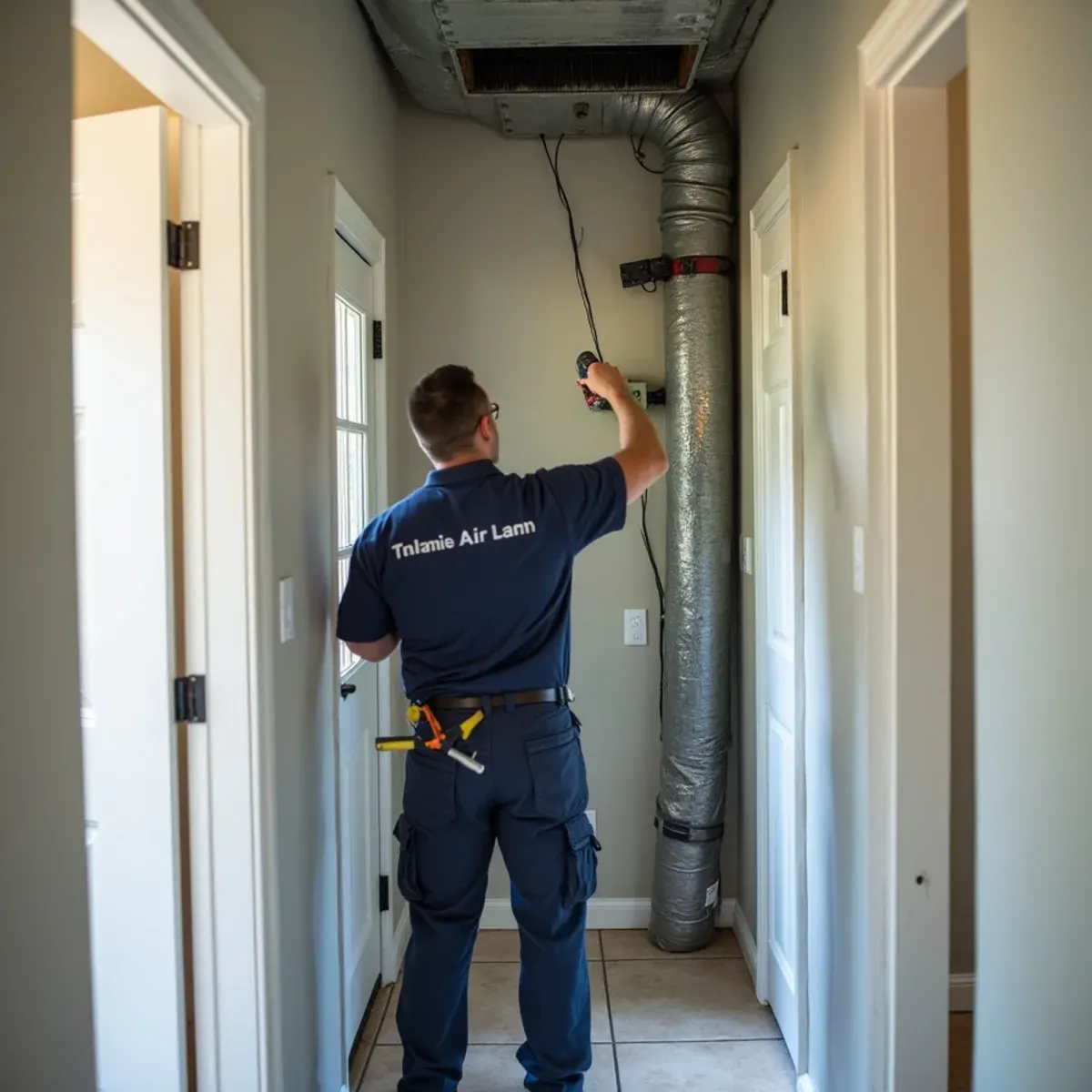
Whittier has been a city since the Quakers founded it in 1887 and its air distribution shows every decade of that. Uptown along Greenleaf Avenue holds late-Victorian bay-window houses, Craftsman with deep porches and 1920s Spanish Revival under clay tile, nearly all on raised foundations. None of them were built with ducts. Where central air went in, it went into the crawl space with floor or low-wall registers, or into a cramped attic under heavy tile. After a crawl-space leak, the ducting is sitting in the wettest part of the property with nobody looking at it.
The hills work differently. College Hills, subdivided in 1923 as the city's first planned hillside development, has steep grades and curving streets, and Friendly Hills and the Whittier Hills climb toward Turnbull Canyon. Those multi-level homes route ducting through interior chases between floors, so slope water entering a lower level travels upward with the air rather than staying put. East Whittier is the straightforward case — conventional postwar slab, attic flex, the same scope we'd write in La Mirada.
What Whittier Changes About Air Ducts & HVAC
1Uptown crawl ducting under original-era homes
A century-old raised foundation near Greenleaf has a dirt crawl, original framing and duct that was added long after both. Slow leaks under these houses run for weeks without surfacing. Wet flex down there gets removed rather than cleaned, and while the crawl is open it's the right moment to deal with ground vapor and any missing barrier, because that's the condition that put moisture in the duct in the first place.
2Interior chases carry moisture between floors
In College Hills and Friendly Hills, split and multi-level homes stack duct chases vertically between floors. Water entering a lower level puts moisture into the base of that chase, and the system carries it to upstairs rooms that never got wet. Upstairs registers smelling wrong after a downstairs intrusion is a chase problem, and it's inspected from both ends.
3Clay tile roofs limit attic access above Uptown
Spanish Revival and tile-roofed Craftsman homes in Uptown have attics that are hot, low and difficult to move through, and tile is expensive to disturb. That rules out working from above in a lot of cases. Access comes from the crawl, from register openings and from closet ceilings instead, which is slower but avoids a roofing bill on top of a restoration bill.
How the Work Runs
The method is the same one we use on every air ducts & hvac job, documented to the IICRC S500:2025 standard. Here it is in short — the full air duct cleaning & hvac restoration process explains each stage in detail.
- Inspect before we quote
- Contain and seal the system
- Clean or replace the ducting
- Clean the air handler and coil
- Replace filters and treat surfaces
- Seal, balance, and verify
The Whittier Background Worth Knowing
A leak under a raised foundation does not announce itself the way a slab leak does. There is no puddle on the floor and no warm spot underfoot, because the water drips down into the soil and stays there. What you get instead is a smell that is stronger in the morning, a board that feels slightly soft, and eventually a floor that has been quietly feeding fungal growth for months. By the time an Uptown homeowner calls us about a crawl space leak, the question is rarely how to dry it. It is how much of the joist and subfloor is still doing its job.
There is more on the housing stock, drainage and plumbing history of this city on our water damage restoration in Whittier page.
Whittier at a glance
- Dominant construction era
- 1890–1980
- Foundation type
- mixed on grade
- Supply piping found here
- original turn-of-century piping, galvanized steel, under-slab copper
- Drain line materials
- cast iron, clay
- Terrain and water table
- hillside-mixed, moderate water table
- Most common local failure
- raised-foundation crawl-space leaks in Uptown, and slope drainage failures in the hillside tracts
- Highest-value local prevention
- an annual crawl-space or slope-drain check, depending which Whittier you live in
What It Costs in Whittier
We do not quote a number over the phone before seeing the property — anyone who does is guessing. The variables that actually move the price on a air ducts & hvac job are cleaning versus replacing flex duct, number of supply runs and returns, what kind of contamination it is, and they are broken down in full on the air duct cleaning & hvac restoration page. The assessment and the written estimate are free anywhere in Whittier, day or night, with no obligation.
Air Ducts & HVAC Questions from Whittier Homeowners
Because the duct chase connects them. Multi-level homes in these hills run supply and return vertically through interior chases, and moisture entering at the lower level rises through that shaft with the air the system is moving. The upstairs rooms never got wet but they're downstream of the wet part. We inspect the chase at both levels and check the branches feeding those upstairs registers before deciding what needs to come out.
Fair question, and often it is an upsell. The honest answer depends on whether contamination actually reached the system. If the HVAC ran during the loss or the demolition, if water got into the attic where the ducting lives, or if the loss involved sewage or fire, the system is in scope. If none of that happened, it probably is not. We run a camera and show you before you decide anything.
It depends on where the moisture is. If the inner liner got damp and the fiberglass behind it stayed dry, cleaning and drying the run works. If water got through a torn jacket into the insulation, that fiberglass is porous, it holds moisture and growth, and there is no reliable way to clean it or verify it is clean. Those runs get replaced. We show you which is which rather than guessing on your behalf.
It cuts both ways. A crawl space leak hides longer, because the water drips into soil instead of pooling on your floor, so it often runs for months and reaches the framing before anyone notices. The upside is real though: the plumbing is accessible, so locating and repairing it does not mean breaking concrete. On balance, detection is your weak point in Uptown, which is why an annual look under the house is worth doing.