
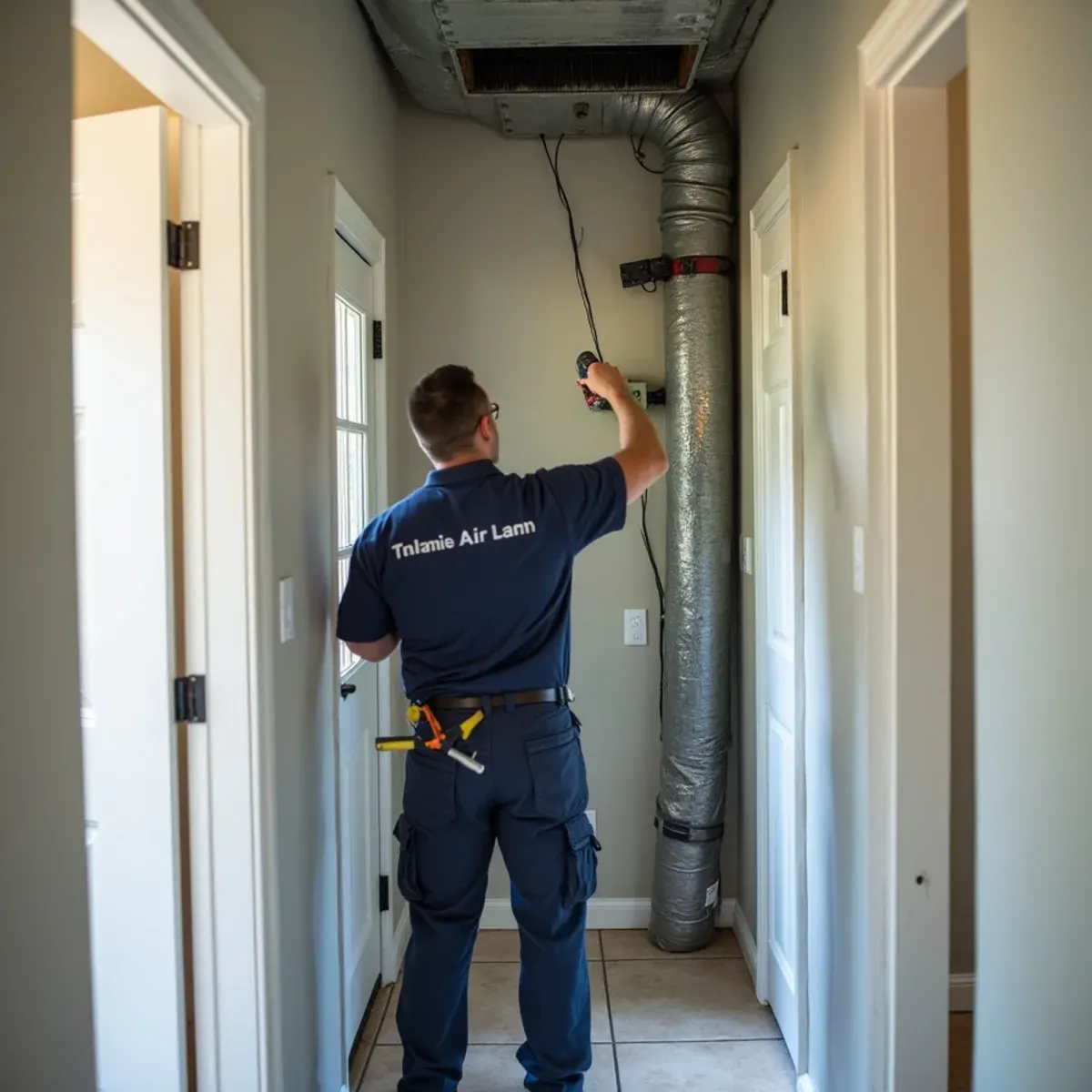
Pico Rivera sits on a strip of ground between two flood-control channels, the San Gabriel River on one side and the Rio Hondo on the other, and that position sets the behavior of everything here. The water table is shallow. In a sustained storm the ground saturates fast rather than absorbing steadily, and the 1945 to 1965 slab houses that fill this city take water at grade — under a door, at a slab edge, through a garage threshold. What almost never happens is water reaching the attic, which is where nearly all the ducting in this city lives.
So the honest scope in Pico Rivera usually starts below the ducts rather than in them. The return grille, filter cabinet, blower wheel, evaporator coil and drain pan all sit at the level the water actually reached, and they're what carries odor into rooms that stayed dry. We'll still open and inspect the attic runs, because a wet ceiling or a roof failure changes the answer completely. The postwar tract here is consistent enough that we can usually predict the duct layout before going up.
What Pico Rivera Changes About Air Ducts & HVAC
1Ground-level water, attic ducting usually spared
When the source is storm intrusion or a fixture overflow, the attic runs typically read dry and stay out of the scope. We say that plainly instead of writing a whole-house duct replacement for a floor-level event. The inspection and readings are documented either way, so if a carrier questions the scope later there's a record of what was checked and what it measured.
2Shallow water table keeps slabs cold and damp
Between two channels with groundwater close to the surface, slabs here run cooler and hold more moisture at baseline than inland tracts. That means flooring assemblies dry slower and indoor humidity stays higher during a dry-down, which loads the coil and pan harder. Equipment sizing and run time on our dehumidification reflects that, not a generic drying chart.
3The return and coil carry the odor
A return grille eighteen inches off a floor that took muddy channel-adjacent water pulls that air across a cold, wet coil every cycle. The coil fins, blower wheel and pan hold organic material and keep releasing it. Those three components are opened, cleaned and treated on nearly every storm-related call here, and they're usually what actually ends the smell.
How the Work Runs
The method is the same one we use on every air ducts & hvac job, documented to the IICRC S500:2025 standard. Here it is in short — the full air duct cleaning & hvac restoration process explains each stage in detail.
- Inspect before we quote
- Contain and seal the system
- Clean or replace the ducting
- Clean the air handler and coil
- Replace filters and treat surfaces
- Seal, balance, and verify
The Pico Rivera Background Worth Knowing
On a hillside, storm water leaves. In Pico Rivera it soaks in, and when the soil is already near capacity it stops soaking in and simply stands. That is why a yard here can hold water two days after the rain stops while a yard up in the Whittier hills is dry by morning. The lawn is not draining badly. The ground underneath it is full. Once that happens, every path water can take toward your house becomes the path it takes: the garage threshold, the slider track, the gap where a patio slab has settled back toward the wall.
There is more on the housing stock, drainage and plumbing history of this city on our water damage restoration in Pico Rivera page.
Pico Rivera at a glance
- Dominant construction era
- 1945–1965
- Foundation type
- slab on grade
- Supply piping found here
- original galvanized steel, copper
- Drain line materials
- cast iron
- Terrain and water table
- flat, shallow water table
- Most common local failure
- ground saturating fast during sustained storms because the water table between two channels sits high
- Highest-value local prevention
- clearing area drains and confirming downspouts discharge well away from the foundation
What It Costs in Pico Rivera
We do not quote a number over the phone before seeing the property — anyone who does is guessing. The variables that actually move the price on a air ducts & hvac job are cleaning versus replacing flex duct, number of supply runs and returns, what kind of contamination it is, and they are broken down in full on the air duct cleaning & hvac restoration page. The assessment and the written estimate are free anywhere in Pico Rivera, day or night, with no obligation.
Air Ducts & HVAC Questions from Pico Rivera Homeowners
Often not the attic runs. Water entering at a threshold in a Pico Rivera slab home stays at floor level, and the ducting is fifteen feet above it in the attic. What does need work is the return, filter cabinet, blower wheel, coil and drain pan, because those sit at the level of the water and are what push the smell into dry rooms. We inspect and meter the attic runs anyway, and if they read clean they stay off the estimate.
Fair question, and often it is an upsell. The honest answer depends on whether contamination actually reached the system. If the HVAC ran during the loss or the demolition, if water got into the attic where the ducting lives, or if the loss involved sewage or fire, the system is in scope. If none of that happened, it probably is not. We run a camera and show you before you decide anything.
It depends on where the moisture is. If the inner liner got damp and the fiberglass behind it stayed dry, cleaning and drying the run works. If water got through a torn jacket into the insulation, that fiberglass is porous, it holds moisture and growth, and there is no reliable way to clean it or verify it is clean. Those runs get replaced. We show you which is which rather than guessing on your behalf.
Not in the way people picture it. The channels are engineered, and what we actually see is a groundwater and surface drainage problem rather than a channel overtopping. Because the water table between the two runs high and the ground is flat, soil here reaches saturation faster than it does a few miles inland. Once it does, storm water stops soaking in and starts looking for the lowest opening in your house, which is almost always the garage.