
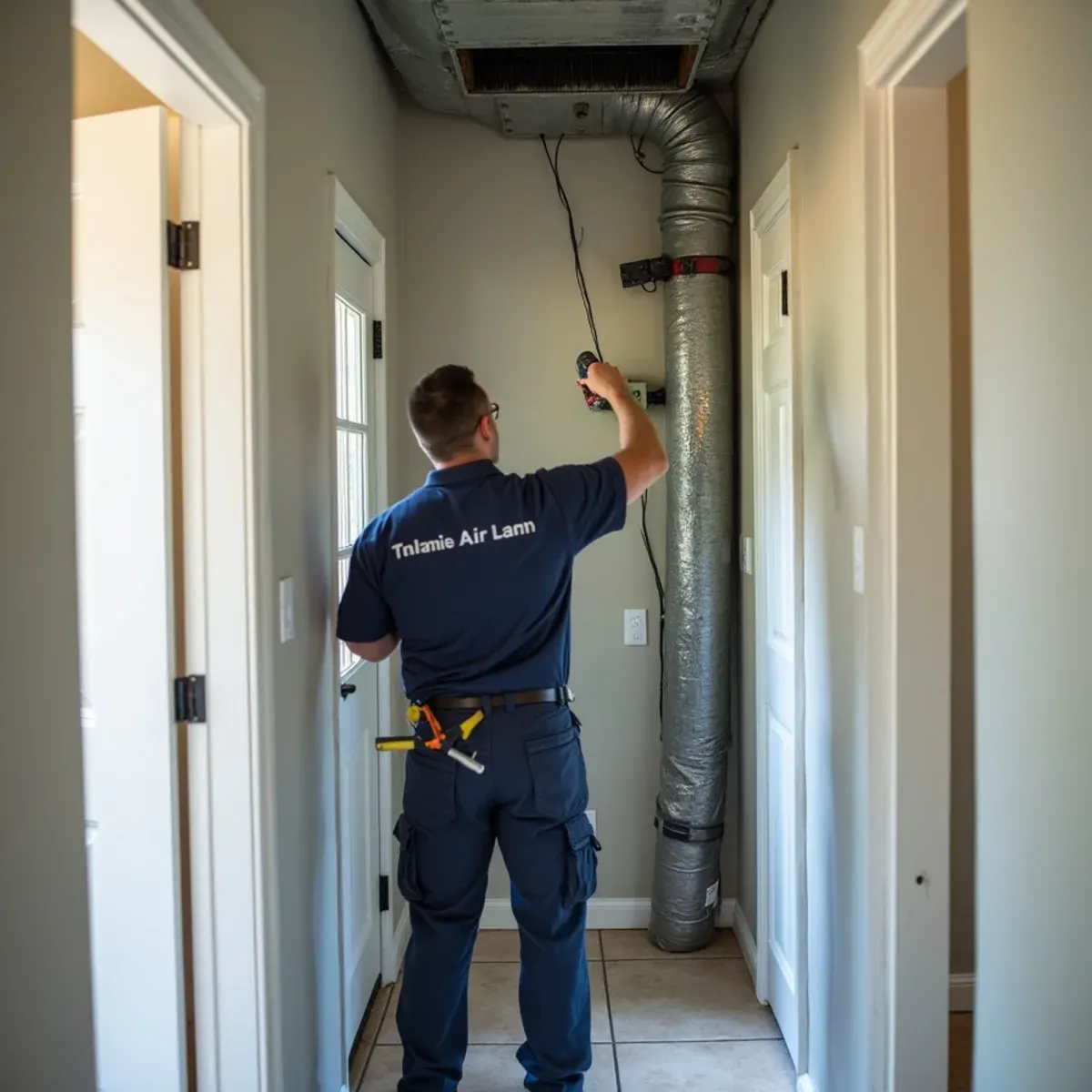
Jean Vandruff's Cinderella Homes are the reason Downey jobs get planned differently. Turrets, pointed rooflines, scalloped bargeboard, diamond-pane windows and interior trim nobody can source anymore — and above all of it, entirely ordinary 1950s attic ducting. The usual way to reach a failed duct run is to open a ceiling. In a Cinderella Home that ceiling and its trim are a meaningful share of what the house is worth, so we work from the attic side and through existing register boots wherever it's physically possible, and we tell you in advance where it isn't.
Under the detailing the mechanics are standard for 1950 to 1965 Downey: slab on grade, original galvanized supply, and central air added long after the house was finished. Galvanized failing inside a wall wets framing and insulation, the return picks it up, and the odor settles into the whole house within days. We stage drying to keep humidity swings gentle around old millwork, because rushing a dry-down can check and split trim that has survived seventy years without incident. The same care applies near original hardwood and plaster.
What Downey Changes About Air Ducts & HVAC
1Low-demolition access around irreplaceable millwork
Reaching contaminated duct through the finished side is fast and cheap and completely wrong in these houses. We plan access from the attic, through register openings and at the plenum, and when a ceiling truly has to be opened we place the cut where the trim pattern and texture can be restored invisibly. That plan gets shown to you before a blade comes out.
21950s galvanized behind decorative walls
Original galvanized in Downey has been scaling shut for seventy years and fails without warning inside walls that often carry built-ins, paneling or original plaster. The wet cavity is next to the return path, so the smell reaches the ducts quickly. Locating the failure with meters and thermal imaging before opening anything is the difference between one small repair and a wall of patchwork.
3Gentle drying protects old trim and plaster
Aggressive dehumidification pulls moisture out of everything in the room, including seventy-year-old wood that has been stable at a certain moisture content for decades. Trim shrinks, joints open, plaster crazes. We run lower-differential drying over a longer period and monitor the materials, which takes more days and considerably less repair carpentry on the back end.
How the Work Runs
The method is the same one we use on every air ducts & hvac job, documented to the IICRC S500:2025 standard. Here it is in short — the full air duct cleaning & hvac restoration process explains each stage in detail.
- Inspect before we quote
- Contain and seal the system
- Clean or replace the ducting
- Clean the air handler and coil
- Replace filters and treat surfaces
- Seal, balance, and verify
The Downey Background Worth Knowing
The instinct on a wet wall is to open it, and sometimes that is correct. But IICRC S500:2025 is built around restoring rather than replacing wherever the drying goals can genuinely be met, and on a house with original arched casings and applied gingerbread, meeting those goals is worth some patience. We would rather spend three extra days with equipment running than pull a run of trim that would have to be milled from scratch to come back. The standard supports that choice and so does the arithmetic on the estimate, because custom millwork is not cheap and matching a fifties profile is not quick.
There is more on the housing stock, drainage and plumbing history of this city on our water damage restoration in Downey page.
Downey at a glance
- Dominant construction era
- 1950–1965
- Foundation type
- slab on grade
- Supply piping found here
- galvanized steel, under-slab copper
- Drain line materials
- cast iron
- Terrain and water table
- flat, moderate water table
- Most common local failure
- 1950s slab and galvanized failures in houses whose decorative woodwork makes careful, low-demolition drying worth paying for
- Highest-value local prevention
- drying in place wherever readings allow, because the trim and detailing on these houses cannot be bought
What It Costs in Downey
We do not quote a number over the phone before seeing the property — anyone who does is guessing. The variables that actually move the price on a air ducts & hvac job are cleaning versus replacing flex duct, number of supply runs and returns, what kind of contamination it is, and they are broken down in full on the air duct cleaning & hvac restoration page. The assessment and the written estimate are free anywhere in Downey, day or night, with no obligation.
Air Ducts & HVAC Questions from Downey Homeowners
We try hard not to. Most of these houses have workable attic access, and a lot of duct work can be done from above and through the register boots. Where a run is buried under insulation against a low eave, we look for an access point in a closet, hallway or garage ceiling first. If a finished ceiling is genuinely the only route, you'll see the proposed location and the restoration plan for the texture and trim before anything is opened.
Fair question, and often it is an upsell. The honest answer depends on whether contamination actually reached the system. If the HVAC ran during the loss or the demolition, if water got into the attic where the ducting lives, or if the loss involved sewage or fire, the system is in scope. If none of that happened, it probably is not. We run a camera and show you before you decide anything.
It depends on where the moisture is. If the inner liner got damp and the fiberglass behind it stayed dry, cleaning and drying the run works. If water got through a torn jacket into the insulation, that fiberglass is porous, it holds moisture and growth, and there is no reliable way to clean it or verify it is clean. Those runs get replaced. We show you which is which rather than guessing on your behalf.
Usually, yes. We go into the wall cavity through small ports low on the wall, hidden behind shoe molding or inside a closet, and dry from the inside out rather than taking the finished face off. That takes longer and needs more equipment than gutting the wall would, which is exactly the trade we think is worth making on a house with millwork that cannot be bought. Where it will not work, we tell you early.