
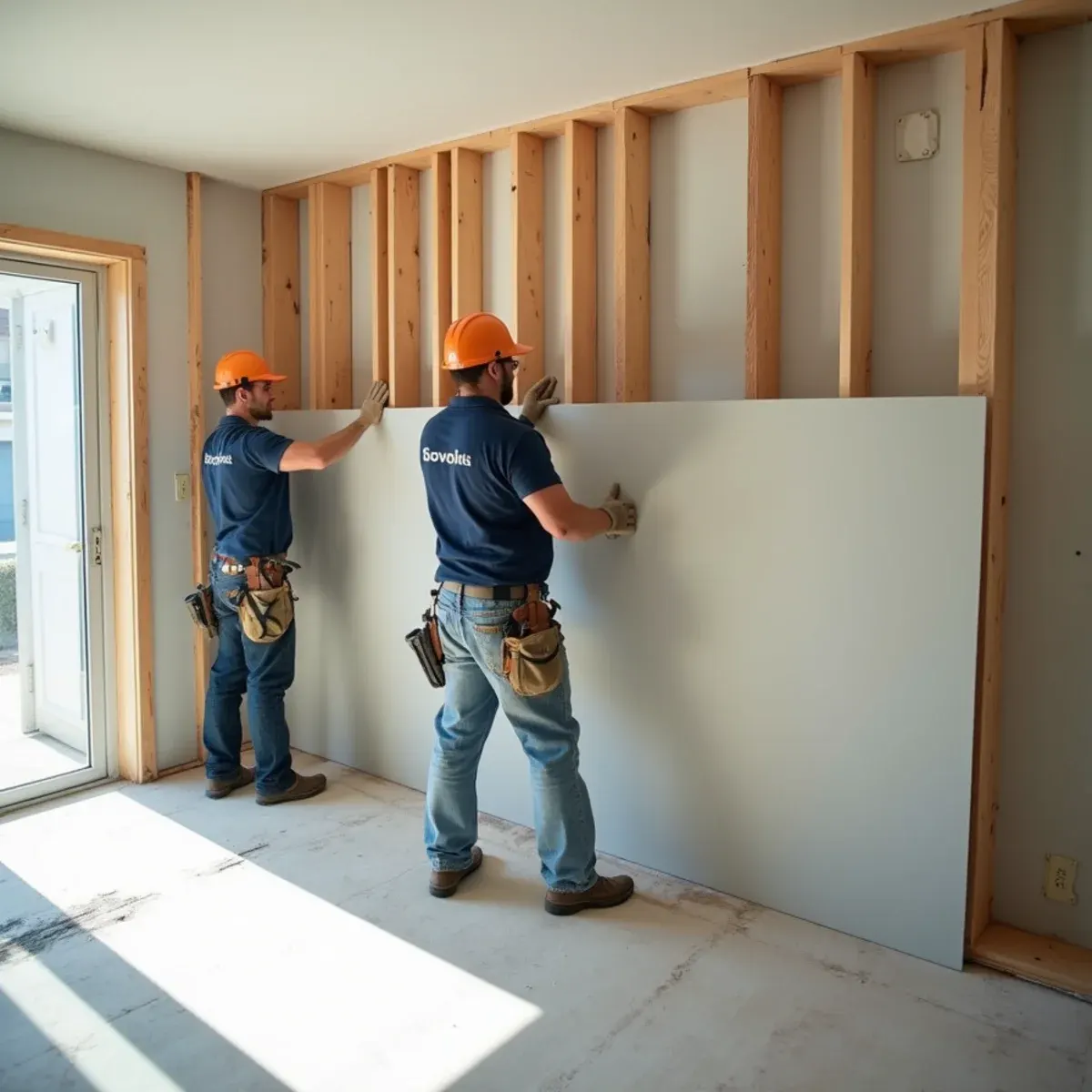
A crawl space is bad news for detection and good news for the rebuild. In the pre-war Craftsman and Spanish Revival blocks near downtown Fullerton, water from a failed supply line drips away instead of pooling on a floor, so the leak often runs undetected for weeks. But once we find it, we can get underneath — pull wet insulation, replace subfloor, sister a joist, dry the framing from below — without demolishing the finished floor above. In a slab city that same repair means cutting concrete and taking the floor out. Here the original floor usually stays where it is.
That floor is worth the trouble. Old-growth Douglas fir framing and thick original oak around Hillcrest Park and up into Raymond Hills sand and refinish where a modern engineered product would have delaminated on the first day. Higher up, multi-level hillside homes send a loss across floors and the rebuild follows it down. And around Cal State Fullerton and Fullerton College, the student rental stock has a chronic delayed-reporting problem: a leak reported three weeks late isn't a drywall patch, it's framing, insulation and subfloor, and the scope has to say so.
What Fullerton Changes About Repair & Reconstruction
1Repairs made from the crawl space up
Access from below changes what has to be sacrificed. We can remove saturated insulation, dry joists and subfloor with directed airflow, treat and replace framing members, and re-insulate without lifting a single board of the finished floor. It also lets us verify moisture in the framing itself rather than inferring it from a surface reading taken upstairs.
2Original floors refinished rather than replaced
Thick original oak and fir has enough material left for sanding, which is exactly what modern thin-wear-layer flooring does not. Where boards have cupped, we dry slowly and let the wood relax before deciding anything — rushing that is what turns a refinishable floor into a replacement. Where boards are lost, we weave in salvage and refinish the whole field so there's no patch line.
3Student rentals rebuilt between terms
Rentals near the two campuses report losses late and turn over on an academic calendar, which gives owners a narrow window for reconstruction. We schedule the noisy, disruptive phases into term breaks where we can, and write scopes that account for the extra framing and insulation work that always comes with a leak that ran for weeks before anyone mentioned it.
How the Work Runs
The method is the same one we use on every repair & reconstruction job, documented to the IICRC S500:2025 standard. Here it is in short — the full water damage repair & reconstruction process explains each stage in detail.
- Scope and estimate while mitigation finishes
- Agree the scope with you and the carrier
- Material selection
- Rough work and inspections
- Finishes
- Walkthrough and warranty
The Fullerton Background Worth Knowing
The pre-war homes around downtown Fullerton were built with materials that behave completely differently from modern construction. Lath and plaster walls hold several times the water drywall does. Old-growth Douglas fir framing is dense and dries slowly. Original oak and fir flooring is thick, high-quality material that is well worth saving.
There is more on the housing stock, drainage and plumbing history of this city on our water damage restoration in Fullerton page.
Fullerton at a glance
- Dominant construction era
- 1910–1980
- Foundation type
- mixed on grade
- Supply piping found here
- galvanized steel, copper, original pre-war piping
- Drain line materials
- cast iron, clay
- Terrain and water table
- rolling, moderate water table
- Most common local failure
- crawl-space leaks that run undetected for weeks because the water drips away instead of pooling on a floor
- Highest-value local prevention
- posting a shutoff location and emergency contact in every rental, since delayed reporting is the local failure mode
What It Costs in Fullerton
We do not quote a number over the phone before seeing the property — anyone who does is guessing. The variables that actually move the price on a repair & reconstruction job are how much came out during mitigation, finish level and material availability, texture and finish matching difficulty, and they are broken down in full on the water damage repair & reconstruction page. The assessment and the written estimate are free anywhere in Fullerton, day or night, with no obligation.
Repair & Reconstruction Questions from Fullerton Homeowners
Less often than you'd expect. Because we can work from the crawl space, the drying happens against the underside of the subfloor rather than through the finish above, which is gentler on the wood and doesn't require demolition to get airflow where it matters. Old-growth oak and fir tolerate this well. What we watch for is cupping that doesn't relax as moisture equalizes, and any framing that's gone soft. We'll give you an honest read after several days of drying, not on day one.
Both, under one contract. The same team that documented and dried your loss handles the rebuild — drywall, texture, flooring, cabinetry, trim, and paint — so you are not managing multiple contractors or explaining the scope twice.
A single-room repair is typically one to two weeks after drying finishes. Kitchen or multi-room rebuilds run three to six weeks, and jobs requiring permits and inspections take longer because of the inspection windows. You get a written schedule before work starts.
Yes, and they need a different approach. Lath and plaster and old-growth framing hold far more water than modern materials and dry much more slowly, so we plan for seven to fourteen days with higher-capacity equipment. The original material is worth that effort — nothing sold today replaces it.