
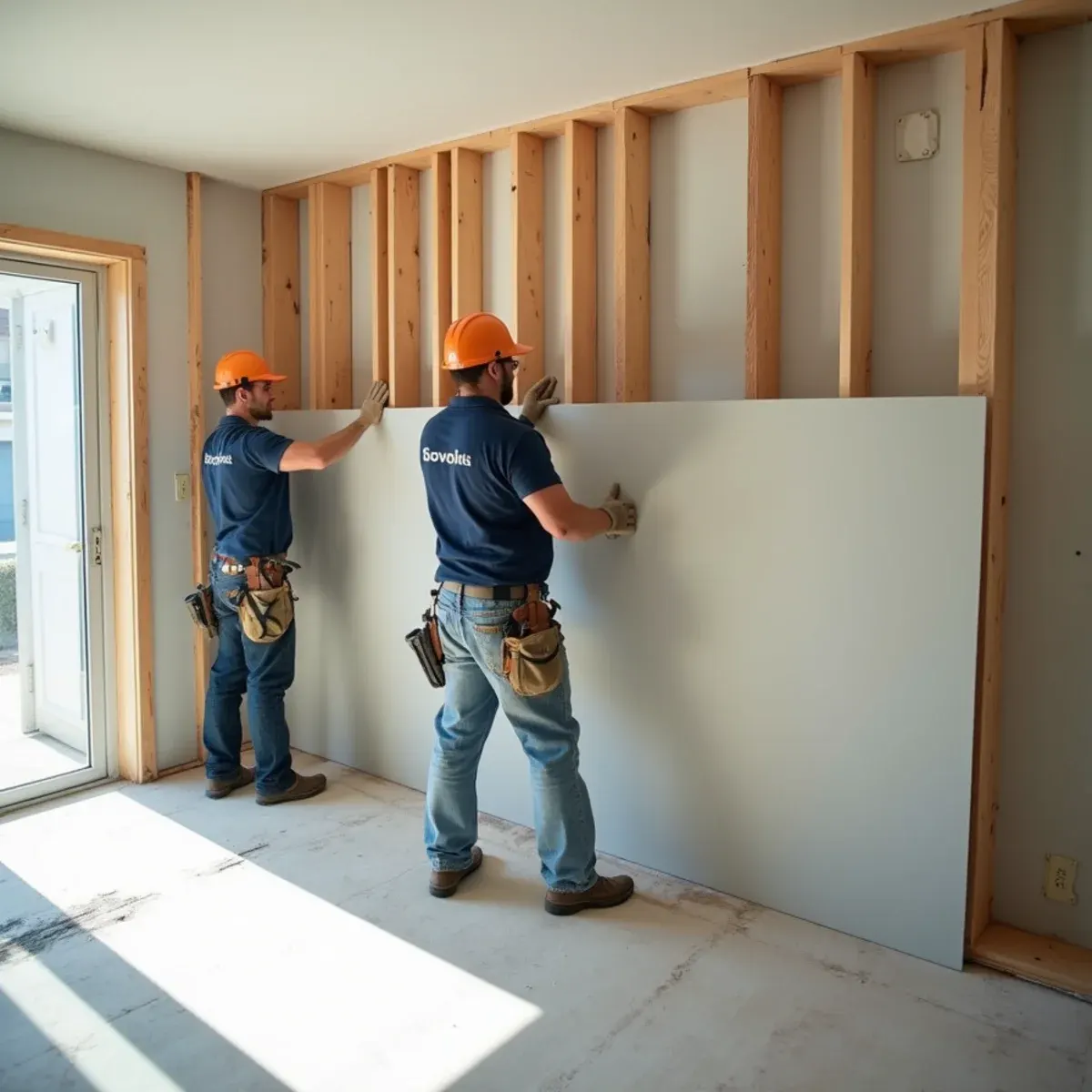
Carson has one of the larger manufactured-home populations in the area, and repairing one after a water loss has almost nothing in common with repairing a stick-built house. The floor is particleboard decking over a steel chassis, wrapped underneath in a plastic belly membrane that holds water against the deck instead of letting it drain. Walls are thin gypsum panels with batten strips instead of taped drywall. Ceilings are often a printed vinyl-faced board. None of it takes a standard drywall patch, and drying alone will not save a soaked deck.
The rest of the city is conventional. Scottsdale, Carson Park and Victoria are 1950s-to-1970s slab tract with galvanized and under-slab copper, and those rebuilds look like the ones we do in Bellflower or La Habra — concrete patch, bottom plate, flooring, texture, paint. A shallow water table across the flats means slabs give up moisture slowly, so we test before flooring goes back. And with refineries, logistics yards and the Dominguez industrial belt right there, a fair amount of our Carson work is commercial tenant space rather than housing.
What Carson Changes About Repair & Reconstruction
1Belly wrap has to be resealed
Water trapped in the belly membrane under a manufactured home won't dry from above. We open the wrap at low points to drain and access the cavity, remove saturated batt insulation, dry the deck and framing from below, then repair the membrane so it seals again. Leaving a slit open invites rodents and moisture. Taping it shut over wet insulation guarantees a soft floor in a year.
2Particleboard decking doesn't recover
Once particleboard floor decking swells and loses bond, drying doesn't bring it back — it stays soft and it telegraphs through whatever you put on top. We cut back to sound material, sister or block the joists as needed, and replace with matching-thickness decking so the finished floor sits level with the rest of the home. Any soft spot underfoot gets metered before we decide.
3Park rules and utility access
Working in a Carson mobile home park means checking in with management, following the park's contractor rules, and locating shutoffs that may serve more than one coach. Access under the home is often tight and shared with utility lines. We sort that out before demolition day so a crew isn't standing around waiting on a manager to unlock a gate.
How the Work Runs
The method is the same one we use on every repair & reconstruction job, documented to the IICRC S500:2025 standard. Here it is in short — the full water damage repair & reconstruction process explains each stage in detail.
- Scope and estimate while mitigation finishes
- Agree the scope with you and the carrier
- Material selection
- Rough work and inspections
- Finishes
- Walkthrough and warranty
The Carson Background Worth Knowing
Manufactured homes are built with the floor deck, usually particleboard or OSB, sitting on a steel frame, with batt insulation below it and a vapor barrier belly wrap stapled underneath to hold everything in place. Supply lines run through that cavity. When one leaks, the water does not run out onto the ground where you would see it. The belly wrap catches and holds it, the insulation soaks it up, and you now have a sealed reservoir under your floor with no path to evaporate. It can sit there for months before anything shows upstairs.
There is more on the housing stock, drainage and plumbing history of this city on our water damage restoration in Carson page.
Carson at a glance
- Dominant construction era
- 1950–1975
- Foundation type
- slab on grade
- Supply piping found here
- galvanized steel, under-slab copper, manufactured-home supply lines
- Drain line materials
- cast iron
- Terrain and water table
- flat, shallow water table
- Most common local failure
- manufactured-home underfloor leaks trapped in the belly wrap, alongside conventional 1960s slab failures
- Highest-value local prevention
- treating any soft spot in a manufactured-home floor as moisture until a meter proves otherwise
What It Costs in Carson
We do not quote a number over the phone before seeing the property — anyone who does is guessing. The variables that actually move the price on a repair & reconstruction job are how much came out during mitigation, finish level and material availability, texture and finish matching difficulty, and they are broken down in full on the water damage repair & reconstruction page. The assessment and the written estimate are free anywhere in Carson, day or night, with no obligation.
Repair & Reconstruction Questions from Carson Homeowners
You can, and the documentation is what does the pushing. Manufactured homes use different assemblies — belly wrap, particleboard decking, batten-strip wall panels, vinyl-faced ceiling board — and the standard residential line items don't describe them or price them correctly. We photograph the actual construction, note the model and decking thickness, and write the scope with the manufactured-housing items rather than forcing it into stick-built categories. Adjusters generally accept it when the evidence is in front of them.
Both, under one contract. The same team that documented and dried your loss handles the rebuild — drywall, texture, flooring, cabinetry, trim, and paint — so you are not managing multiple contractors or explaining the scope twice.
A single-room repair is typically one to two weeks after drying finishes. Kitchen or multi-room rebuilds run three to six weeks, and jobs requiring permits and inspections take longer because of the inspection windows. You get a written schedule before work starts.
By locating it rather than arguing about it. The dividing line is the connection point where the park's service meets your home. Upstream of that is the park's responsibility, downstream is yours. We open the belly wrap where water is pooling, trace the wet path back to its source, and photograph what we find with the connection in frame. That documentation settles the question. Guessing from where the wet spot showed up inside is unreliable, because water travels along the frame first.