
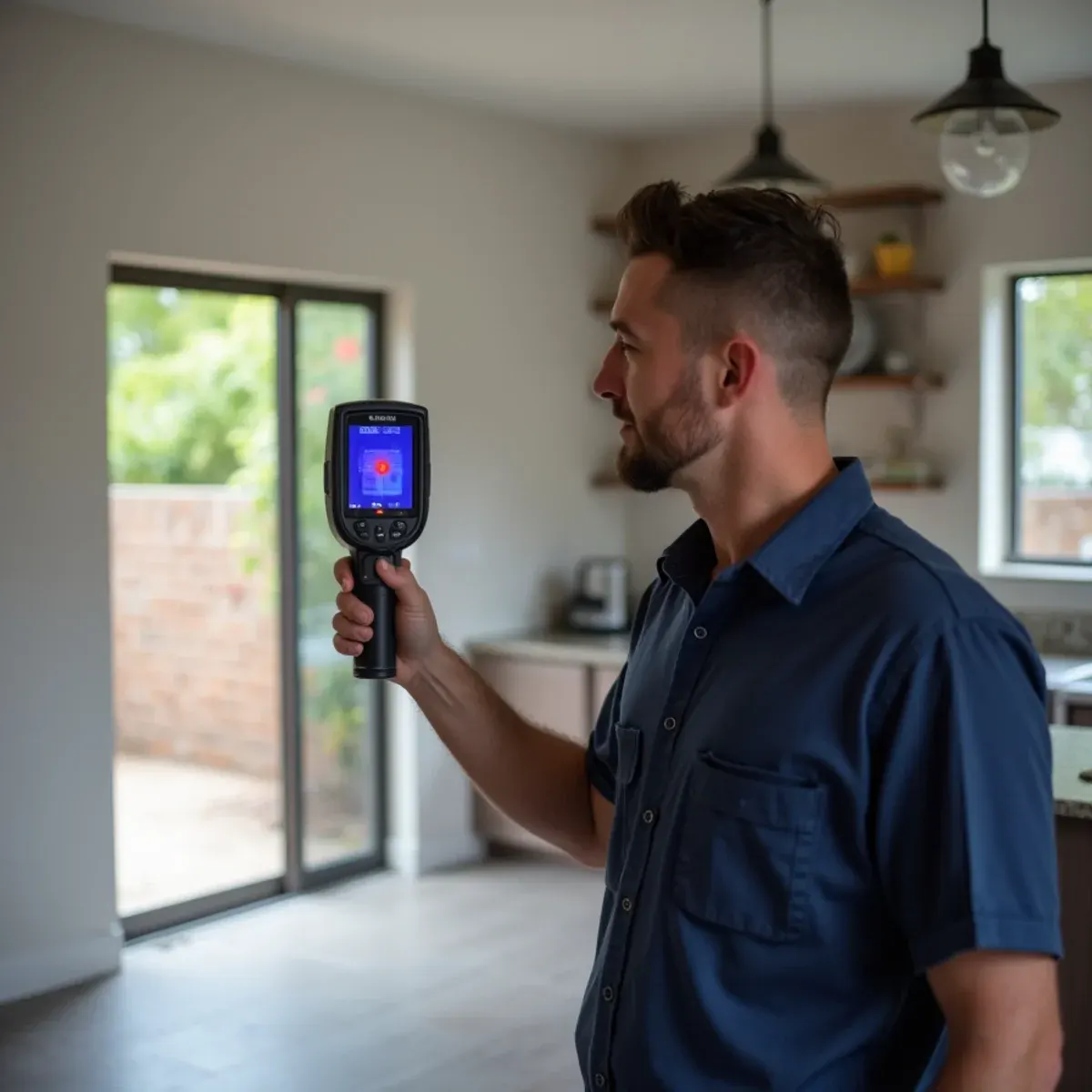
A Yorba Linda call in February often turns out not to be a plumbing problem. Water shows up along a downhill wall, or in a lower-level room cut into the grade, and the source is fifty feet uphill — a terrace drain packed with leaf litter, a v-ditch that silted in, a retaining wall whose weep holes stopped weeping. The house did nothing wrong. The engineered hillside it sits on stopped moving water the way it was designed to, and the water found the next-easiest path down.
So our inspection here works outside-in. We look at the slope above you, the drain inlets, the wall drainage and where irrigation actually lands, then bring the thermal camera and meters inside to map how far the water traveled through the slab and framing. In East Lake Village, Bryant Ranch and Travis Ranch the housing is newer than most of what we service — 1970s through 2005, copper and later PEX — so pipe failures are less common and drainage failures more so. In the Freeway Complex Fire footprint, runoff behavior changed for years afterward.
What Yorba Linda Changes About Inspection & Leak Detection
1Slope drains decide most winter losses
On an engineered hillside, the drainage is part of the structure. One blocked terrace drain turns a graded slope into a funnel aimed at whatever is downhill. When we inspect after a wet spell we walk the terraces and the wall weeps before we touch the house, because finding a wet drywall panel without finding what fed it just guarantees you see us again next season.
2Deep water table, different symptoms
Groundwater isn't the driver here the way it is down on the flats. Moisture in a Yorba Linda house is almost always coming from above or beside — surface runoff, irrigation overspray, a hillside seep after a long storm, or a supply line. That narrows the search, and it means a high reading low on a wall tells a story worth following outward.
3Irrigation on large lots skews tests
Big lots and equestrian properties here run a lot of water through valves and drip lines. If irrigation shares the domestic meter, an isolation test reads as a house leak when it's really a stuck valve or a cracked lateral in a planter. We separate the two before we conclude anything, and we tell you if the loss turned out to be landscape rather than plumbing.
How the Work Runs
The method is the same one we use on every inspection & leak detection job, documented to the IICRC S500:2025 standard. Here it is in short — the full water damage inspection & leak detection process explains each stage in detail.
- Talk through the history
- Thermal imaging survey
- Confirm with moisture meters
- Supply-side isolation testing
- Written findings with images
- Options, not a sales pitch
The Yorba Linda Background Worth Knowing
A hillside lot in Yorba Linda is a drainage system with a house attached. Terrace drains cut across the face of the slope to intercept water before it gains speed. Brow ditches run along the top to keep runoff from ever reaching the slope face. Down-drains carry the collected water to the street or a storm connection. Retaining walls have weep holes and, behind them, a gravel subdrain that relieves pressure on the wall. Every one of those was engineered as part of the pad. Every one of them silts up, roots over, or gets buried by landscaping.
There is more on the housing stock, drainage and plumbing history of this city on our water damage restoration in Yorba Linda page.
Yorba Linda at a glance
- Dominant construction era
- 1970–2005
- Foundation type
- slab on grade
- Supply piping found here
- under-slab copper, later PEX and CPVC
- Drain line materials
- ABS, cast iron
- Terrain and water table
- hillside-mixed, deep water table
- Most common local failure
- exterior water from failed slope drainage, terrace drains and retaining-wall systems rather than from plumbing
- Highest-value local prevention
- clearing terrace and slope drains before the season, since a blocked one turns an engineered hillside into a funnel
What It Costs in Yorba Linda
We do not quote a number over the phone before seeing the property — anyone who does is guessing. The variables that actually move the price on a inspection & leak detection job are standard moisture inspection — no charge, electronic slab leak location, pre-purchase moisture survey, and they are broken down in full on the water damage inspection & leak detection page. The assessment and the written estimate are free anywhere in Yorba Linda, day or night, with no obligation.
Inspection & Leak Detection Questions from Yorba Linda Homeowners
On a hillside lot, usually drainage. We meter the wall to see how high the moisture goes and how far it spreads — a supply leak wets from a point and climbs, while slope water wets low and wide along the grade. Then we go outside and look at the terrace drain, the wall weeps and the swale above you. Written findings tell you which it was, which matters because your insurer treats those two causes very differently.
The standard moisture inspection is — thermal imaging, moisture mapping, and written findings, with no obligation. Specialized services like electronic slab leak location, a full pre-purchase survey, or lab sampling carry a fee, and we tell you the number before we start.
Twenty to forty minutes for a targeted check of a specific concern. A comprehensive whole-home survey for a real estate transaction runs about ninety minutes to two hours.
Seeping from the weep holes is usually the wall doing its job, relieving water pressure from the soil behind it. The concerning version is the opposite: weep holes that stay dry through a storm while the ground above stays soggy, which suggests the subdrain behind the wall is plugged and pressure is building. Also watch for new cracking, bulging, or a wall that has tipped slightly. Those are engineering questions rather than restoration ones, and we will say so.