
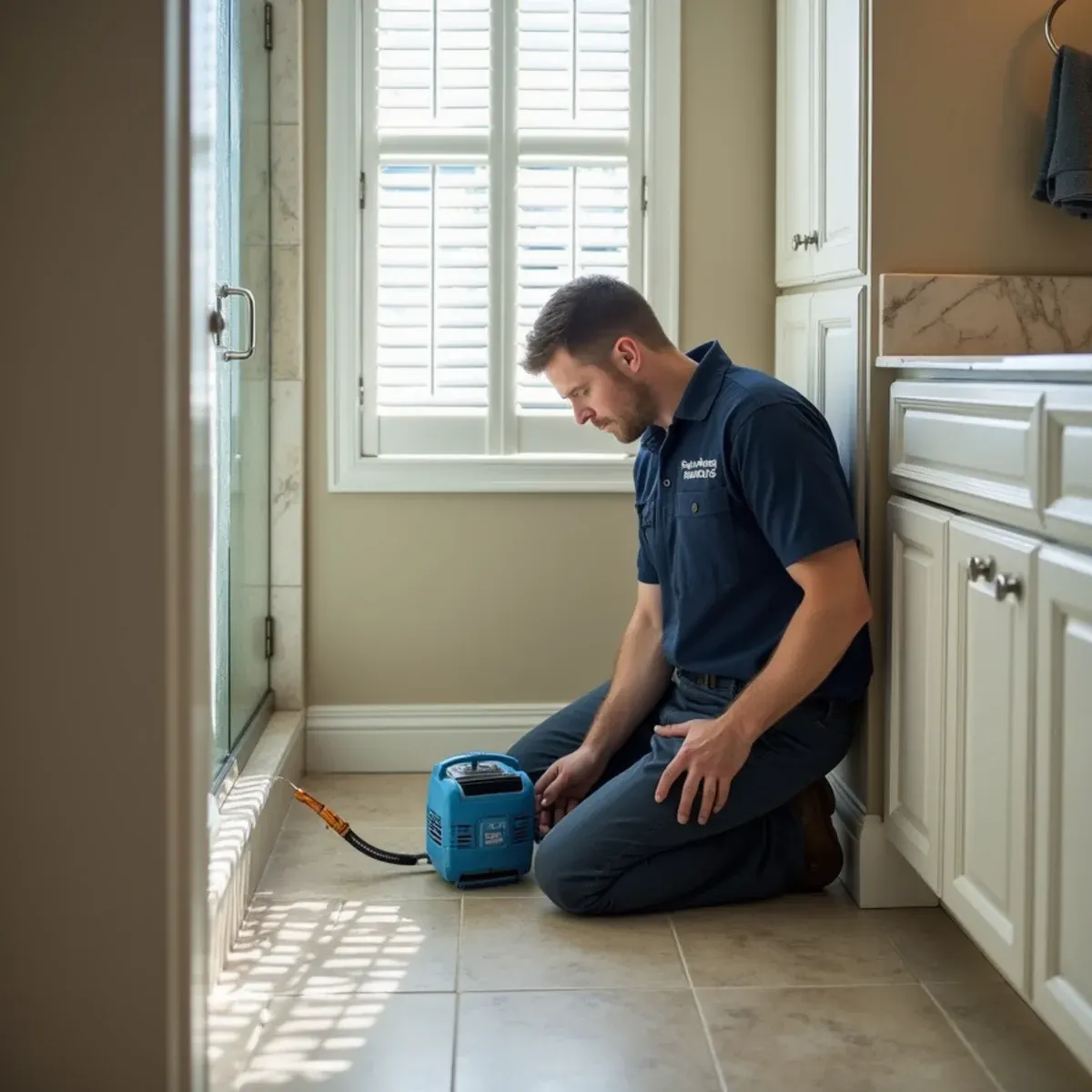
A Costa Mesa Eastside call usually sounds harmless. Slight musty smell in the hall, a bathroom floor that gives a little near the shower door, nothing dramatic. Then we open the crawl hatch on a 1920s to 1940s cottage and find soil that has been damp for months under the bathroom, joists darkened along one bay, and a hot-mopped pan liner that gave up somewhere at a corner. On a raised foundation the water never makes a puddle you would notice. It just leaves.
What makes it worse here than in an inland city is that the drying never really happens on its own. Costa Mesa has strong marine influence and a shallow water table, and the Eastside cottages sit under heavy tree canopy that keeps sun off the ground and holds humidity in the crawl space. Ambient air that stays near saturation for a good part of the day will not pull moisture out of soil or framing. So a small ongoing shower leak that would slowly dry between uses somewhere hot instead accumulates. Mesa Verde's 1960s slab tract behaves differently, and the Westside mix of housing and light industrial brings its own building types.
What Costa Mesa Changes About Shower Pan Leaks
1Marine air stalls crawl-space drying
Under an Eastside cottage the air is often close to the dew point for hours a day, especially in the May and June pattern. Passive ventilation does almost nothing then. When we dry a crawl space after a bathroom leak here we use containment and dehumidification rather than relying on fans and vents, and we monitor to a target rather than guessing by feel.
2Shallow water table under the Eastside
With groundwater close to the surface near the Santa Ana River side, crawl-space soil starts wetter than it does inland. That raises the baseline and shortens how long a leak can run before framing is affected. It also means damp soil alone does not prove a plumbing failure — we look for a localized wet zone under the fixture, not general dampness.
3Mesa Verde slab behaves nothing like this
If you are in the 1960s Mesa Verde tract, there is no crawl space, so a failed pan pushes water into the wall base and the adjoining room. Different inspection, different drying plan, different repair. We ask which side of town before we plan the visit, because bringing crawl gear to a slab house wastes everyone's morning.
How the Work Runs
The method is the same one we use on every shower pan leaks job, documented to the IICRC S500:2025 standard. Here it is in short — the full shower pan & bathroom leak repair process explains each stage in detail.
- Map the moisture first
- Flood test the pan
- Isolate the actual failure
- Open only what has to open
- Dry the structure to standard
- Rebuild the waterproofing correctly
The Costa Mesa Background Worth Knowing
Under a raised Eastside cottage there is bare soil, and that soil is supposed to stay dry because the foundation vents exchange air with the outside. That system depends on the outside air being drier than the space under the house. For a good part of the year in Costa Mesa it is not. The marine layer holds humidity high through the night and well into the morning, so the crawl space never gets the dry stretch it needs, and moisture that arrives from a plumbing drip, a downspout, or an irrigation line just accumulates.
There is more on the housing stock, drainage and plumbing history of this city on our water damage restoration in Costa Mesa page.
Costa Mesa at a glance
- Dominant construction era
- 1920–1980
- Foundation type
- mixed on grade
- Supply piping found here
- original 1920s–1940s piping on the Eastside, galvanized steel, under-slab copper
- Drain line materials
- cast iron, clay
- Terrain and water table
- coastal-flat, shallow water table
- Most common local failure
- crawl-space moisture under Eastside cottages, held in by a marine layer that slows every natural drying process
- Highest-value local prevention
- confirming crawl-space vents are actually open and that the ground under the house is dry
What It Costs in Costa Mesa
We do not quote a number over the phone before seeing the property — anyone who does is guessing. The variables that actually move the price on a shower pan leaks job are how long the shower kept running, what sits under the shower floor, whether the framing is compromised, and they are broken down in full on the shower pan & bathroom leak repair page. The assessment and the written estimate are free anywhere in Costa Mesa, day or night, with no obligation.
Shower Pan Leaks Questions from Costa Mesa Homeowners
The crawl space, first. On these raised-foundation cottages a failed shower pan or toilet flange drains straight into the dirt and the bathroom stays picture perfect. Look for a localized damp patch of soil directly under the shower, staining down one or two joists, and rusted fasteners in that bay. Given how slowly this air lets anything dry, a leak that started in spring can still be wet in fall. We inspect underneath, flood-test the pan, then dry with containment.
Timing is the cleanest clue. A pan leak only produces water when the shower is running, so the symptom appears within hours of use and dries out between uses. A pressurized supply line leaks around the clock, and the damage grows steadily whether anyone is home or not. Shut off every fixture and watch the water meter's low-flow indicator. If it still moves, you have a supply leak, not a pan. We confirm it with a flood test either way.
Sometimes, and we will tell you honestly which case you are in. A leak at the drain clamping ring, or a failed seal where the surround meets the pan, can occasionally be handled with a limited opening. A split or perforated liner cannot. Liquid-applied products sold as pan sealers can buy a few months on a pinhole, but they will not repair a membrane that has failed at a fold or a corner, and we are not going to sell you that as a fix.
Almost always the crawl space. On these raised 1920s to 1940s houses the soil under the floor stays damp when the foundation vents are blocked and the marine layer keeps outside air humid overnight. That moisture moves up through the subfloor and into the rooms above it. Before assuming anything, walk your perimeter and see whether a planter, a poured patio or landscaping has covered the vents that are supposed to be breathing.