
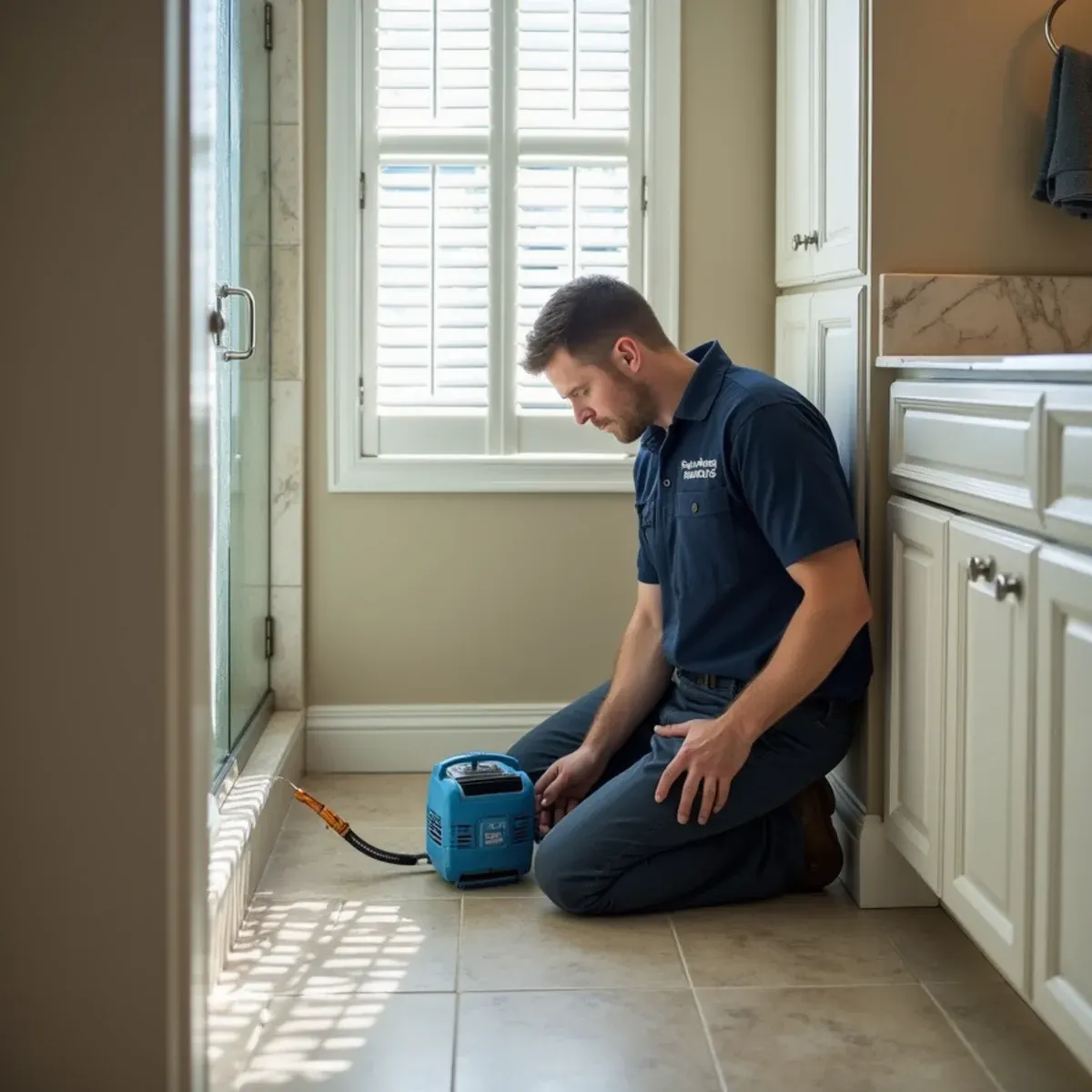
Sealants have a shorter working life here than they do five miles inland, and that shows up in bathrooms more than anywhere else in the house. Salt-laden air plus a room that never fully dries between uses is hard on caulk joints, grout and the metal parts of a drain assembly. In the sixties through nineties tracts across the neighborhoods south of Adams and inland of Beach, we routinely find curb grout gone chalky and a pan-to-wall caulk line that stopped sealing years ago, with the mortar bed underneath already saturated.
Huntington Harbour changes the job again. Those canal-front homes often put the primary bath on the upper floor over living space or a garage, so a pan failure crosses a floor assembly before it shows, and the tidal groundwater under the slab means ground-level readings need a control before they mean anything. Downtown adds a logistics problem instead of a technical one. Narrow lots with no driveway mean long hose runs from the street and careful equipment staging, which we plan for rather than discover on arrival.
What Huntington Beach Changes About Shower Pan Leaks
1Sealant life is genuinely shorter here
Caulk and grout are wear items everywhere, but coastal humidity and salt shorten the interval noticeably. In Huntington Beach we treat the pan-to-wall joint and the curb as maintenance items on a schedule, not as permanent construction. Renewing them on time is far cheaper than replacing a mortar bed, and most of the pan rebuilds we do here started as a caulk joint nobody touched.
2Harbour baths sit above living space
In the canal-front homes an upstairs pan leak travels through the floor assembly and appears at the low point of a joist bay, often a room away from the bathroom. We meter the ceiling below in a grid before opening it. Near the seawalls we also take a control reading at ground level, because tidal groundwater makes lower-floor slab readings run high on their own.
3Downtown lots with no driveway
On the narrow lots near Main Street there is nowhere to park a truck close to the work, so extraction and drying mean long hose and cord runs from the street. We stage equipment to keep walkways clear and to keep noise off shared walls with the neighbor three feet away. Planning that run in advance is the difference between one day and two.
How the Work Runs
The method is the same one we use on every shower pan leaks job, documented to the IICRC S500:2025 standard. Here it is in short — the full shower pan & bathroom leak repair process explains each stage in detail.
- Map the moisture first
- Flood test the pan
- Isolate the actual failure
- Open only what has to open
- Dry the structure to standard
- Rebuild the waterproofing correctly
The Huntington Beach Background Worth Knowing
Salt does not damage buildings directly. It damages the details that keep water out, and then water does the rest.
There is more on the housing stock, drainage and plumbing history of this city on our water damage restoration in Huntington Beach page.
Huntington Beach at a glance
- Dominant construction era
- 1960–1990
- Foundation type
- slab on grade
- Supply piping found here
- under-slab copper
- Drain line materials
- cast iron, ABS
- Terrain and water table
- coastal-flat, shallow water table
- Most common local failure
- wind-driven rain entering through salt-corroded window flashing and failed exterior sealant
- Highest-value local prevention
- renewing exterior caulking and flashing on a far shorter cycle than inland guidance suggests
What It Costs in Huntington Beach
We do not quote a number over the phone before seeing the property — anyone who does is guessing. The variables that actually move the price on a shower pan leaks job are how long the shower kept running, what sits under the shower floor, whether the framing is compromised, and they are broken down in full on the shower pan & bathroom leak repair page. The assessment and the written estimate are free anywhere in Huntington Beach, day or night, with no obligation.
Shower Pan Leaks Questions from Huntington Beach Homeowners
Sometimes, and in Huntington Beach more often than inland. Caulk fails faster in salt air, so a yearly recaulk is not unusual here. But caulk only seals the surface joint. If the liner under the mortar bed has failed, no amount of caulk holds it back, and recaulking over a wet bed traps the moisture in. A flood test tells you which one you have. If the pan holds its level overnight, your problem really is the joint.
Timing is the cleanest clue. A pan leak only produces water when the shower is running, so the symptom appears within hours of use and dries out between uses. A pressurized supply line leaks around the clock, and the damage grows steadily whether anyone is home or not. Shut off every fixture and watch the water meter's low-flow indicator. If it still moves, you have a supply leak, not a pan. We confirm it with a flood test either way.
Sometimes, and we will tell you honestly which case you are in. A leak at the drain clamping ring, or a failed seal where the surround meets the pan, can occasionally be handled with a limited opening. A split or perforated liner cannot. Liquid-applied products sold as pan sealers can buy a few months on a pinhole, but they will not repair a membrane that has failed at a fold or a corner, and we are not going to sell you that as a fix.
Ambient humidity near the coast stays high enough for long enough that materials dry slowly on their own, which widens the window in which growth can establish after any moisture event. Combined with salt-accelerated failures of exterior sealants and flashings, coastal homes simply get more moisture intrusion and dry from it more slowly.