
Most of Los Alamitos was built between 1950 and 1965, a full construction generation ahead of the tracts around it. That matters for mold because the supply lines here have been repaired piecemeal for decades. Galvanized steel tied into copper, copper tied back into galvanized, and every one of those mixed-metal joints quietly corroding from the inside. Those joints rarely burst. They weep. A weep behind a bathroom wall puts a few ounces a day into framing and insulation, and by the time a stain shows on the paint, the cavity behind it has been growing for months.
Foundations here are mixed, which changes where we look. On the raised-floor homes near Laurel Park, a slow leak drips into the crawl space and the growth shows up on the subfloor and joists before anything appears in the rooms above. On the slab homes, the same leak wicks sideways into bottom plates and baseboard. And a real share of our work in this city isn't houses at all. Dental suites, medical offices and small commercial space near Los Alamitos Medical Center and along the Katella corridor, where containment has to let the business keep running.
What Los Alamitos Changes About Mold Remediation
1Mixed-metal joints corrode out of sight
Sixty years of piecemeal repairs left copper tied into galvanized steel throughout this city's older housing. Those junctions corrode from the inside, and the failure mode is a weep rather than a break. A weep keeps a wall cavity damp for months, which is more than enough for growth to take hold. Finding and correcting that joint comes before we build any containment.
2Clay laterals under a mature canopy
Drain lines here are cast iron and clay, running under decades-old street trees. Roots find the clay joints, the line cracks, and waste water seeps into soil beneath the slab or into a crawl space, feeding growth with no plumbing noise to warn you. Almost no home here has ever had its lateral scoped. When the source investigation points at the drain side, a camera run settles it in an afternoon.
3Medical and office work after hours
A meaningful share of what we do in Los Alamitos is commercial, in suites near Los Alamitos Medical Center and along Katella. Containment there has to keep the rest of the floor operating: negative air pulled away from occupied space, work staged after hours, and verification finished before staff and patients come back in. We schedule around your appointment book, not ours.
How the Work Runs
The method is the same one we use on every mold remediation job, documented to the IICRC S500:2025 standard. Here it is in short — the full mold remediation & removal process explains each stage in detail.
- Inspection and moisture source identification
- Testing where it is warranted
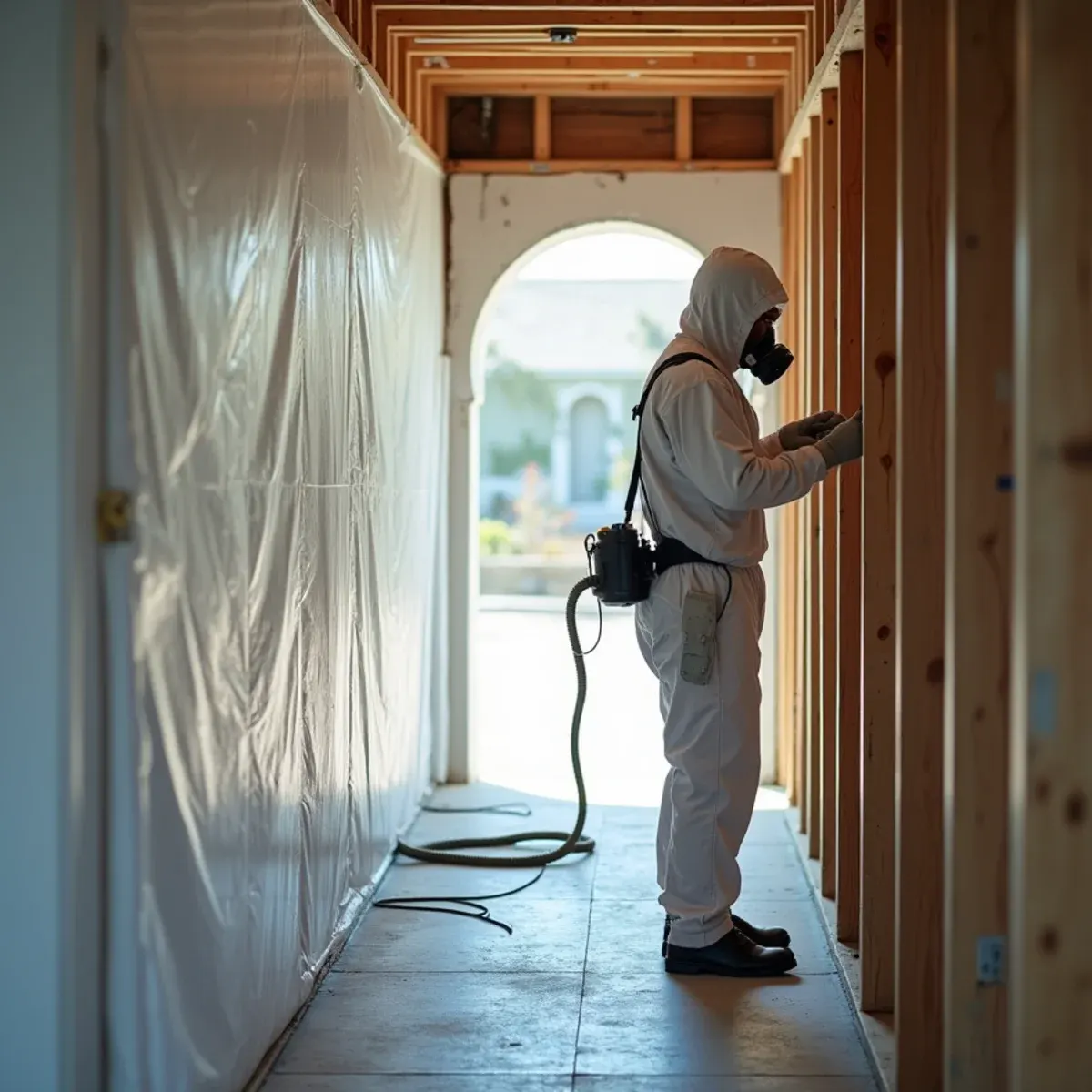
- Containment and negative pressure
- Removal of contaminated material
- HEPA cleaning and antimicrobial application
- Verification before containment comes down
The Los Alamitos Background Worth Knowing
When a home has been standing since 1958, the plumbing question is not whether something will fail but which thing already has. We routinely find three generations of repair inside a single Los Alamitos wall: original galvanized, a copper section from a 1980s repair, and a PEX patch from last decade, all joined with whatever transition fitting was on the truck that day.
There is more on the housing stock, drainage and plumbing history of this city on our water damage restoration in Los Alamitos page.
Los Alamitos at a glance
- Dominant construction era
- 1950–1965
- Foundation type
- mixed on grade
- Supply piping found here
- galvanized steel, early copper, mixed-metal repair joints
- Drain line materials
- cast iron, clay
- Terrain and water table
- flat, moderate water table
- Most common local failure
- galvanic corrosion at mixed-metal joints where sixty years of piecemeal repairs meet
- Highest-value local prevention
- a camera inspection of the sewer lateral, which has never been scoped on most homes here
What It Costs in Los Alamitos
We do not quote a number over the phone before seeing the property — anyone who does is guessing. The variables that actually move the price on a mold remediation job are square footage of affected material, where it is, containment complexity, and they are broken down in full on the mold remediation & removal page. The assessment and the written estimate are free anywhere in Los Alamitos, day or night, with no obligation.
Mold Remediation Questions from Los Alamitos Homeowners
We start with moisture mapping, meters and thermal imaging across the suspect walls, to find the wettest point, then open the smallest area that gets us to the pipe. In homes like yours the culprit is often a joint where copper was tied into old galvanized, and the corrosion is on the inside where nothing shows. If the pattern points at the drain side instead, we camera the lateral. No containment goes up until the source is stopped.
On a hard, non-porous surface like tile or glass, bleach handles surface growth. On drywall, wood, or anything porous it does not — the water content soaks in and can feed further growth while the chlorine stays on the surface. Porous material with real growth needs to be removed, not treated.
Usually not for visible growth with an obvious cause — you can see the problem and the work would be identical regardless of species. Testing is worthwhile when there is odor but nothing visible, when you need documentation for a claim or dispute, or when you want independent verification that the job was done right.
Usually fifteen to twenty-five minutes — Los Alamitos is our closest neighbor, straight east on Katella from where our trucks stage. The 60-minute response commitment applies here the same as in Cypress.