
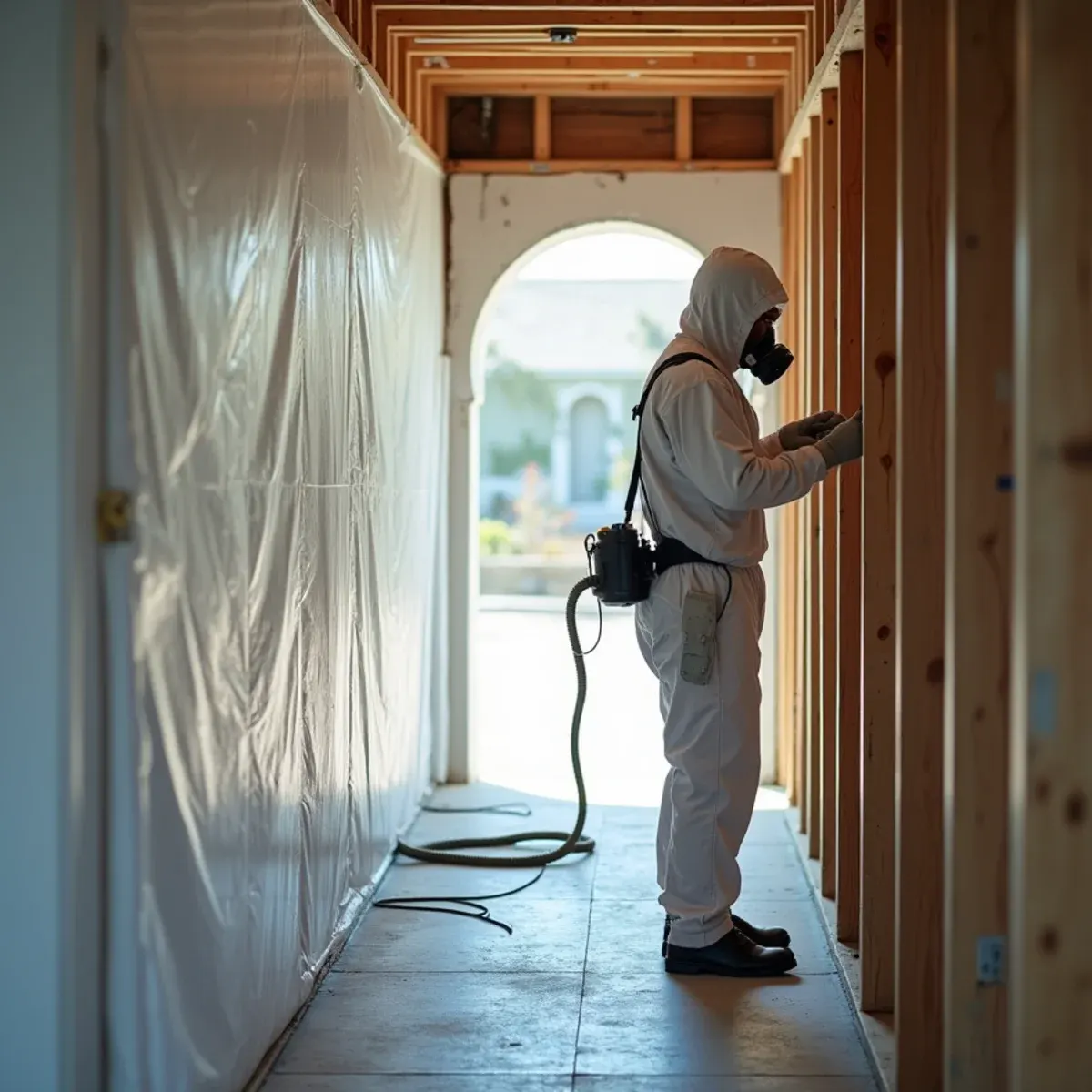
About 17,500 Lakewood homes went up between 1950 and 1953, at a pace of up to a hundred a day. That means an entire city whose supply plumbing shares not just a decade but a three-year installation window, all of it original galvanized steel, now seventy years old. Galvanized rarely bursts first. The zinc wears through, the steel rusts, scale narrows the bore, velocity rises and a fitting starts to weep. A weep is a mold machine. Not enough water to flood a floor, plenty to keep insulation and framing damp indefinitely.
What makes it worse here is the floor plan. These houses cluster kitchen, bathroom and laundry so they share plumbing walls, so a single weeping fitting can feed a cavity backing three different rooms. You smell it in the hall bath while the wet framing sits behind the kitchen cabinets. When we open a wall like that for mold work, we will tell you plainly if the pipe inside it is at the end of its life, because repiping while a wall is already open costs a fraction of doing it as its own project later.
What Lakewood Changes About Mold Remediation
1Weeps, not bursts, feed mold
Original galvanized fails along a predictable path: zinc wears through, steel corrodes, scale narrows the bore, velocity rises and a fitting starts to seep. A seep will not flood a floor. It keeps framing and insulation damp for months, which is the ideal condition for growth. That is why so many Lakewood calls start with an odor rather than with water.
2Clustered wet cores share walls
These houses were built at up to a hundred a day with kitchen, bath and laundry grouped so they share plumbing walls. One weeping fitting can therefore feed a cavity backing three rooms. You will smell it in the bathroom while the wet framing sits behind the kitchen cabinets, so the removal scope is often wider than the room where you first noticed something.
3Repipe while the wall is open
When mold work opens a wall containing seventy-year-old galvanized, the expensive parts of a repipe, demolition and drywall repair, are already in the scope. Replacing that run now costs a fraction of doing it later as a standalone project. We will show you the inside of the pipe we cut out, so the decision rests on what is actually there.
How the Work Runs
The method is the same one we use on every mold remediation job, documented to the IICRC S500:2025 standard. Here it is in short — the full mold remediation & removal process explains each stage in detail.
- Inspection and moisture source identification
- Testing where it is warranted
- Containment and negative pressure
- Removal of contaminated material
- HEPA cleaning and antimicrobial application
- Verification before containment comes down
The Lakewood Background Worth Knowing
Galvanized steel supply piping was standard when Lakewood was built, and it fails in a specific and predictable way. The zinc coating protecting the steel wears through from the inside, the steel corrodes, and scale builds up on the interior wall — narrowing the pipe over decades. As the diameter shrinks, water velocity and turbulence increase, which accelerates the erosion at elbows and fittings until a thin spot lets go.
There is more on the housing stock, drainage and plumbing history of this city on our water damage restoration in Lakewood page.
Lakewood at a glance
- Dominant construction era
- 1950–1953
- Foundation type
- slab on grade
- Supply piping found here
- original galvanized steel
- Drain line materials
- cast iron
- Terrain and water table
- flat, moderate water table
- Most common local failure
- seventy-year-old galvanized supply lines letting go at a scaled, eroded fitting
- Highest-value local prevention
- repiping while walls are already open for a repair, rather than as a separate project later
What It Costs in Lakewood
We do not quote a number over the phone before seeing the property — anyone who does is guessing. The variables that actually move the price on a mold remediation job are square footage of affected material, where it is, containment complexity, and they are broken down in full on the mold remediation & removal page. The assessment and the written estimate are free anywhere in Lakewood, day or night, with no obligation.
Mold Remediation Questions from Lakewood Homeowners
If the pipe in that wall is original galvanized, yes. That is the cheapest repiping you will ever buy, because the demolition and the drywall repair are already in the scope. Doing it later as a standalone project means opening the same walls a second time and paying for finish work twice. We will show you the condition of the pipe we expose, so you can decide with your own eyes rather than on principle.
On a hard, non-porous surface like tile or glass, bleach handles surface growth. On drywall, wood, or anything porous it does not — the water content soaks in and can feed further growth while the chlorine stays on the surface. Porous material with real growth needs to be removed, not treated.
Usually not for visible growth with an obvious cause — you can see the problem and the work would be identical regardless of species. Testing is worthwhile when there is odor but nothing visible, when you need documentation for a claim or dispute, or when you want independent verification that the job was done right.
Have it assessed. Seventy-year-old galvanized has exceeded any reasonable service life, and declining pressure or rust-colored water means it is well along. If a repair is already opening walls, that is the cheapest moment you will ever get to repipe — the demolition and patching are already in the scope.