
La Palma homes are, on the whole, unusually well kept. Long-tenured owners, updated kitchens, fresh paint, tidy yards. That is exactly what makes mold here surprising, because the parts that fail are the parts nobody has touched since the house went up between 1960 and 1980. The under-slab copper, and the supply lines feeding a second-floor bathroom. A ring on a downstairs ceiling in a house that looks this good reads as trivial. It usually isn't. Water has been sitting in the floor cavity long enough to travel sideways.
That cavity is the whole problem. Between the upstairs floor and the downstairs ceiling sits a closed, unventilated space full of joists, subfloor and sometimes insulation. Water from a failed angle stop or a shower pan spreads flat along the joist bays. There is no airflow, the temperature stays comfortable, and growth does well there. In Orange County's smallest city, with a higher share of two-story homes than its neighbors, that is the pattern we see most often. Reaching it means opening the ceiling below, because drying from the room will not touch it.
What La Palma Changes About Mold Remediation
1Well-kept homes, untouched original plumbing
Owners here hold their homes a long time and maintain them well, which is exactly why the under-slab copper and the second-floor supply lines from the 1960s and 70s get overlooked. Nothing about the house looks its age. Mold in La Palma usually turns up in a home that has been renovated everywhere except inside the walls, where the original pipe is still doing the work.
2The floor assembly has to open
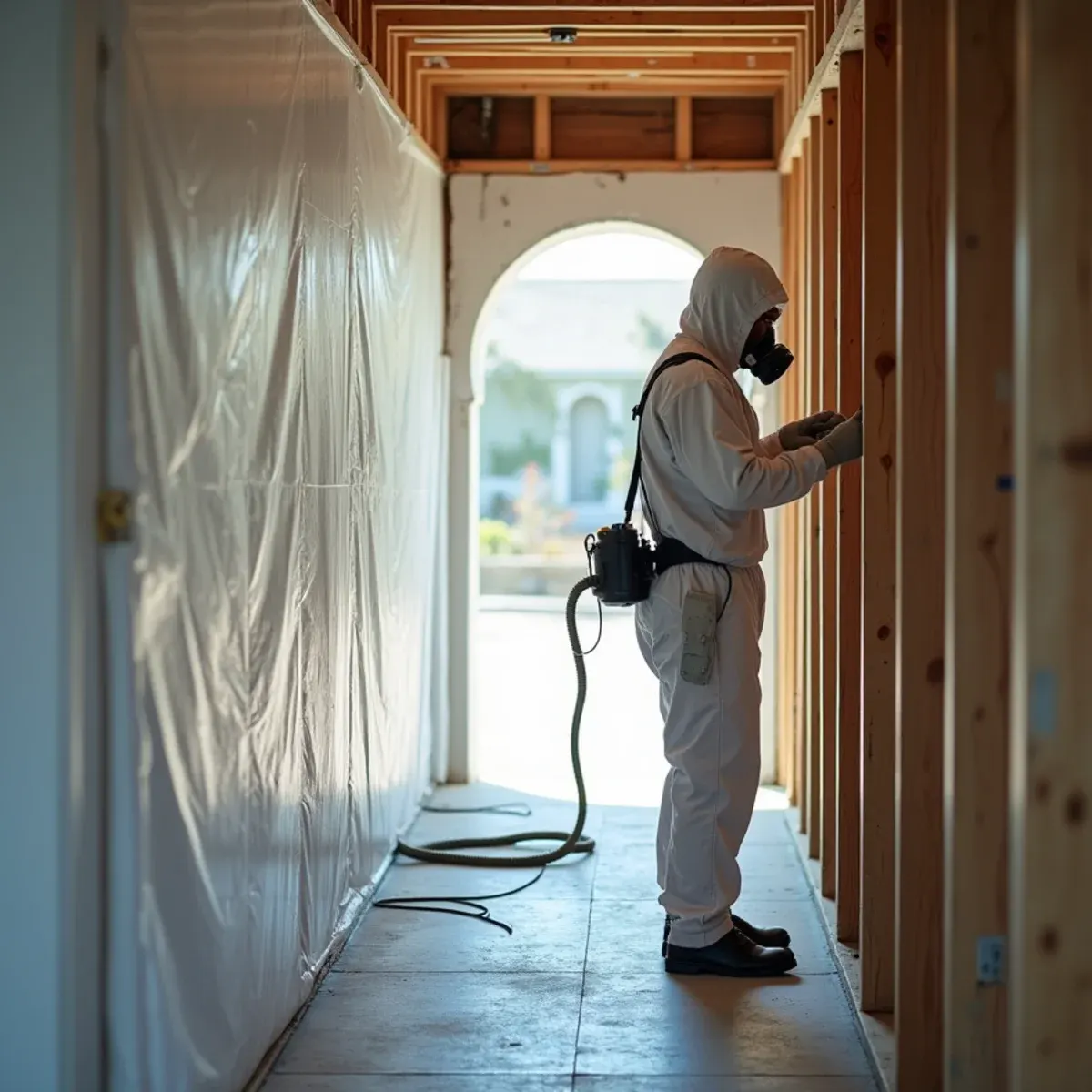
Growth inside the space between an upstairs floor and a downstairs ceiling cannot be reached by pointing air movers at the ceiling. Insulation, subfloor and joist faces hold it. Porous material that has taken on contamination comes out rather than being sprayed and left in place. We open the smallest area that gives us full access, then verify with readings before the containment comes down.
3Confirm your main shutoff still turns
The difference between a wall repair and a whole-floor mold job is often four minutes with the water still running. Plenty of shutoffs in these houses have not been operated since installation and have seized in place. Find yours, turn it, turn it back. Do that on a Saturday afternoon rather than in the dark. If it will not move, replace it now.
How the Work Runs
The method is the same one we use on every mold remediation job, documented to the IICRC S500:2025 standard. Here it is in short — the full mold remediation & removal process explains each stage in detail.
- Inspection and moisture source identification
- Testing where it is warranted
- Containment and negative pressure
- Removal of contaminated material
- HEPA cleaning and antimicrobial application
- Verification before containment comes down
The La Palma Background Worth Knowing
There is a pattern we see repeatedly in La Palma. A homeowner has taken excellent care of a house for thirty years — new roof, dual-pane windows, updated electrical panel, remodeled kitchen. Then a slab leak runs for eight months under the living room and nobody catches it, because there was never anything to see.
There is more on the housing stock, drainage and plumbing history of this city on our water damage restoration in La Palma page.
La Palma at a glance
- Dominant construction era
- 1960–1980
- Foundation type
- slab on grade
- Supply piping found here
- under-slab copper
- Drain line materials
- cast iron, ABS
- Terrain and water table
- flat, moderate water table
- Most common local failure
- second-floor supply and fixture failures that travel through the floor assembly into the ceiling below
- Highest-value local prevention
- knowing where the main shutoff is and confirming it still turns, because two-story losses double in size in minutes
What It Costs in La Palma
We do not quote a number over the phone before seeing the property — anyone who does is guessing. The variables that actually move the price on a mold remediation job are square footage of affected material, where it is, containment complexity, and they are broken down in full on the mold remediation & removal page. The assessment and the written estimate are free anywhere in La Palma, day or night, with no obligation.
Mold Remediation Questions from La Palma Homeowners
Dry to the touch does not mean dry inside. That ring tells you water sat in the floor assembly above the ceiling, and the cavity has almost no ventilation. We would meter it first. If the framing and insulation read dry and there is no odor, you may only need the stain sealed and painted. If they read wet, or the ring has grown since it first appeared, the ceiling needs to open so we can see what is on the joists.
On a hard, non-porous surface like tile or glass, bleach handles surface growth. On drywall, wood, or anything porous it does not — the water content soaks in and can feed further growth while the chlorine stays on the surface. Porous material with real growth needs to be removed, not treated.
Usually not for visible growth with an obvious cause — you can see the problem and the work would be identical regardless of species. Testing is worthwhile when there is odor but nothing visible, when you need documentation for a claim or dispute, or when you want independent verification that the job was done right.
Typically fifteen to twenty minutes. La Palma borders Cypress directly to the north, so it is one of the fastest calls we run and the 60-minute commitment applies in full.