
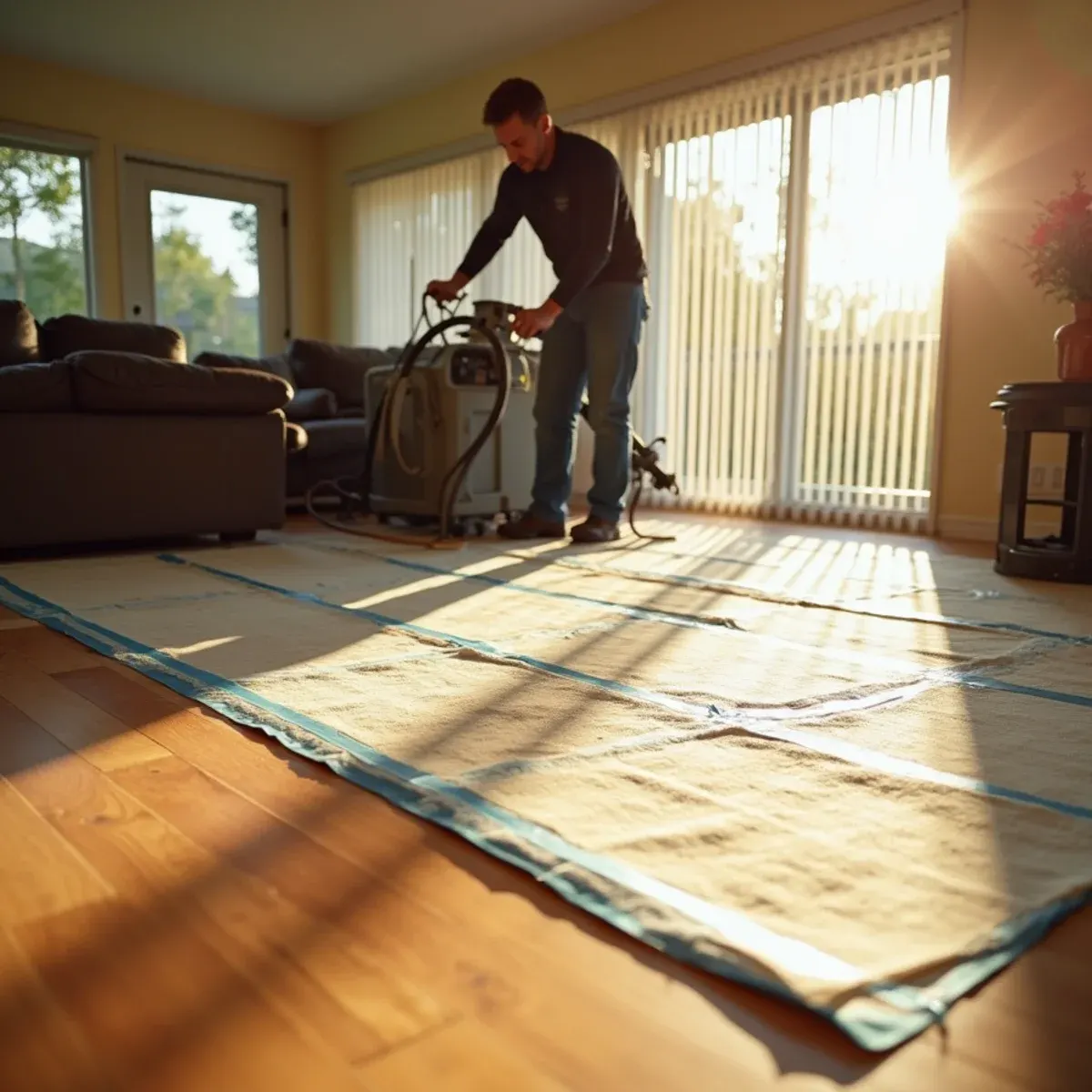
In Leisure World the floor is rarely just your floor. Nine thousand attached units built in the early sixties share walls and share paperwork, so a wet wood floor in one home can involve your policy, your neighbor's, the mutual and the management company all at once. We document each unit separately from the first hour for exactly that reason. It also means we ask about the mutual's flooring rules before planning anything, because what is permitted to go back down after drying is not always what came up.
Then there is the air. The marine layer sits over this city for long stretches, and grain for grain the outdoor air is wetter here than it is five miles inland, which means a wood floor gives up moisture more slowly and we bring more dehumidification than the same job would need in College Park East. Old Town lots often have a raised foundation, and that is the best case we get anywhere near the water. We work the underside of the floor as well as the top, and those floors come back faster than anything sitting on a slab.
What Seal Beach Changes About Hardwood Floor Drying
1Mutual approval before equipment goes in
Leisure World work runs on the mutual's rules, not ours. Access routing, quiet hours, hallway obstruction and what flooring is permitted to go back down all get settled before we start, because reversing a decision afterward is far harder than asking first. Most residents stay in the unit throughout, so equipment placement gets planned around how someone actually moves through the rooms.
2Each affected unit documented on its own
In attached construction a single failure crosses shared walls and involves several policies and the mutual at once. From the first hour we keep separate moisture maps, photographs and equipment logs for every unit. It feels like duplication on day one, and it is the difference between a clean claim and months of argument about which unit's floor got wet from what.
3Marine layer adds days to the plan
The marine layer sits over Seal Beach for long stretches, and outdoor air here carries more moisture than air a few miles inland. A wood floor releases moisture into whatever the room already holds, so we bring more dehumidification capacity and expect a longer run than an inland job of the same size. Salt is hard on the exterior side of these buildings too.
How the Work Runs
The method is the same one we use on every hardwood floor drying job, documented to the IICRC S500:2025 standard. Here it is in short — the full hardwood floor water damage drying process explains each stage in detail.
- Measure before deciding anything
- Extract from below the surface
- Control the drying rate deliberately
- Dry the subfloor and any cavity below
- Let it acclimate before judging it
- Sand and refinish only if needed
The Seal Beach Background Worth Knowing
Structural drying works by creating a vapor pressure differential — dry air pulls moisture out of wet materials. When the surrounding air is already carrying a heavy moisture load, that differential shrinks and everything slows down.
There is more on the housing stock, drainage and plumbing history of this city on our water damage restoration in Seal Beach page.
Seal Beach at a glance
- Dominant construction era
- 1920–1965
- Foundation type
- mixed on grade
- Supply piping found here
- galvanized steel, copper, shared community mains
- Drain line materials
- cast iron, clay
- Terrain and water table
- coastal-flat, shallow water table
- Most common local failure
- losses that cross shared walls between attached units, involving several policies and a mutual at once
- Highest-value local prevention
- documenting each affected unit separately from the first hour
What It Costs in Seal Beach
We do not quote a number over the phone before seeing the property — anyone who does is guessing. The variables that actually move the price on a hardwood floor drying job are square footage under the mat system, solid versus engineered wood, what is underneath, and they are broken down in full on the hardwood floor water damage drying page. The assessment and the written estimate are free anywhere in Seal Beach, day or night, with no obligation.
Hardwood Floor Drying Questions from Seal Beach Homeowners
Practically, it usually takes both parties. Your unit's interior is generally your responsibility and the shared structure is the mutual's, and which is which depends on your specific governing documents. What we can do is document your unit independently from the first hour, so whoever ends up paying has a clear record of what was wet in your rooms and what equipment ran. Get written notice to management early.
Frequently, yes. Cupping is caused by uneven moisture between the top and bottom of each board, and when the moisture equalizes during controlled drying, much of the deformation reverses. Full flattening can take two to four weeks of acclimation after the equipment comes out, which is why we do not recommend sanding immediately.
Five to ten days under the mat system is typical, which is longer than drywall because wood gives up moisture slowly and has to be dried at a controlled rate. Rushing it causes splitting and permanent gapping, so the extra days are doing real work.
Coastal marine layer conditions keep ambient humidity high for extended periods, which reduces the vapor pressure differential that drives drying. Jobs near the water need sealed chambers and more dehumidification capacity than an equivalent loss inland, and the equipment stays on longer.