
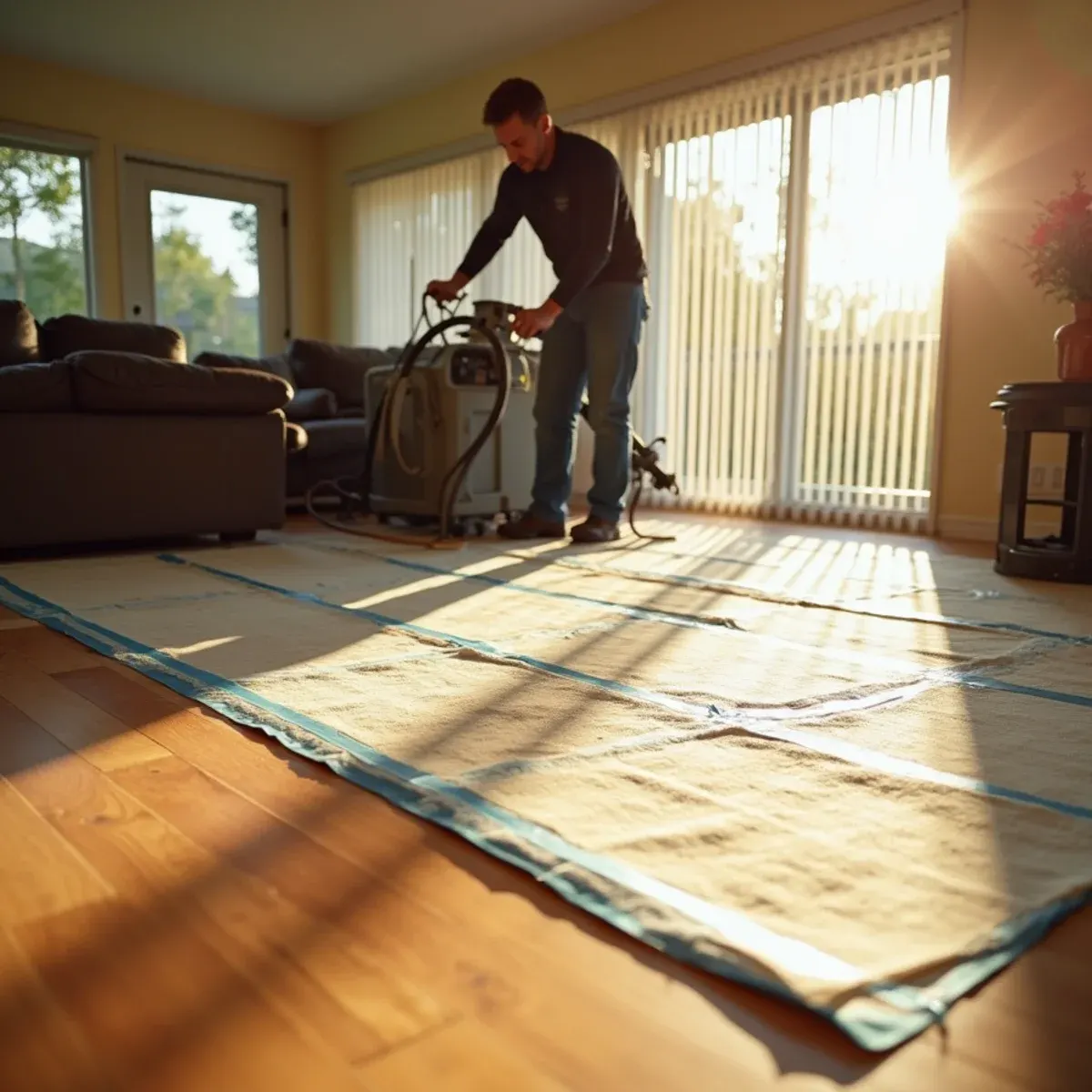
The call usually comes from a second-floor bathroom. A supply riser or an angle stop lets go upstairs, and by the time anyone hears it the water has already found the floor assembly, run sideways along a joist bay, and come through the ceiling onto the hardwood downstairs. La Palma has more two-story homes than the cities around it, and in the tracts off Walker Street those upstairs wet rooms sit directly over the living space. The downstairs floor takes a soaking from above while sitting on a slab that gives it nowhere to drain.
This is a well-kept city, which works against you in one narrow way. The homes look so sound that nobody thinks about under-slab copper that has been in the ground since the seventies and has never been touched. When it does fail, water surfaces at the slab and wets the floor from underneath, the opposite direction with the same result. Either way we end up drying a wood floor with concrete on one side of it, so the mat system does all the work and the timeline is honest: longer than a crawl space, shorter than most people fear.
What La Palma Changes About Hardwood Floor Drying
1Ceiling cavity and floor dry separately
When water comes down from an upstairs bathroom you have two wet assemblies, not one: the enclosed floor structure between levels and the wood floor it landed on. Drying only the visible floor leaves moisture in the joist bay above the ceiling, and it will find its way back down. We open a controlled access point, dry the cavity, and run the floor mats at the same time.
2Engineered upstairs, solid oak downstairs
Two-story La Palma homes often carry different flooring on each level, and the two behave nothing alike. Solid wood cups, releases moisture through the seams, and usually flattens back out. Engineered plank swells at the core and the veneer separates from it, and once that bond opens no amount of drying closes it again. We tell you which floor you have before equipment goes in.
3Under-slab copper wets from the underside
The supply lines under these slabs went in during the seventies and, in a city maintained this well, have almost never been touched. When one fails, water surfaces through the slab and wets the underside of the floor, the face we cannot reach directly. Cupping appears quickly and clears slowly, and the mats have to pull that moisture up through every board seam.
How the Work Runs
The method is the same one we use on every hardwood floor drying job, documented to the IICRC S500:2025 standard. Here it is in short — the full hardwood floor water damage drying process explains each stage in detail.
- Measure before deciding anything
- Extract from below the surface
- Control the drying rate deliberately
- Dry the subfloor and any cavity below
- Let it acclimate before judging it
- Sand and refinish only if needed
The La Palma Background Worth Knowing
There is a pattern we see repeatedly in La Palma. A homeowner has taken excellent care of a house for thirty years — new roof, dual-pane windows, updated electrical panel, remodeled kitchen. Then a slab leak runs for eight months under the living room and nobody catches it, because there was never anything to see.
There is more on the housing stock, drainage and plumbing history of this city on our water damage restoration in La Palma page.
La Palma at a glance
- Dominant construction era
- 1960–1980
- Foundation type
- slab on grade
- Supply piping found here
- under-slab copper
- Drain line materials
- cast iron, ABS
- Terrain and water table
- flat, moderate water table
- Most common local failure
- second-floor supply and fixture failures that travel through the floor assembly into the ceiling below
- Highest-value local prevention
- knowing where the main shutoff is and confirming it still turns, because two-story losses double in size in minutes
What It Costs in La Palma
We do not quote a number over the phone before seeing the property — anyone who does is guessing. The variables that actually move the price on a hardwood floor drying job are square footage under the mat system, solid versus engineered wood, what is underneath, and they are broken down in full on the hardwood floor water damage drying page. The assessment and the written estimate are free anywhere in La Palma, day or night, with no obligation.
Hardwood Floor Drying Questions from La Palma Homeowners
It is the same loss but a separate drying problem. Water spreads sideways through the floor structure before it drops, so the cavity above your ceiling holds moisture the floor mats cannot reach. We make a small controlled opening, dry that space with directed airflow, and run the floor at the same time. Doing only one of the two is the most common reason a repaired ceiling stains again months later.
Frequently, yes. Cupping is caused by uneven moisture between the top and bottom of each board, and when the moisture equalizes during controlled drying, much of the deformation reverses. Full flattening can take two to four weeks of acclimation after the equipment comes out, which is why we do not recommend sanding immediately.
Five to ten days under the mat system is typical, which is longer than drywall because wood gives up moisture slowly and has to be dried at a controlled rate. Rushing it causes splitting and permanent gapping, so the extra days are doing real work.
Typically fifteen to twenty minutes. La Palma borders Cypress directly to the north, so it is one of the fastest calls we run and the 60-minute commitment applies in full.