
Pico Rivera occupies a strip of ground between two flood-control channels — the San Gabriel River on one side, the Rio Hondo on the other — and that position sets the drainage behavior of the whole city. The water table is shallow. During a sustained storm the ground saturates quickly and stops accepting anything more, so water backs up at the slab edge, gets into the bottom plate and moves into the drywall from behind. None of that is visible until a baseboard swells or a stain finally surfaces on the painted face.
It also means the drying environment fights you. The soil around a Pico Rivera house holds moisture long after the rain stops, so a wall opened for cavity ventilation keeps getting resupplied from below unless the exterior side is addressed too. Housing here is postwar tract from roughly 1945 to 1965, built before and after Pico and Rivera merged into one city in 1958 — slab, wood frame, half-inch board, modest room sizes. Predictable to patch. The decision that matters is whether the cavity is actually going to dry.
What Pico Rivera Changes About Drywall Repair
1Saturated soil refills the wall
Between the San Gabriel River and the Rio Hondo, the ground stays wet long after a storm passes. A wall opened to dry keeps getting resupplied from below unless the exterior grade, the slab edge and any planter against the wall get addressed at the same time. Otherwise the meter plateaus and everyone stands around wondering why the numbers stopped moving.
2Damage starts behind the baseboard
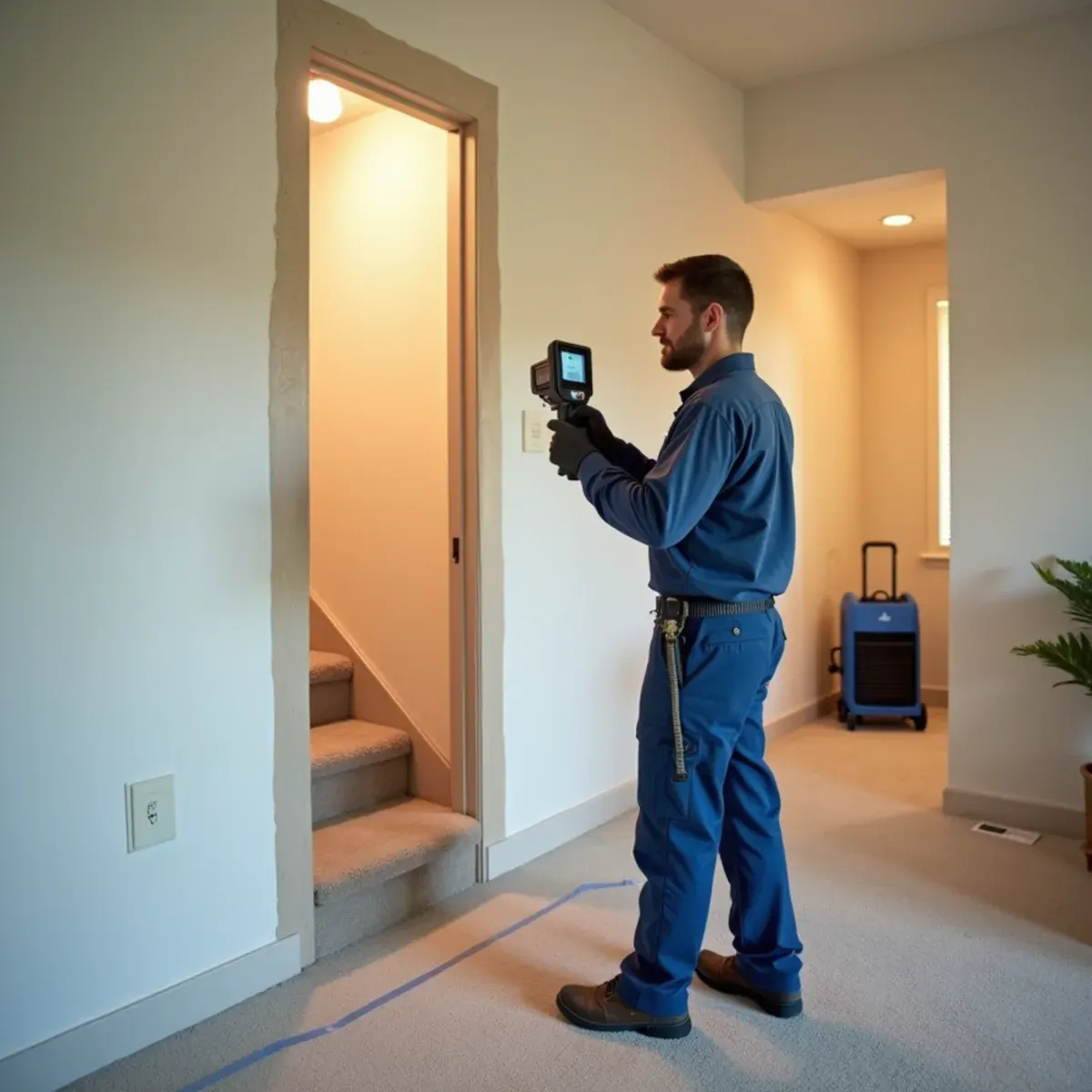
Storm water in Pico Rivera typically enters at the slab edge rather than through a roof or a pipe. It wets the bottom plate and moves into the back of the board while the painted face still looks perfect. Pulling baseboard and reading the wall low is the first thing we do, before anybody decides how much material has to come out.
3Predictable tract, predictable rebuild
Postwar housing from roughly 1945 to 1965, built before and after Pico and Rivera merged in 1958, is consistent: slab, wood frame, half-inch board, modest room sizes and a short list of textures. That consistency makes the rebuild straightforward once drying is settled. The hard call in this city is almost always the drying, not the patching.
How the Work Runs
The method is the same one we use on every drywall repair job, documented to the IICRC S500:2025 standard. Here it is in short — the full drywall water damage repair process explains each stage in detail.
- Meter the wall first
- Decide dry-in-place or remove
- Open the cavity, not the wall
- Cut to a stud and a seam line
- Clear the cavity and dry the framing
- Tape, texture, prime, paint
The Pico Rivera Background Worth Knowing
On a hillside, storm water leaves. In Pico Rivera it soaks in, and when the soil is already near capacity it stops soaking in and simply stands. That is why a yard here can hold water two days after the rain stops while a yard up in the Whittier hills is dry by morning. The lawn is not draining badly. The ground underneath it is full. Once that happens, every path water can take toward your house becomes the path it takes: the garage threshold, the slider track, the gap where a patio slab has settled back toward the wall.
There is more on the housing stock, drainage and plumbing history of this city on our water damage restoration in Pico Rivera page.
Pico Rivera at a glance
- Dominant construction era
- 1945–1965
- Foundation type
- slab on grade
- Supply piping found here
- original galvanized steel, copper
- Drain line materials
- cast iron
- Terrain and water table
- flat, shallow water table
- Most common local failure
- ground saturating fast during sustained storms because the water table between two channels sits high
- Highest-value local prevention
- clearing area drains and confirming downspouts discharge well away from the foundation
What It Costs in Pico Rivera
We do not quote a number over the phone before seeing the property — anyone who does is guessing. The variables that actually move the price on a drywall repair job are how much board comes out, cut height and seam count, texture type and match difficulty, and they are broken down in full on the drywall water damage repair page. The assessment and the written estimate are free anywhere in Pico Rivera, day or night, with no obligation.
Drywall Repair Questions from Pico Rivera Homeowners
Because in Pico Rivera the ground stays wet long after the sky clears. The city sits on a strip between the San Gabriel River and the Rio Hondo with a shallow water table, and saturated soil against the slab edge keeps feeding moisture into the bottom plate. Drying the room only addresses half of it. We look at grade, downspout discharge and any planter sitting against the wall, because until the outside stops resupplying it, the meter won't move.
No, and that assumption is why a lot of walls come out that did not need to. Gypsum board that got clean water, still reads firm under thumb pressure, and is coming down in moisture content day over day can usually be dried in place through the cavity. What forces removal is contaminated water, a core that has softened or swelled, visible growth on the paper, or insulation behind it that holds moisture against the board. We take readings before we answer that question.
Usually two feet or four feet above the floor, measured level across the whole run rather than following the stain. Board comes in four-foot widths, so a cut at either height lands the new seam where a factory edge would sit, which is far easier to hide than a seam floating mid-wall. The cut also has to end at the center of a stud on each side, so the patch has something to fasten to. Cutting to the shape of the damage looks thrifty and finishes badly.
Not in the way people picture it. The channels are engineered, and what we actually see is a groundwater and surface drainage problem rather than a channel overtopping. Because the water table between the two runs high and the ground is flat, soil here reaches saturation faster than it does a few miles inland. Once it does, storm water stops soaking in and starts looking for the lowest opening in your house, which is almost always the garage.