
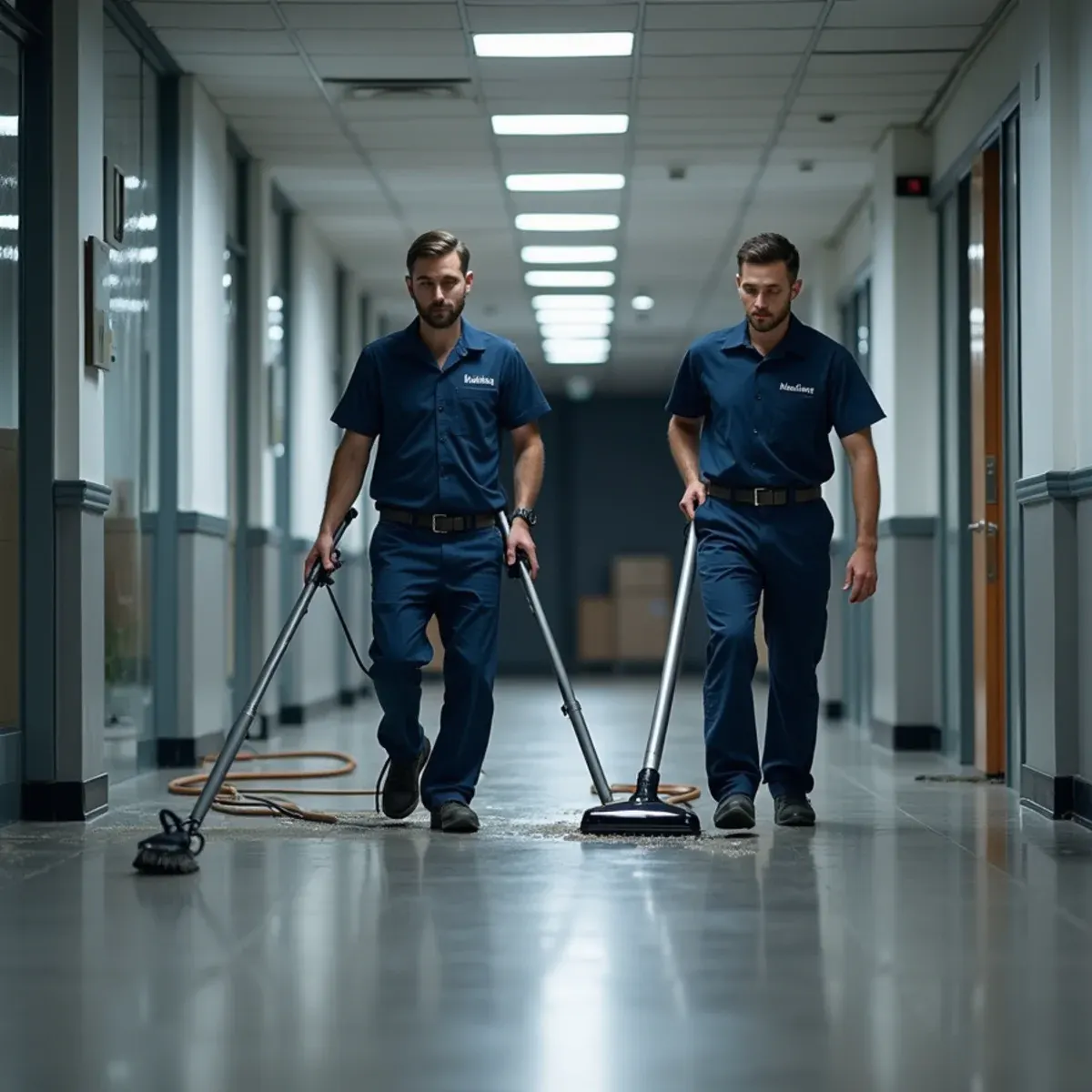
Access is the first thing we solve in downtown Huntington Beach. Main Street lots are narrow, most have no driveway and no rear loading, and street parking near Pacific City disappears by mid-morning. Truck-mounted extraction means long hose runs across a public sidewalk, which has to be planned before we arrive rather than improvised once we are there. We map staging on the way, and we favor early-morning and overnight mobilization so the extraction is finished before the block fills with people.
The second thing is the air. This is the most coastal-exposed city we serve, and sustained marine humidity means drying runs longer and needs more capacity than the same loss inland. Salt has already shortened the life of every exterior sealant, flashing and fastener on these buildings, so a meaningful share of commercial losses here are wind-driven rain finding a corroded window flashing rather than a plumbing failure. That changes the repair scope entirely, and it changes what your carrier will and will not cover.
What Huntington Beach Changes About Commercial Restoration
1Staging on narrow downtown lots
With no driveway and limited curb space, extraction and equipment placement have to be planned before the truck arrives. We scout access, run hose lines along protected paths, and where the street will not allow it we use portable extraction and stage from the alley. Getting this right is the difference between starting at 6 a.m. and starting after the lunch rush.
2Salt-driven envelope failures, not pipes
Within a mile of the water, exterior sealant and window flashing fail years earlier than inland guidance suggests. Many commercial losses here trace to wind-driven rain entering a corroded flashing during a storm. We find the entry point rather than just drying the wall, because otherwise the same wall is wet again with the next system, and the second claim gets harder to argue.
3Longer drying schedules on the coast
Sustained ocean humidity limits how much moisture the air can take on. We size dehumidification for the actual conditions and monitor ambient readings alongside material moisture, rather than assuming a standard three-day cycle. Telling a Main Street tenant five days honestly beats promising three and pulling equipment out of a building that has not reached its drying goal.
How the Work Runs
The method is the same one we use on every commercial restoration job, documented to the IICRC S500:2025 standard. Here it is in short — the full commercial water damage restoration process explains each stage in detail.
- Rapid assessment with a business continuity lens
- Coordinate with stakeholders
- After-hours mobilization
- Documentation at commercial standard
- Scaled drying and containment
- Phased reconstruction
The Huntington Beach Background Worth Knowing
Salt does not damage buildings directly. It damages the details that keep water out, and then water does the rest.
There is more on the housing stock, drainage and plumbing history of this city on our water damage restoration in Huntington Beach page.
Huntington Beach at a glance
- Dominant construction era
- 1960–1990
- Foundation type
- slab on grade
- Supply piping found here
- under-slab copper
- Drain line materials
- cast iron, ABS
- Terrain and water table
- coastal-flat, shallow water table
- Most common local failure
- wind-driven rain entering through salt-corroded window flashing and failed exterior sealant
- Highest-value local prevention
- renewing exterior caulking and flashing on a far shorter cycle than inland guidance suggests
What It Costs in Huntington Beach
We do not quote a number over the phone before seeing the property — anyone who does is guessing. The variables that actually move the price on a commercial restoration job are square footage and ceiling height, occupancy and access constraints, building systems involved, and they are broken down in full on the commercial water damage restoration page. The assessment and the written estimate are free anywhere in Huntington Beach, day or night, with no obligation.
Commercial Restoration Questions from Huntington Beach Homeowners
We plan it before we roll. For downtown Huntington Beach jobs we scout curb access and alley approaches, use portable extraction where a truck-mount hose run would block pedestrians, and mobilize early morning when Main Street is quiet. Equipment goes in through the front on protected floor covering, and condensate lines run to an approved drain rather than across the walk. If the city requires anything for sidewalk use, we handle that rather than leaving it to you.
Yes, and for most commercial clients that is the default. Night and weekend crews cost somewhat more in labor and almost always cost far less than the revenue lost by closing during business hours.
Regularly. Multi-family losses are documented unit by unit with separate files, moisture mapping, and drying logs, which is what allows multiple owners, an HOA, and several carriers to resolve their portions cleanly.
Ambient humidity near the coast stays high enough for long enough that materials dry slowly on their own, which widens the window in which growth can establish after any moisture event. Combined with salt-accelerated failures of exterior sealants and flashings, coastal homes simply get more moisture intrusion and dry from it more slowly.