
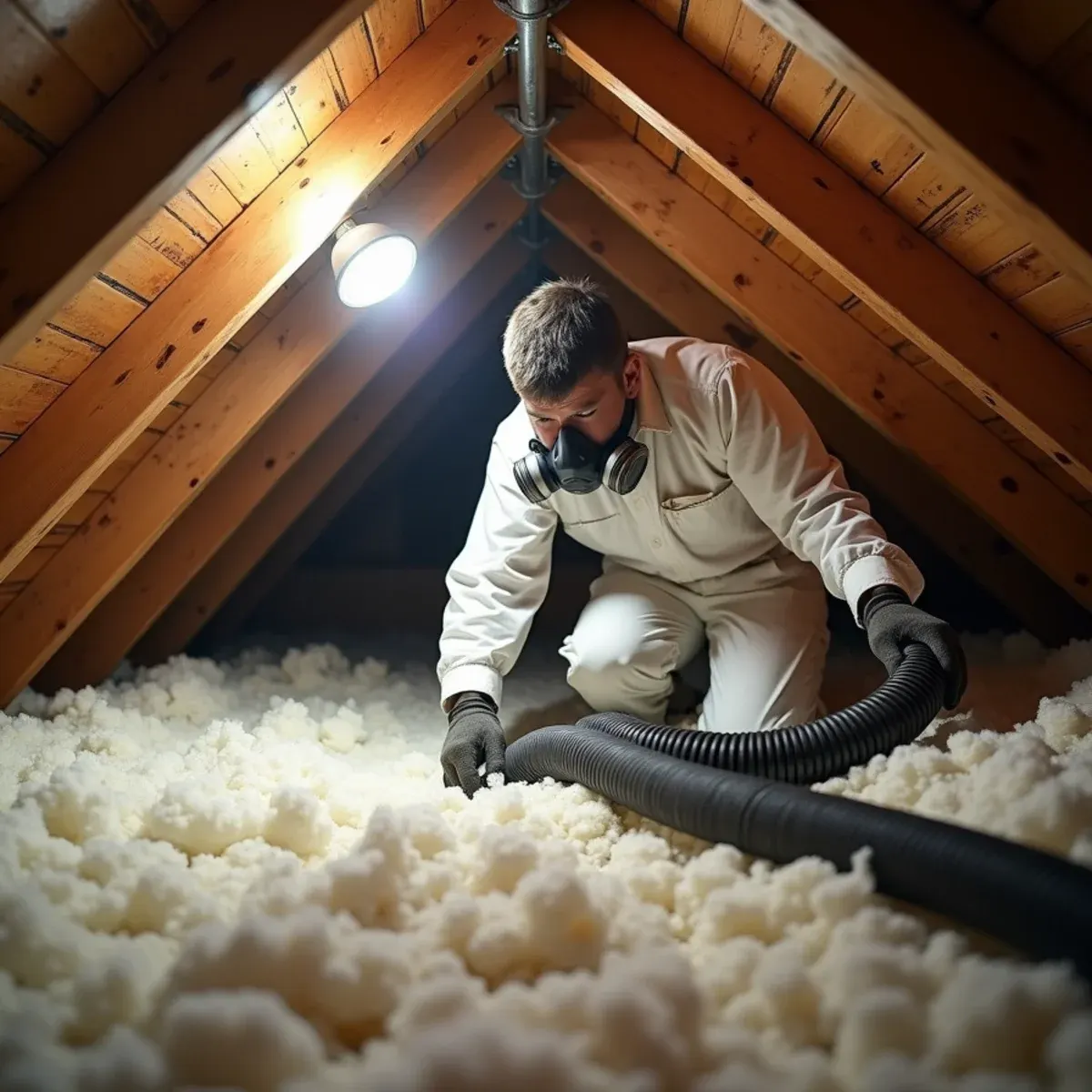
About 17,500 houses went up here in roughly three years, at a pace of up to a hundred a day. That kind of repetition means we usually know the attic before we see it: shallow pitch, tight at the eaves, a hatch in the hall or a bedroom closet, and a wet core where the kitchen, bath and laundry share plumbing walls. The insulation is almost never original, it is a later blow-in sitting on bare joists. Working it means belly-crawling, which is slow, and worth telling you before we quote hours.
The water source is often overhead pipe, not the roof. These houses were plumbed in galvanized steel, and where a run was carried up and over instead of under the slab, it has spent seventy years rusting from the inside at the threaded joints. A pinhole up there wets insulation for weeks before a ceiling shows anything. The other frequent culprit is retrofit air conditioning, a unit dropped onto a platform in an attic that was never sized for one, with a condensate pan you cannot easily see from the hatch.
What Lakewood Changes About Attic & Insulation
1The wet core tells us where to start
Kitchen, bath and laundry share plumbing walls in these plans, so the attic above that core is where a supply or vent failure shows first. We probe that section before anything else and often find the rest of the plane dry. Caught early, this stays a small job over a few hundred square feet instead of a whole-attic removal, which is a real difference on your claim.
2Low clearance changes how we dry
You cannot stand up in a Lakewood attic and you cannot get a dehumidifier through the hatch. Air movers work from the hatch and the gable ends, aimed down the joist bays, and drying takes longer than it would in a taller attic. Sometimes the honest fix is a temporary opening in the gable to move real air. We will show you the tradeoff before cutting anything.
3Putting depth back over shallow joists
Ceiling joists in these houses are shallow, so bringing insulation back to current R-value means material sitting well above the joist tops. Done carelessly, that buries junction boxes, blocks the last inch of eave and turns the hatch into a cold spot. Baffles and a dam at every can light and at the access panel go in before the hose does. It takes an extra hour.
How the Work Runs
The method is the same one we use on every attic & insulation job, documented to the IICRC S500:2025 standard. Here it is in short — the full attic water damage & insulation replacement process explains each stage in detail.
- Map the wet area before touching it
- Contain the hatch and protect the path
- Vacuum out the saturated insulation
- HEPA vacuum and treat the plane
- Dry the deck, joists, and top plates
- Reinstall insulation and check the details
The Lakewood Background Worth Knowing
Galvanized steel supply piping was standard when Lakewood was built, and it fails in a specific and predictable way. The zinc coating protecting the steel wears through from the inside, the steel corrodes, and scale builds up on the interior wall — narrowing the pipe over decades. As the diameter shrinks, water velocity and turbulence increase, which accelerates the erosion at elbows and fittings until a thin spot lets go.
There is more on the housing stock, drainage and plumbing history of this city on our water damage restoration in Lakewood page.
Lakewood at a glance
- Dominant construction era
- 1950–1953
- Foundation type
- slab on grade
- Supply piping found here
- original galvanized steel
- Drain line materials
- cast iron
- Terrain and water table
- flat, moderate water table
- Most common local failure
- seventy-year-old galvanized supply lines letting go at a scaled, eroded fitting
- Highest-value local prevention
- repiping while walls are already open for a repair, rather than as a separate project later
What It Costs in Lakewood
We do not quote a number over the phone before seeing the property — anyone who does is guessing. The variables that actually move the price on a attic & insulation job are how much of the attic got wet, clearance, access, and layout, the type of insulation up there, and they are broken down in full on the attic water damage & insulation replacement page. The assessment and the written estimate are free anywhere in Lakewood, day or night, with no obligation.
Attic & Insulation Questions from Lakewood Homeowners
We know where to look, which saves you hours. Same hatch location, same wet core, same shallow pitch, same generation of galvanized. What we do not know is which of those failed in your house, and guessing is how people pay to replace insulation while the leak keeps running. So we meter, we open the smallest access we can, and we show you the source before we quote the removal.
Only the affected area plus a margin back to dry, lofted material. If the wet section covers a small part of the attic, that is all that comes out. Once it reaches roughly half the plane, replacing the whole field usually costs less than blending old and new to an even depth, and it leaves you with one consistent R-value instead of a patchwork ceiling that performs unevenly room to room.
Most attics take a few days once the wet insulation is out, but we will not promise a number on day one, and you should be careful with anyone who does. Plywood sheathing dries at a different rate than old plank decking, a sealed attic dries faster than a heavily vented one, and marine-layer mornings slow everything down. The daily readings decide when equipment leaves, not the calendar.
Have it assessed. Seventy-year-old galvanized has exceeded any reasonable service life, and declining pressure or rust-colored water means it is well along. If a repair is already opening walls, that is the cheapest moment you will ever get to repipe — the demolition and patching are already in the scope.