
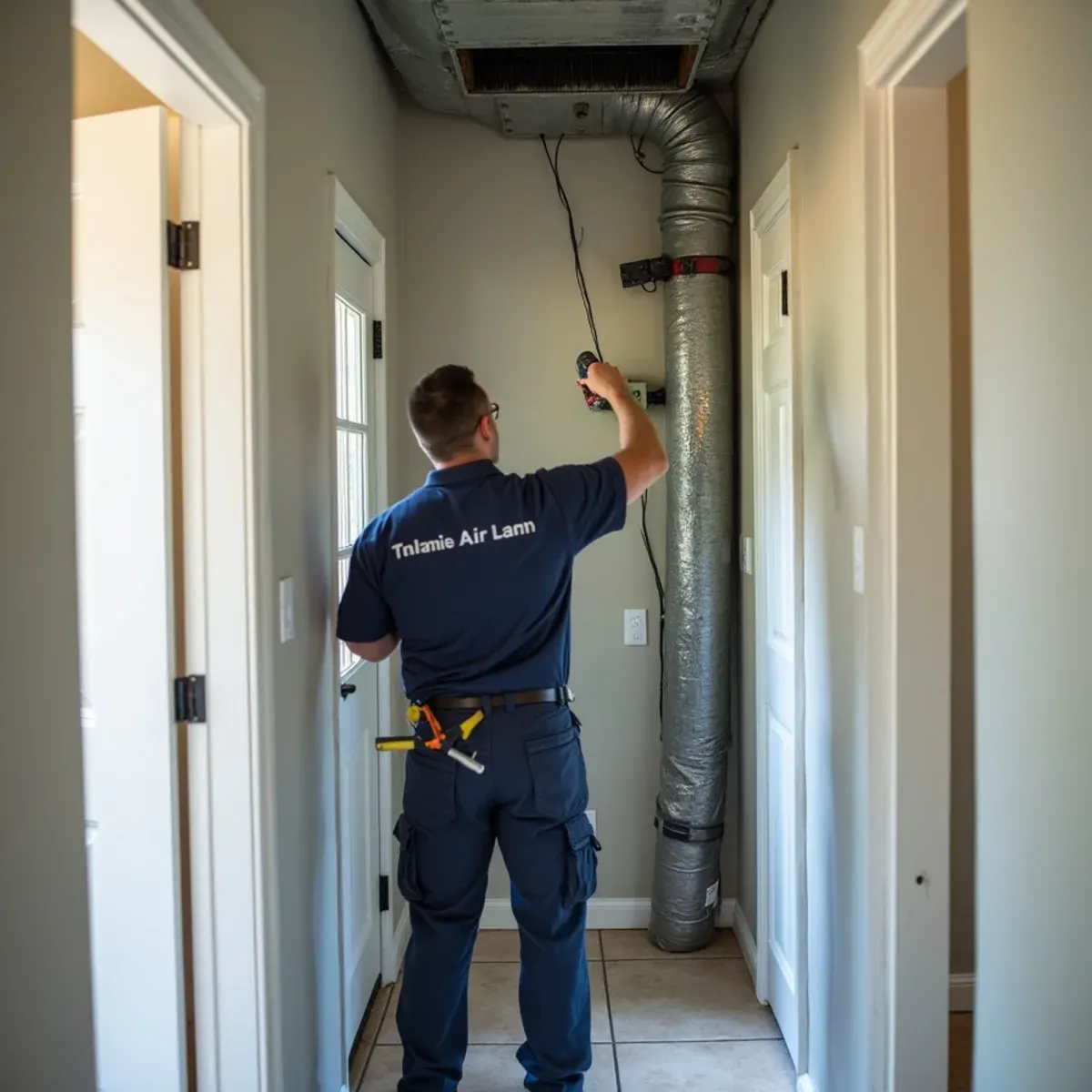
Fountain Valley sits dead flat on what was once called Gospel Swamp, and it has the shallowest water table in Orange County. That is not trivia, it is the reason duct work behaves differently here. Indoor humidity carries a higher baseline all year, cold supply duct in a summer attic sweats more than it does a few miles north, and anything that gets wet dries slower. A flex run that would recover in a day elsewhere can hold moisture in its jacket for a week in this city.
Homes are 1960 to 1980 tract on slab, with attic runs and the air handler either up in the attic or in a garage closet sitting on the floor. Slab vapor emission is a routine background condition here rather than an emergency, and it gets blamed for a lot of things it did not do, plus a few it did. Working out which is which before anyone opens a ceiling is most of the value we bring to a Fountain Valley call.
What Fountain Valley Changes About Air Ducts & HVAC
1Cold duct in a humid attic sweats
Condensation on supply duct is common here in summer and it looks exactly like a leak. Wet insulation under a boot, a stain on the ceiling at the register, dripping at a joint, all of it can come from air rather than plumbing. We check jacket condition, sealing at the collars and attic ventilation before assuming a pipe failed. Fixing the sweat is usually cheaper than what the homeowner was bracing for.
2Slab vapor rides the return air
Where flooring sits on a slab that is still emitting, the vapor does not stay under the floor. It reaches the room, and the return grille takes it straight into the system, which is why homeowners describe the smell as coming out of the vents. Cleaning the duct does not touch that at all. We test the slab first and say plainly when duct work is not the fix.
3Garage air handlers sit at floor level
With no fall anywhere in this city, yard and street water heads into garages during heavy rain. The furnace or air handler is sitting on that slab and the return plenum is at floor level. Six inches of water in a garage means a soaked return, a wet blower compartment and filter media that wicked everything up. It is a different scope from an attic loss and it is easy to overlook.
How the Work Runs
The method is the same one we use on every air ducts & hvac job, documented to the IICRC S500:2025 standard. Here it is in short — the full air duct cleaning & hvac restoration process explains each stage in detail.
- Inspect before we quote
- Contain and seal the system
- Clean or replace the ducting
- Clean the air handler and coil
- Replace filters and treat surfaces
- Seal, balance, and verify
The Fountain Valley Background Worth Knowing
Groundwater beneath Fountain Valley sits close enough to the surface that moisture vapor migration up through concrete slabs is a routine background condition rather than an anomaly. Homeowners here regularly describe a slab that feels cool and damp, or a closet on an exterior wall that never quite feels dry, without any leak at all.
There is more on the housing stock, drainage and plumbing history of this city on our water damage restoration in Fountain Valley page.
Fountain Valley at a glance
- Dominant construction era
- 1960–1980
- Foundation type
- slab on grade
- Supply piping found here
- under-slab copper
- Drain line materials
- cast iron
- Terrain and water table
- flat, shallow water table
- Most common local failure
- slab vapor emission mistaken for a leak, and flooring failures caused by installing over an untested slab
- Highest-value local prevention
- clearing the yard and area drains before the season, because a blocked drain on dead-flat ground ponds water against the house
What It Costs in Fountain Valley
We do not quote a number over the phone before seeing the property — anyone who does is guessing. The variables that actually move the price on a air ducts & hvac job are cleaning versus replacing flex duct, number of supply runs and returns, what kind of contamination it is, and they are broken down in full on the air duct cleaning & hvac restoration page. The assessment and the written estimate are free anywhere in Fountain Valley, day or night, with no obligation.
Air Ducts & HVAC Questions from Fountain Valley Homeowners
In this city it is often neither one on its own. High slab moisture raises indoor humidity, the system pulls that air across a cold coil, and duct jackets that never fully dry hold onto it. We measure the slab, check coil and drain pan condition, and look at duct sealing and attic ventilation before recommending anything. Sometimes the fix is sealing and drainage work, not cleaning, and we will tell you when cleaning would change nothing.
Fair question, and often it is an upsell. The honest answer depends on whether contamination actually reached the system. If the HVAC ran during the loss or the demolition, if water got into the attic where the ducting lives, or if the loss involved sewage or fire, the system is in scope. If none of that happened, it probably is not. We run a camera and show you before you decide anything.
It depends on where the moisture is. If the inner liner got damp and the fiberglass behind it stayed dry, cleaning and drying the run works. If water got through a torn jacket into the insulation, that fiberglass is porous, it holds moisture and growth, and there is no reliable way to clean it or verify it is clean. Those runs get replaced. We show you which is which rather than guessing on your behalf.
The city sits on former wetland with one of the shallowest water tables in Orange County, so moisture vapor migrating up through slabs is a normal background condition here rather than a defect. It matters most when installing flooring over the slab, which is why we test with in-situ RH probes before anything goes back down.