
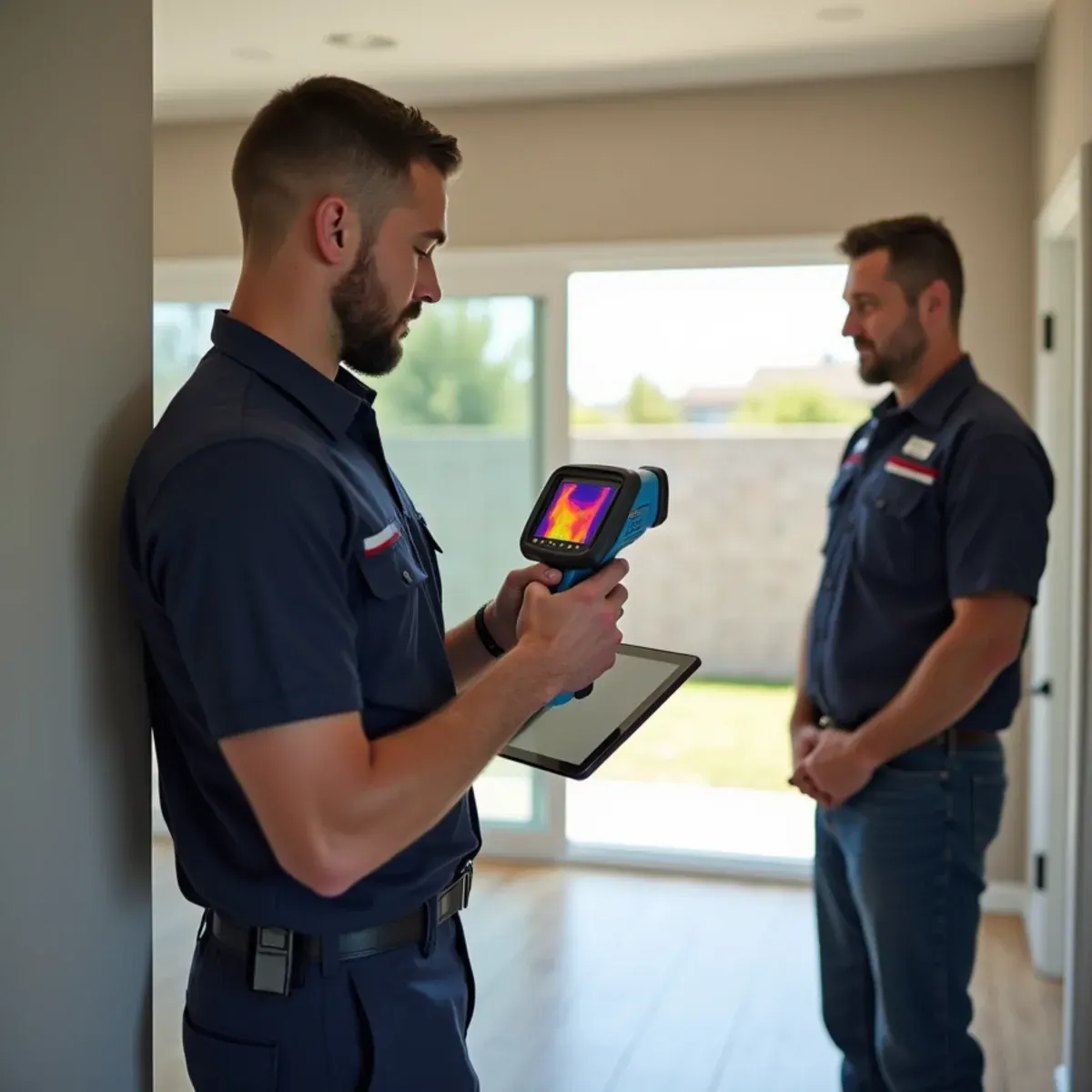
The most valuable thing we do in Fountain Valley some days is talk a homeowner out of filing. The city was built between 1960 and 1980 on dead-flat former wetland known as Gospel Swamp, and it carries the shallowest water table in Orange County. Slab vapor emission is a background condition here, not an event. Damp concrete under a floor that is lifting looks exactly like a leak, and frequently is not one. Reporting before that is settled puts a claim on your record for a condition no policy covers.
So the sequence matters. We test the slab, take a control reading somewhere dry, run a meter test at the main with irrigation off, and only then decide whether there is a sudden discharge worth documenting. If there is, the file gets built properly and we bill your carrier direct. If there is not, you have spent nothing and kept a clean claim history, which in the current California market is worth more than most people expect. Around Mile Square Park and the Talbert corridor we have called it both ways in the same week.
What Fountain Valley Changes About Insurance Claim Help
1Test the slab before you file
A relative humidity probe in the slab and a control reading from an unaffected room take under an hour and answer the only question that matters first: is this water arriving today, or moisture that has always been there. We do that at no charge and with no claim open. Once a claim is reported it exists whether it pays or not, so the order of operations is worth getting right.
2Groundwater is not a covered peril
With the water table this shallow, moisture can move up through a slab or in at a cold joint after heavy rain without a single pipe failing. That is generally excluded on a homeowners policy, and no amount of documentation changes it. We tell you that on the first visit rather than after a denial, and we scope the fix as a repair you decide on rather than a claim you chase.
3Dead flat ground drains slowly
Fountain Valley has almost no fall to it, so yard water sits after a storm and finds thresholds, garage slabs and side doors. Where that water entered decides which side of the policy it lands on. We document the entry point and elevation while the ground is still wet, because a week later the evidence is a dry stain and a homeowner's recollection.
How the Work Runs
The method is the same one we use on every insurance claim help job, documented to the IICRC S500:2025 standard. Here it is in short — the full water damage insurance claim assistance process explains each stage in detail.
- Photograph before anything moves
- Map moisture and set the category
- Open the file with the right facts
- Write the scope in their platform
- Daily drying logs and supplements
- Completion documents that release depreciation
The Fountain Valley Background Worth Knowing
Groundwater beneath Fountain Valley sits close enough to the surface that moisture vapor migration up through concrete slabs is a routine background condition rather than an anomaly. Homeowners here regularly describe a slab that feels cool and damp, or a closet on an exterior wall that never quite feels dry, without any leak at all.
There is more on the housing stock, drainage and plumbing history of this city on our water damage restoration in Fountain Valley page.
Fountain Valley at a glance
- Dominant construction era
- 1960–1980
- Foundation type
- slab on grade
- Supply piping found here
- under-slab copper
- Drain line materials
- cast iron
- Terrain and water table
- flat, shallow water table
- Most common local failure
- slab vapor emission mistaken for a leak, and flooring failures caused by installing over an untested slab
- Highest-value local prevention
- clearing the yard and area drains before the season, because a blocked drain on dead-flat ground ponds water against the house
What It Costs in Fountain Valley
We do not quote a number over the phone before seeing the property — anyone who does is guessing. The variables that actually move the price on a insurance claim help job are how quickly the loss was documented, category and class of water, whether the materials still match, and they are broken down in full on the water damage insurance claim assistance page. The assessment and the written estimate are free anywhere in Fountain Valley, day or night, with no obligation.
Insurance Claim Help Questions from Fountain Valley Homeowners
Not yet. In this city that pattern is as likely to be slab vapor emission as a leak, and vapor is not a covered peril anywhere. Have the slab tested and a meter test run at the main first. If there is a sudden discharge, we document it and file properly. If there is not, you have avoided putting a claim on your record for something no carrier would pay, which matters at renewal in California right now.
No, and the distinction matters. A public adjuster is licensed to represent you in negotiating your settlement and charges a percentage of it. We are a restoration contractor. We document the loss, write and defend the scope of the physical work, and bill your carrier directly for it. If your claim turns into a genuine coverage dispute rather than a scope disagreement, that is the point to consider a public adjuster or an attorney, and we will say so.
Sometimes no. If the total loss is close to or below your deductible, filing puts a claim on your record without producing a payment worth having, and claim history affects renewal in California's current market. Get a written estimate first and compare it to your deductible before you call your carrier. We will give you that number without a claim being open. Any company that pushes you to file before you have seen an estimate has told you something.
The city sits on former wetland with one of the shallowest water tables in Orange County, so moisture vapor migrating up through slabs is a normal background condition here rather than a defect. It matters most when installing flooring over the slab, which is why we test with in-situ RH probes before anything goes back down.