
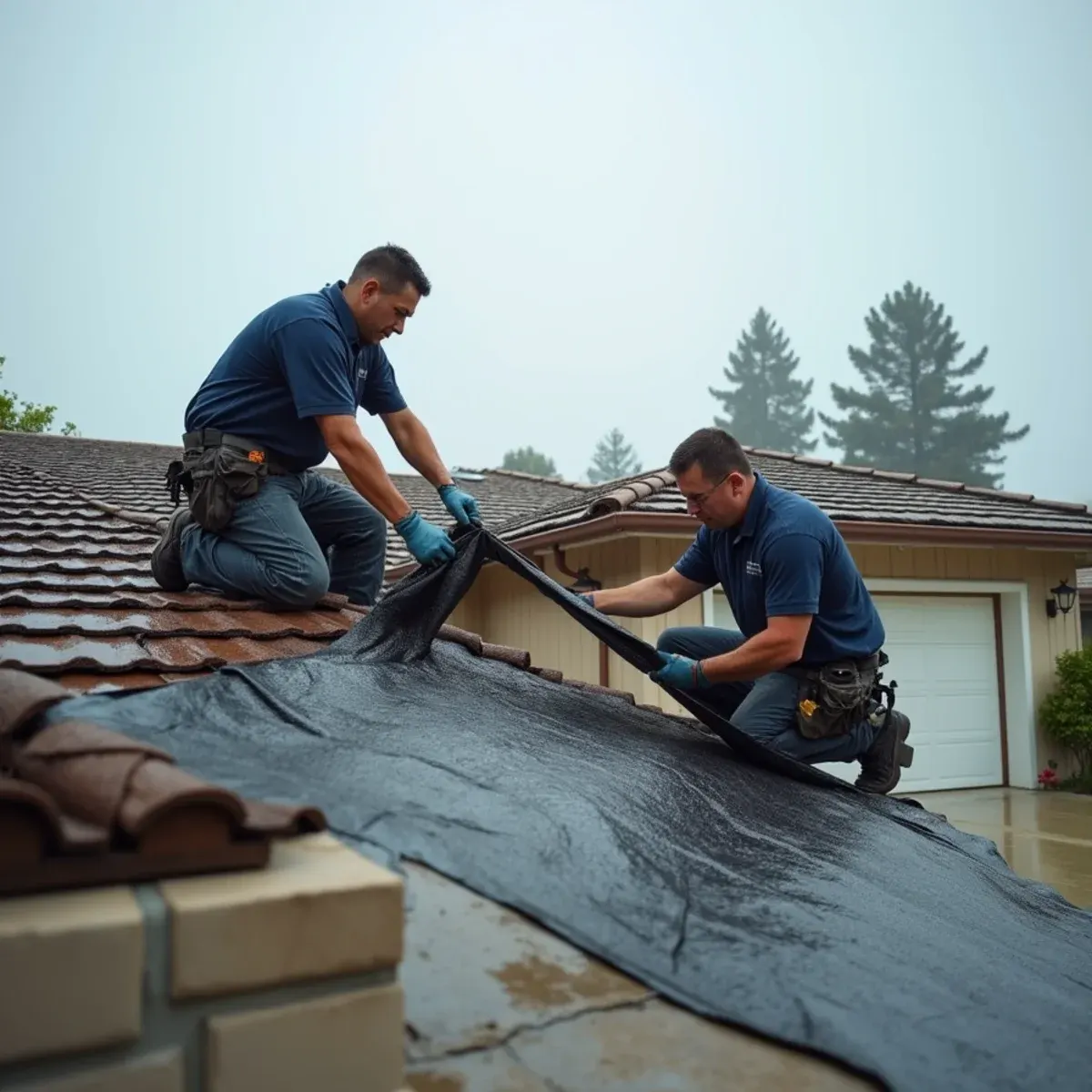
There's a piece of information available in Rossmoor that isn't available almost anywhere else: if your neighbor's roof failed in the last storm, yours is on the same clock. Ross Cortese built roughly 3,500 single-story ranch homes here in about four years, to a handful of floor plans, with the same low-pitch roof geometry and the same eave and valley details. Age, exposure and design are shared. When we work one street in The Ranchos, we often end up on two or three houses within the week.
Those low-slope roofs and wide overhangs are the reason. A shallow pitch gives wind-driven rain time to push back under the courses, and the original oak strip flooring that survives under carpet in many of these houses is unforgiving once it gets wet — it cups fast and it doesn't come back if you wait. Near Rush Park and along Montecito Road we've pulled carpet on a storm call and found floor worth saving underneath. Getting air to it on the first day decides that.
What Rossmoor Changes About Storm Damage
1Original oak hiding under the carpet
A lot of these houses still have 1950s oak strip flooring under later carpet and pad. Wet pad holds water against the wood and cups the boards within a day or two. If we can lift carpet and pad early and dry the flooring from above and below, it usually survives and refinishes. Left under saturated padding across a weekend, it rarely does.
2Low-pitch roofs and driven rain
The shallow ranch roof that defines this neighborhood sheds fine in ordinary rain and struggles when the wind turns sideways. Water backs up under the courses at valleys and at the wide eaves, wets the sheathing, and drips into the attic well inside the exterior wall. We tarp above the entry point rather than above the stain, which on this roof geometry can be several feet apart.
3One failure, several neighbors
When we get a Rossmoor call we ask what the houses either side look like, because the answer is usually relevant. Identical build year, identical roof design, identical exposure. If your plan matches a house that just failed at a valley or a vent, that's your inspection list. It's the cheapest storm prevention available in this tract and almost nobody uses it.
How the Work Runs
The method is the same one we use on every storm damage job, documented to the IICRC S500:2025 standard. Here it is in short — the full storm damage restoration process explains each stage in detail.
- Emergency tarping and board-up
- Water diversion and extraction
- Full damage documentation
- Interior mitigation
- Structural drying to standard
- Permanent repairs
The Rossmoor Background Worth Knowing
Plumbing failure is largely a function of time, water chemistry, and installation method — and in Rossmoor all three are effectively identical from house to house. That is why leak calls here tend to arrive in clusters, and why a neighbor's slab leak is genuinely relevant information about your own home.
There is more on the housing stock, drainage and plumbing history of this city on our water damage restoration in Rossmoor page.
Rossmoor at a glance
- Dominant construction era
- 1957–1961
- Foundation type
- slab on grade
- Supply piping found here
- under-slab copper, some galvanized
- Drain line materials
- cast iron
- Terrain and water table
- flat, moderate water table
- Most common local failure
- clustered slab leaks, where one failure on a street reliably predicts the neighbors
- Highest-value local prevention
- treating a neighbor's slab leak as information about your own house and running the meter test
What It Costs in Rossmoor
We do not quote a number over the phone before seeing the property — anyone who does is guessing. The variables that actually move the price on a storm damage job are size of the opening and duration of intrusion, emergency mitigation scope, how many rooms the water reached, and they are broken down in full on the storm damage restoration page. The assessment and the written estimate are free anywhere in Rossmoor, day or night, with no obligation.
Storm Damage Questions from Rossmoor Homeowners
Nothing's wrong beyond age and sameness. These homes went up in the same short window with the same roof design, so they reach the end of a covering or a flashing detail at roughly the same time, and one storm finds all of them. It's a cohort, not a defect. The practical response is to treat a neighbor's failure as a free inspection report and check the same detail on your own roof before the next system arrives.
During. Emergency tarping and board-up happen in the rain — that is the entire point of them. We triage by severity, so active intrusion into occupied living space goes to the front of the queue.
Sudden wind and rain damage is generally covered, including the resulting interior water damage. What gets excluded is damage from a roof that had already failed or from deferred maintenance, and flooding from water that came across the ground, which needs separate flood insurance.
Because they were all built between 1957 and 1961 with the same materials and methods. Copper routed through a slab fails from internal erosion and external soil corrosion on a fairly predictable timeline, and when an entire community shares one construction date, it shares one failure window too.