
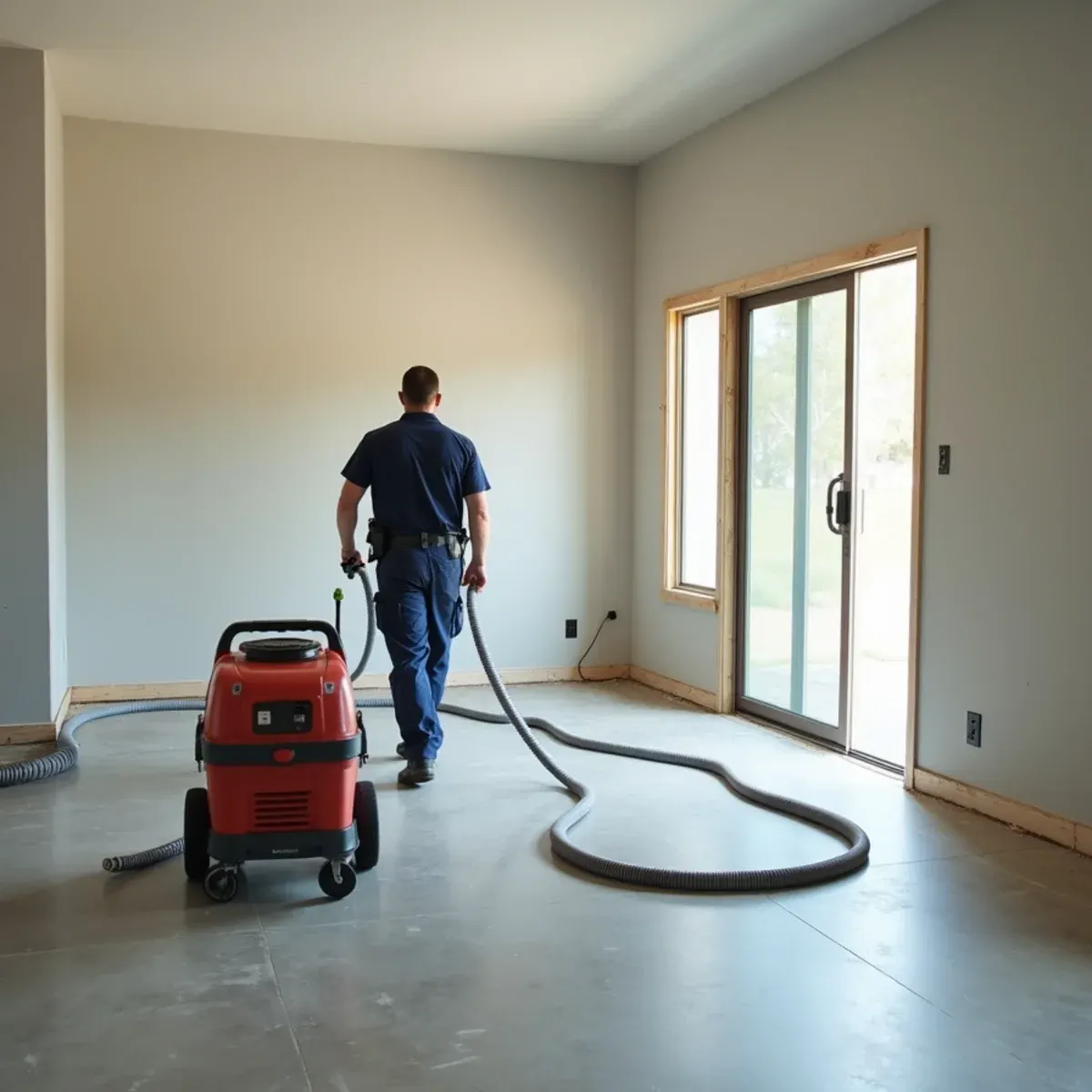
A manufactured home hides water in a place a stick-built house does not have. Underneath the floor, a plastic belly wrap holds insulation up against the joists, and a supply leak drips into that pocket and stays there, sometimes for months, with nothing showing on the floor above. Carson carries an unusually large mobile home park population alongside its postwar tract, so this is routine work here rather than an oddity. The odor rises through floor penetrations and around the perimeter, and no air treatment inside the home reaches insulation sealed under a membrane.
The rest of the city is conventional 1950s to 1975 slab, built on former ranch, oil-field and industrial land, incorporated in 1968, with refinery and logistics operations immediately adjacent and a shallow water table underneath. Those houses fail in ordinary ways and get the ordinary treatment. The manufactured homes need something else entirely: cutting and dropping the belly board across the wet section, pulling saturated batt insulation, drying the joists and the underside of the decking, then installing new wrap. Most of that work happens under the home, not inside it.
What Carson Changes About Odor Removal
1Belly wrap holds water against the floor
The membrane under a manufactured home is meant to keep insulation up and rodents out, and it does the same job on water. A leak fills the pocket, the batts stay saturated, and the decking above wicks from them. Deodorizing the living space while that sits underneath accomplishes nothing. The belly has to be opened across the wet section, cleared, dried and closed back up.
2Small interior volume, real ozone risk
A single-wide has a fraction of the air volume of a tract house and far more rubber, vinyl and adhesive per square foot. An aggressive ozone cycle in that space can degrade seals, window gaskets and finishes while residue under the floor keeps producing odor anyway. Hydroxyl running longer, with the belly opened up first, is the approach that actually holds.
3Shallow water table under the tract stock
Groundwater sits close to the surface across much of Carson, keeping soil moisture high at slab edges and under pier-set homes. It slows drying at the perimeter, and it means a missing or torn ground vapor barrier under a manufactured home matters more here than it would inland. We check the ground cover as part of any odor call on a park space.
How the Work Runs
The method is the same one we use on every odor removal job, documented to the IICRC S500:2025 standard. Here it is in short — the full odor removal & deodorization process explains each stage in detail.
- Locate the residue
- Remove what holds it
- Clean the surfaces that stay
- Filter the air while we work
- Seal only what cannot be cleaned
- Treat the air, then verify
The Carson Background Worth Knowing
Manufactured homes are built with the floor deck, usually particleboard or OSB, sitting on a steel frame, with batt insulation below it and a vapor barrier belly wrap stapled underneath to hold everything in place. Supply lines run through that cavity. When one leaks, the water does not run out onto the ground where you would see it. The belly wrap catches and holds it, the insulation soaks it up, and you now have a sealed reservoir under your floor with no path to evaporate. It can sit there for months before anything shows upstairs.
There is more on the housing stock, drainage and plumbing history of this city on our water damage restoration in Carson page.
Carson at a glance
- Dominant construction era
- 1950–1975
- Foundation type
- slab on grade
- Supply piping found here
- galvanized steel, under-slab copper, manufactured-home supply lines
- Drain line materials
- cast iron
- Terrain and water table
- flat, shallow water table
- Most common local failure
- manufactured-home underfloor leaks trapped in the belly wrap, alongside conventional 1960s slab failures
- Highest-value local prevention
- treating any soft spot in a manufactured-home floor as moisture until a meter proves otherwise
What It Costs in Carson
We do not quote a number over the phone before seeing the property — anyone who does is guessing. The variables that actually move the price on a odor removal job are how much material comes out, where the residue ended up, the type of odor involved, and they are broken down in full on the odor removal & deodorization page. The assessment and the written estimate are free anywhere in Carson, day or night, with no obligation.
Odor Removal Questions from Carson Homeowners
Almost certainly saturated insulation trapped in the belly wrap, with the soft spot being decking that has been wicking from it. The membrane keeps that water against the underside of the floor, so it can sit for months without showing on top. The repair means opening the belly board along the wet run, pulling the wet batts, drying the joists and decking, then installing new insulation and wrap. Treating the air inside will not touch it.
It may mask it for a few weeks. Rental units are usually undersized for a whole structure, and they treat air rather than the material producing the odor. They also should not run with anyone home, and long heavy cycles can degrade rubber seals, leather, and paint sheen. If the residue sits in a wall cavity or under the flooring, no amount of ozone reaches it.
Because residue was left somewhere. That is the answer nearly every time. The usual spots are attic insulation, the inside of flex duct, the wall cavity behind drywall that was replaced but never cleaned, the subfloor under new flooring, and the back of a cabinet run. Drying a structure to standard does not remove residue, so a job dried correctly can still smell if cleaning stopped at visible surfaces.
By locating it rather than arguing about it. The dividing line is the connection point where the park's service meets your home. Upstream of that is the park's responsibility, downstream is yours. We open the belly wrap where water is pooling, trace the wet path back to its source, and photograph what we find with the connection in frame. That documentation settles the question. Guessing from where the wet spot showed up inside is unreliable, because water travels along the frame first.