
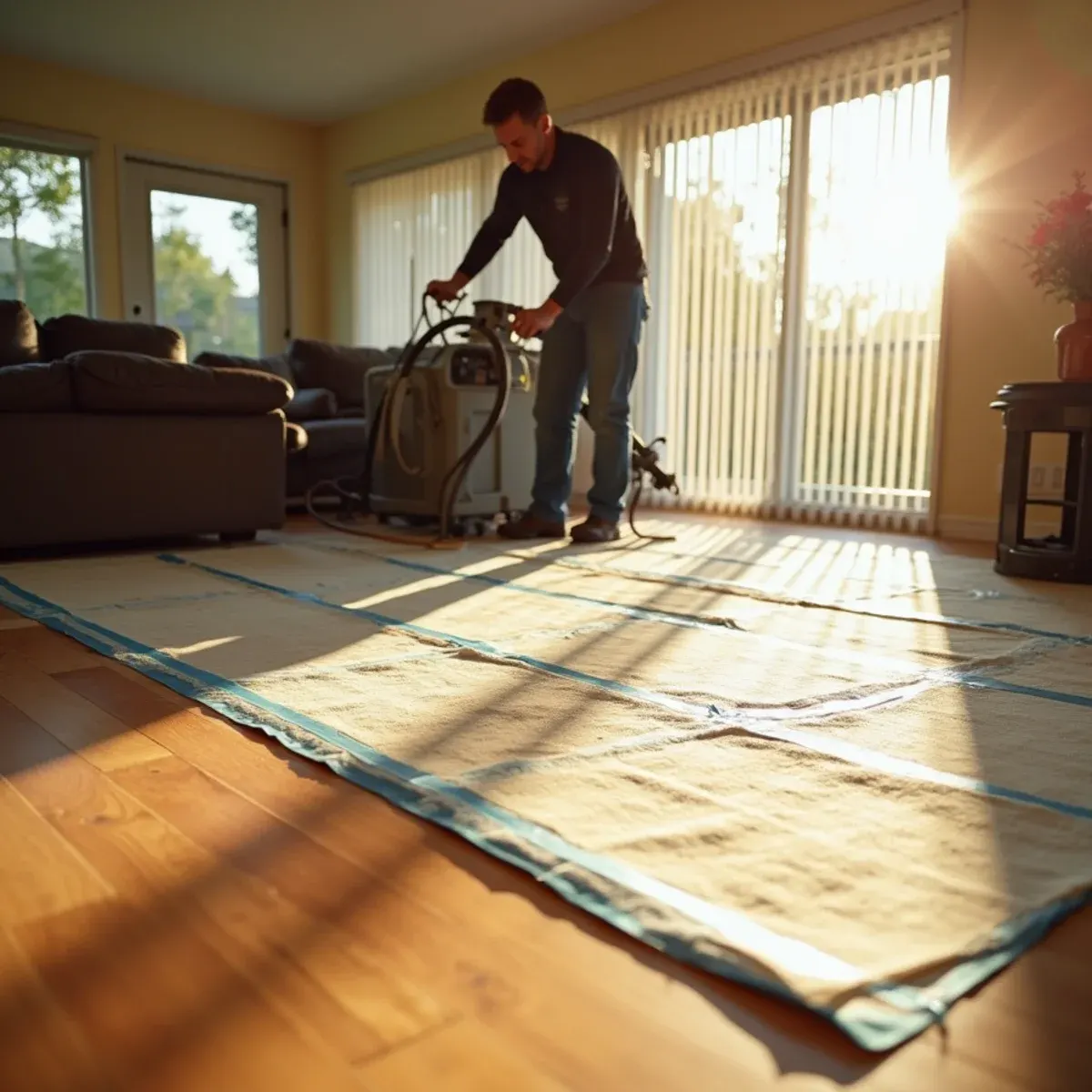
Most of the hardwood we dry in Yorba Linda got wet from outside. A blocked terrace drain above a Bryant Ranch pad, a slope inlet packed with eucalyptus litter, water finding a garage slab or a great-room slider threshold — that's the pattern here far more often than a burst supply line. It matters for your floor because outside water isn't clean. Under IICRC S500:2025, storm and slope runoff generally starts as Category 3, and category changes what can be dried in place versus what has to come out.
The other Yorba Linda factor is scale. These are newer, larger homes with open plans and long uninterrupted runs of wide-plank flooring, often the same continuous floor from the entry through the kitchen. Water that enters at one threshold in East Lake Village can travel thirty feet under the plank before anyone sees a cupped board. We map the whole floor with a moisture meter and thermal imaging before placing a single mat, because the wet edge is almost never where the puddle was.
What Yorba Linda Changes About Hardwood Floor Drying
1Slope runoff is usually Category 3
Water off a hillside carries soil, decomposed granite, fertilizer and whatever sat in the drain. Under IICRC S500:2025 that's generally Category 3, and category drives the decision as much as moisture does. A solid floor wet with clean supply water can often be dried in place. The same floor wet with slope runoff may have to come up at the perimeter so we can clean what's underneath it.
2Terrace drains decide your floor's fate
Nearly every hillside pad in Bryant Ranch, Travis Ranch and Vista del Verde relies on terrace drains, v-ditches and area inlets to move water past the house. One inlet packed with eucalyptus litter turns an engineered slope into a chute aimed at your slider. Clearing them before the season costs an afternoon and prevents the loss we're called for most often in this city.
3Wide-plank floors hide the wet edge
These are larger homes with continuous flooring running from the entry through the kitchen and great room. Water travels under the plank well past where the surface looks wet. We map with a meter and thermal imaging across the entire floor plane before setting equipment, because placing mats on the visible damage and missing the leading edge is how floors fail weeks after the crew leaves.
How the Work Runs
The method is the same one we use on every hardwood floor drying job, documented to the IICRC S500:2025 standard. Here it is in short — the full hardwood floor water damage drying process explains each stage in detail.
- Measure before deciding anything
- Extract from below the surface
- Control the drying rate deliberately
- Dry the subfloor and any cavity below
- Let it acclimate before judging it
- Sand and refinish only if needed
The Yorba Linda Background Worth Knowing
A hillside lot in Yorba Linda is a drainage system with a house attached. Terrace drains cut across the face of the slope to intercept water before it gains speed. Brow ditches run along the top to keep runoff from ever reaching the slope face. Down-drains carry the collected water to the street or a storm connection. Retaining walls have weep holes and, behind them, a gravel subdrain that relieves pressure on the wall. Every one of those was engineered as part of the pad. Every one of them silts up, roots over, or gets buried by landscaping.
There is more on the housing stock, drainage and plumbing history of this city on our water damage restoration in Yorba Linda page.
Yorba Linda at a glance
- Dominant construction era
- 1970–2005
- Foundation type
- slab on grade
- Supply piping found here
- under-slab copper, later PEX and CPVC
- Drain line materials
- ABS, cast iron
- Terrain and water table
- hillside-mixed, deep water table
- Most common local failure
- exterior water from failed slope drainage, terrace drains and retaining-wall systems rather than from plumbing
- Highest-value local prevention
- clearing terrace and slope drains before the season, since a blocked one turns an engineered hillside into a funnel
What It Costs in Yorba Linda
We do not quote a number over the phone before seeing the property — anyone who does is guessing. The variables that actually move the price on a hardwood floor drying job are square footage under the mat system, solid versus engineered wood, what is underneath, and they are broken down in full on the hardwood floor water damage drying page. The assessment and the written estimate are free anywhere in Yorba Linda, day or night, with no obligation.
Hardwood Floor Drying Questions from Yorba Linda Homeowners
It depends on what came in with the water. Clean water on solid wood, caught fast, is a good dry-in-place candidate. Hillside runoff brings silt and organics under the boards, and no amount of airflow cleans a contaminated cavity. We usually remove a band of flooring along the entry path, clean and dry the substrate, then dry the balance in place with mats. Losing two feet of plank beats replacing eight hundred square feet.
Frequently, yes. Cupping is caused by uneven moisture between the top and bottom of each board, and when the moisture equalizes during controlled drying, much of the deformation reverses. Full flattening can take two to four weeks of acclimation after the equipment comes out, which is why we do not recommend sanding immediately.
Five to ten days under the mat system is typical, which is longer than drywall because wood gives up moisture slowly and has to be dried at a controlled rate. Rushing it causes splitting and permanent gapping, so the extra days are doing real work.
Seeping from the weep holes is usually the wall doing its job, relieving water pressure from the soil behind it. The concerning version is the opposite: weep holes that stay dry through a storm while the ground above stays soggy, which suggests the subdrain behind the wall is plugged and pressure is building. Also watch for new cracking, bulging, or a wall that has tipped slightly. Those are engineering questions rather than restoration ones, and we will say so.