
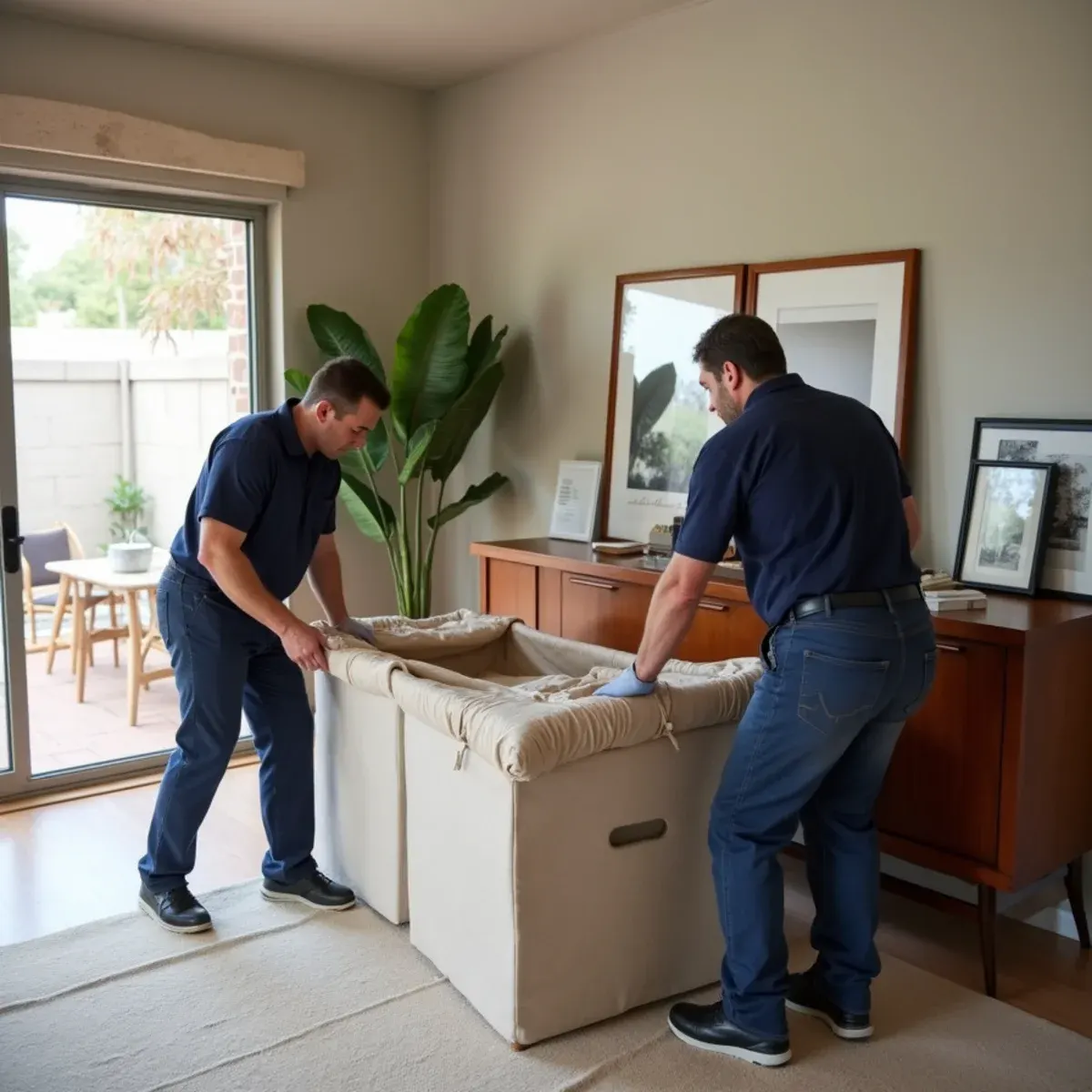
The hard part of a Whittier pack-out is often the first thirty feet. Uptown, around Greenleaf Avenue and Philadelphia Street, holds late-Victorian houses with bay windows, Craftsman with deep porches and 1920s Spanish Revival with clay tile roofs. Original doorways, tight turns at the stair, porch steps never meant to carry a loaded dolly. College Hills, subdivided in 1923 as the city's first planned hillside tract, has curving streets and grades steep enough that a full-size truck cannot always park within reach of the house. Both need planning before anything gets boxed.
What sits inside those Uptown houses matches their age. Raised foundations mean a supply leak often drains into the crawl space, so belongings above come out musty rather than dripping and the closets against exterior walls go first. These are also houses that have held families a long time, which means real archives: photographs, letters, sheet music, church and school records. East Whittier is conventional postwar slab tract and behaves nothing like that, with fast floor-level wetting, garages full of stored boxes, and contents losses that stay low to the ground.
What Whittier Changes About Contents & Pack-Out
1Original doorways set the pack-out method
Large case goods in Uptown houses frequently came in before a later remodel narrowed the path back out. Where a piece will not clear, we photograph it in place, document the disassembly step by step, and reassemble at return rather than forcing it through and splitting a rail. Jambs, newel posts and stair treads get padded, because the woodwork is part of what makes these houses what they are.
2Hillside streets limit the vehicle
On College Hills and up toward Turnbull Canyon, grade and curb geometry decide which truck comes. We shuttle with smaller vehicles where the approach requires it and carry in shorter runs, which is slower per load and safer for both the crew and your belongings. A wet storm day on those streets can close the window entirely, and we will reschedule rather than take a loaded truck down a slick slope.
3Paper archives in long-held houses
Homes that have not changed hands in fifty years hold paper nobody has audited: deeds, letters, photograph albums, records from Whittier College years. Once wet, that material has hours before ink runs and pages block together. It gets pulled ahead of furniture and frozen the same day, then dried and sorted later, when decisions about what actually matters can be made calmly.
How the Work Runs
The method is the same one we use on every contents & pack-out job, documented to the IICRC S500:2025 standard. Here it is in short — the full contents restoration & pack-out process explains each stage in detail.
- Room-by-room photographic inventory
- Triage into three categories
- Careful packing and transport
- Cleaning and restoration by material type
- Climate-controlled storage
- Delivery and placement back
The Whittier Background Worth Knowing
A leak under a raised foundation does not announce itself the way a slab leak does. There is no puddle on the floor and no warm spot underfoot, because the water drips down into the soil and stays there. What you get instead is a smell that is stronger in the morning, a board that feels slightly soft, and eventually a floor that has been quietly feeding fungal growth for months. By the time an Uptown homeowner calls us about a crawl space leak, the question is rarely how to dry it. It is how much of the joist and subfloor is still doing its job.
There is more on the housing stock, drainage and plumbing history of this city on our water damage restoration in Whittier page.
Whittier at a glance
- Dominant construction era
- 1890–1980
- Foundation type
- mixed on grade
- Supply piping found here
- original turn-of-century piping, galvanized steel, under-slab copper
- Drain line materials
- cast iron, clay
- Terrain and water table
- hillside-mixed, moderate water table
- Most common local failure
- raised-foundation crawl-space leaks in Uptown, and slope drainage failures in the hillside tracts
- Highest-value local prevention
- an annual crawl-space or slope-drain check, depending which Whittier you live in
What It Costs in Whittier
We do not quote a number over the phone before seeing the property — anyone who does is guessing. The variables that actually move the price on a contents & pack-out job are volume of contents, proportion of specialty items, storage duration, and they are broken down in full on the contents restoration & pack-out page. The assessment and the written estimate are free anywhere in Whittier, day or night, with no obligation.
Contents & Pack-Out Questions from Whittier Homeowners
Yes, and start with the closets. Crawl-space moisture rises into the least-ventilated parts of the house first, and a closet on an exterior wall is exactly that. Clothing, linens, shoes, stored paper and anything in cardboard hold odor and support growth long before the floor reads wet on a meter. We inventory and remove those categories for cleaning under controlled humidity, and we check the crawl space itself, since that is where the problem actually lives.
It depends on the scope. For a contained single-room loss we often move contents to an unaffected part of the home and block furniture in place. When the drying chamber covers most of the living area or reconstruction is extensive, off-site pack-out is usually both safer and faster.
Every item is photographed and barcoded at your home and tracked through cleaning, storage, and delivery. You receive the inventory, and at delivery we reconcile it with you item by item before we leave.
It cuts both ways. A crawl space leak hides longer, because the water drips into soil instead of pooling on your floor, so it often runs for months and reaches the framing before anyone notices. The upside is real though: the plumbing is accessible, so locating and repairing it does not mean breaking concrete. On balance, detection is your weak point in Uptown, which is why an annual look under the house is worth doing.