
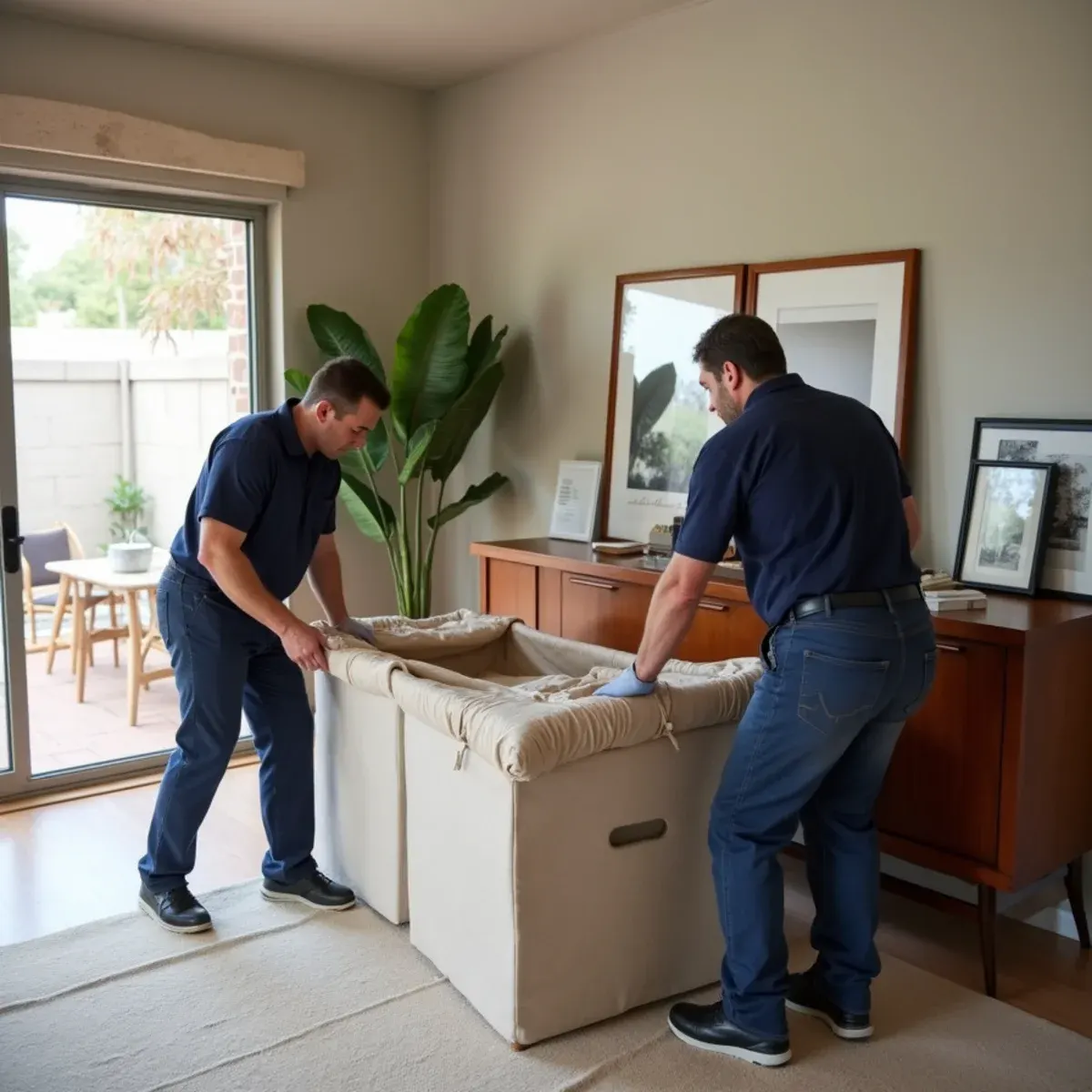
Seventeen and a half thousand houses went up in Lakewood between 1950 and 1953, at up to a hundred a day, off a handful of plans. That means kitchen, bathroom and laundry share plumbing walls in nearly every one of them — a single wet core. When the original galvanized supply lets go at a scaled, eroded fitting, it does not hit one room. It hits the three rooms holding the dishes, the linens, the cleaning chemicals, the medicine cabinet and whatever is stacked on the service porch.
These houses are small and the families in them are often second or third generation at the same address, which compresses seventy years of accumulation into eleven hundred square feet plus a detached garage. There is no attic worth using and no basement. Everything overflows to the garage off the alley, sitting on its own slab. When a wet-core failure migrates that way, the garage is where the irreplaceable boxes are — and it is the last place anyone thinks to check.
What Lakewood Changes About Contents & Pack-Out
1One wet core, three rooms of contents
Kitchen, bath and laundry share walls in the Lakewood plans, so a single supply failure puts three rooms of contents in play at once. Those rooms hold the highest density of small items in the house — cabinets, drawers, medicine, cleaning products. We box by cabinet and by drawer rather than by room, so what comes back goes back where it actually lived.
2Detached garages hold the family archive
Lakewood garages sit off the alley on their own slab, and in a house this size they hold the boxes: photographs, service records, kids' artwork, tax paperwork. Cardboard on concrete wicks even without a loss. If water reaches there, paper and photographs go into the freezer within hours to stop mold and to keep photo emulsions from fusing to each other.
3Repipe timing changes the storage plan
Since the whole city's galvanized is on the same clock, many owners choose to repipe while walls are already open for the repair. That is usually the right call and it extends the job, which means contents stay in storage longer. We say so at the start, so the storage duration is in the claim from the beginning instead of arriving as a surprise.
How the Work Runs
The method is the same one we use on every contents & pack-out job, documented to the IICRC S500:2025 standard. Here it is in short — the full contents restoration & pack-out process explains each stage in detail.
- Room-by-room photographic inventory
- Triage into three categories
- Careful packing and transport
- Cleaning and restoration by material type
- Climate-controlled storage
- Delivery and placement back
The Lakewood Background Worth Knowing
Galvanized steel supply piping was standard when Lakewood was built, and it fails in a specific and predictable way. The zinc coating protecting the steel wears through from the inside, the steel corrodes, and scale builds up on the interior wall — narrowing the pipe over decades. As the diameter shrinks, water velocity and turbulence increase, which accelerates the erosion at elbows and fittings until a thin spot lets go.
There is more on the housing stock, drainage and plumbing history of this city on our water damage restoration in Lakewood page.
Lakewood at a glance
- Dominant construction era
- 1950–1953
- Foundation type
- slab on grade
- Supply piping found here
- original galvanized steel
- Drain line materials
- cast iron
- Terrain and water table
- flat, moderate water table
- Most common local failure
- seventy-year-old galvanized supply lines letting go at a scaled, eroded fitting
- Highest-value local prevention
- repiping while walls are already open for a repair, rather than as a separate project later
What It Costs in Lakewood
We do not quote a number over the phone before seeing the property — anyone who does is guessing. The variables that actually move the price on a contents & pack-out job are volume of contents, proportion of specialty items, storage duration, and they are broken down in full on the contents restoration & pack-out page. The assessment and the written estimate are free anywhere in Lakewood, day or night, with no obligation.
Contents & Pack-Out Questions from Lakewood Homeowners
Getting boxes off the garage slab and onto shelving is worth doing this weekend regardless. Lakewood's galvanized went in during a three-year window, so neighbors really are on the same schedule, and the garage is where the things you cannot replace tend to sit lowest. Photograph the contents of each box while you are at it. If you ever do file, a pre-loss record makes the personal property schedule far easier to defend.
It depends on the scope. For a contained single-room loss we often move contents to an unaffected part of the home and block furniture in place. When the drying chamber covers most of the living area or reconstruction is extensive, off-site pack-out is usually both safer and faster.
Every item is photographed and barcoded at your home and tracked through cleaning, storage, and delivery. You receive the inventory, and at delivery we reconcile it with you item by item before we leave.
Have it assessed. Seventy-year-old galvanized has exceeded any reasonable service life, and declining pressure or rust-colored water means it is well along. If a repair is already opening walls, that is the cheapest moment you will ever get to repipe — the demolition and patching are already in the scope.