
Garden Grove went from farmland to a finished suburb in about fifteen years, and the commercial fabric came with it. What sits on Main Street, along Harbor and Brookhurst, and through the Korean Business District is largely 1950s and 1960s construction with slab floors, galvanized supply and cast iron waste. The tenants in those buildings today are restaurants, markets, salons, dental offices and community spaces that cycle fixtures dozens of times more per day than the plumbing was ever designed to see.
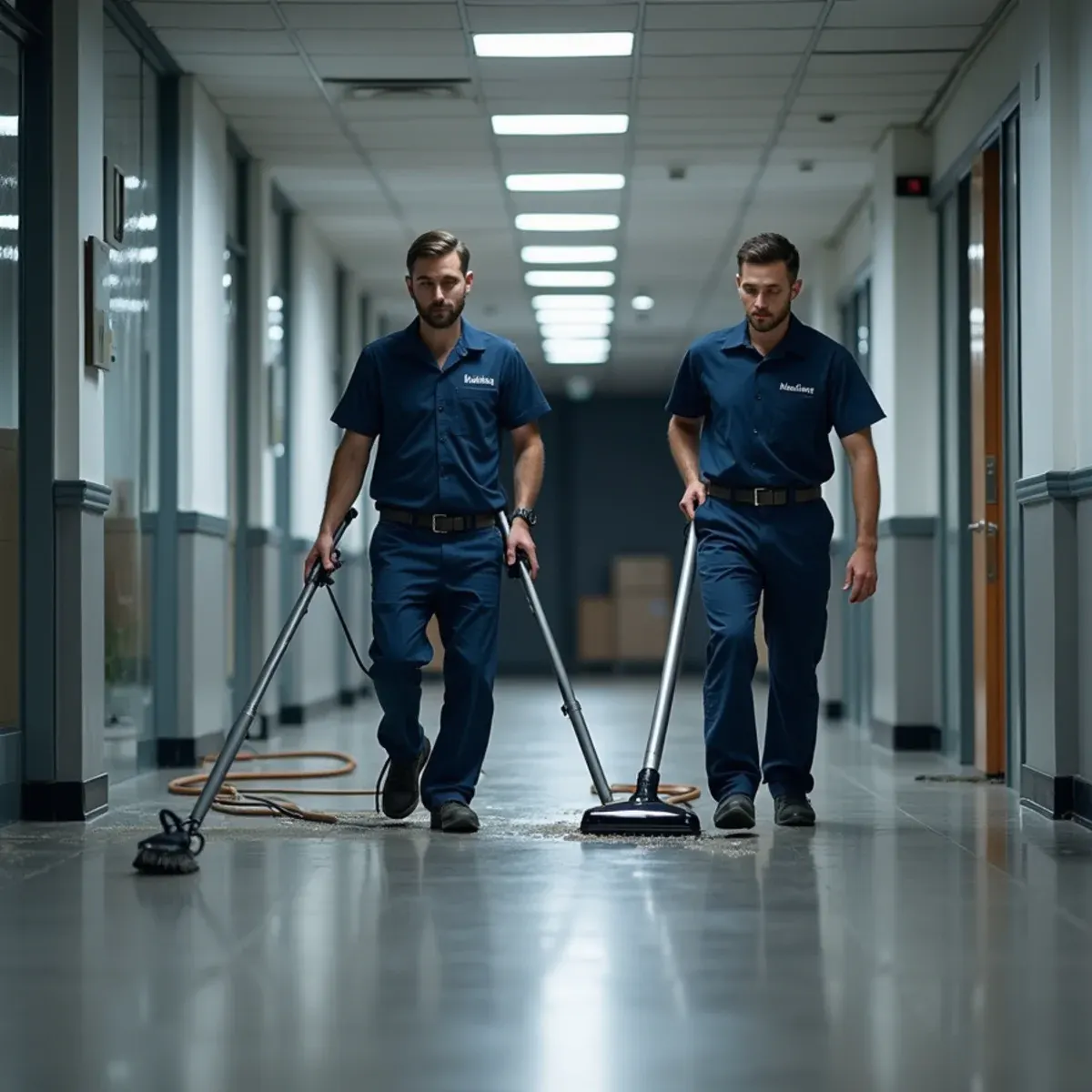
That load shows up in a specific way. Angle stops, supply risers and appliance connectors wear out early here, and they fail at the connection rather than mid-run. For a food business the loss is rarely the water itself; it is the health inspection, the walk-in that lost power, and the days you cannot serve. We run after-hours and weekend crews so kitchens dry overnight, and we keep containment tight enough that a neighboring tenant in the same building never closes at all.
What Garden Grove Changes About Commercial Restoration
1Fixture cycle counts drive early failure
A restaurant three-compartment sink or a market's prep station cycles more in a week than a 1960s house did in a year. Angle stops and braided connectors in these buildings fail early and predictably. When we open a wall for drying, we photograph the condition of every accessible connector so your plumber can replace the whole group rather than the single one that broke.
2After-hours drying around service hours
Closing a Garden Grove restaurant for a week can cost more than the damage. We schedule extraction and demolition overnight, run equipment on a plan that clears the dining room before service, and stage noisy reconstruction after close. Where the kitchen alone is affected, containment at the pass lets front of house keep operating on a limited menu.
3Records that work for the whole building
Many of these buildings hold four or five small businesses under one owner. We keep a separate moisture and equipment log per suite, in plain language, so a landlord can hand a tenant their own file. When several tenants share one loss, that separation is what keeps business interruption claims from stalling behind an argument over whose damage is whose.
How the Work Runs
The method is the same one we use on every commercial restoration job, documented to the IICRC S500:2025 standard. Here it is in short — the full commercial water damage restoration process explains each stage in detail.
- Rapid assessment with a business continuity lens
- Coordinate with stakeholders
- After-hours mobilization
- Documentation at commercial standard
- Scaled drying and containment
- Phased reconstruction
The Garden Grove Background Worth Knowing
A 1958 tract home was plumbed for a family of four with one bathroom in regular use, one washing machine, and a single water heater sized to match. Many Garden Grove homes today support considerably more than that, and the plumbing feels it.
There is more on the housing stock, drainage and plumbing history of this city on our water damage restoration in Garden Grove page.
Garden Grove at a glance
- Dominant construction era
- 1950–1970
- Foundation type
- slab on grade
- Supply piping found here
- galvanized steel, under-slab copper
- Drain line materials
- cast iron, clay
- Terrain and water table
- flat, moderate water table
- Most common local failure
- accelerated wear on angle stops, supply risers and washing machine hoses from far higher fixture cycle counts
- Highest-value local prevention
- shorter replacement intervals on every wear item — hoses at five years without exception
What It Costs in Garden Grove
We do not quote a number over the phone before seeing the property — anyone who does is guessing. The variables that actually move the price on a commercial restoration job are square footage and ceiling height, occupancy and access constraints, building systems involved, and they are broken down in full on the commercial water damage restoration page. The assessment and the written estimate are free anywhere in Garden Grove, day or night, with no obligation.
Commercial Restoration Questions from Garden Grove Homeowners
Usually yes, if the kitchen itself is dry and sanitary. We prioritize the food-contact areas, extract, clean and dry them first, then verify with meter readings rather than by look. Dining rooms and back offices can finish afterward behind containment. What we will not do is tell you to serve out of a space that has not met the drying goal, because a health inspector will find what a wet floor cavity is doing before your customers do.
Yes, and for most commercial clients that is the default. Night and weekend crews cost somewhat more in labor and almost always cost far less than the revenue lost by closing during business hours.
Regularly. Multi-family losses are documented unit by unit with separate files, moisture mapping, and drying logs, which is what allows multiple owners, an HOA, and several carriers to resolve their portions cleanly.
Yes, all five ZIP codes — 92840, 92841, 92843, 92844, and 92845 — for both residential and commercial properties. Response time runs about twenty-five to thirty-five minutes depending on where in the city.