
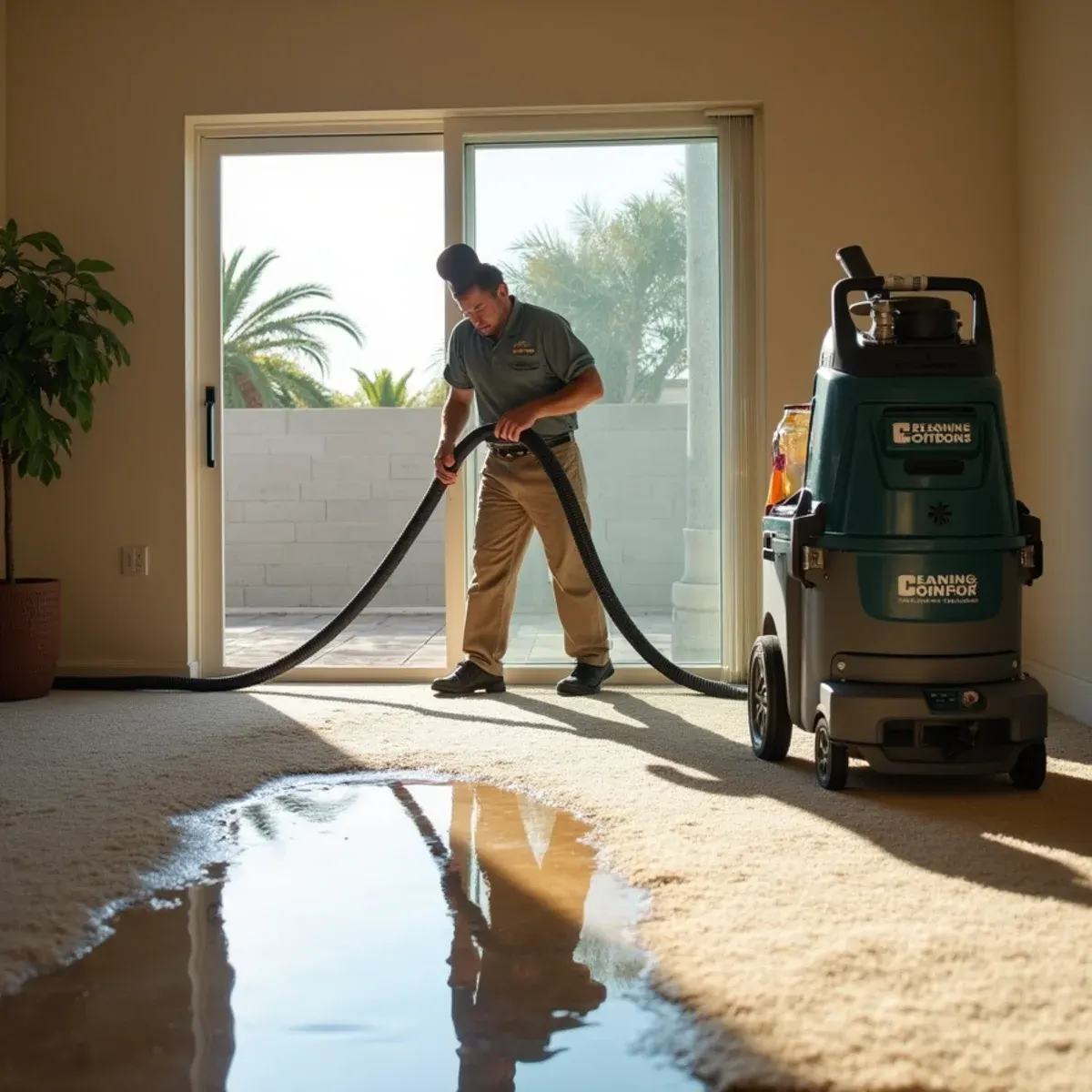
Pico Rivera was built on a strip of ground between two flood-control channels, the San Gabriel River on one side and the Rio Hondo on the other. That position defines how the whole city behaves in a wet week. The water table sits shallow, the postwar tracts from the late forties through the mid sixties are all slab on grade, and during sustained rain the ground saturates quickly rather than absorbing steadily. The slab under your carpet gets cold and damp from below, and it stays that way well after the rain stops.
For carpet drying that has a specific consequence. A floor can extract well, meter dry at the fiber and the pad, then read wet again three days later, not because we missed water but because the slab is still feeding vapor upward through pad and backing. Slabs of that era often went in with a thin vapor barrier or none at all. So we monitor the slab itself, not just the carpet, and we do not call a Pico Rivera job finished on a single dry reading taken during a saturated week.
What Pico Rivera Changes About Carpet Drying
1The slab keeps feeding the carpet
Under a shallow water table, a 1950s slab with a marginal vapor barrier acts as a moisture source rather than a neutral surface. Carpet and pad dried in place can rebound once equipment is pulled. We take slab readings alongside carpet readings, extend monitoring through the wet week, and tell you honestly when the answer is waiting rather than more fans.
2Storm weeks stack losses citywide
When the ground between the channels saturates, calls come in clusters and everything slows down, plumbers and adjusters included. We do not promise the 60-minute window we hold inside Cypress out here. We dispatch as fast as conditions allow, and in the meantime we will tell you over the phone what to move, what to lift off the carpet and what to leave alone.
3Cold slab, warm room, condensation risk
A damp slab under a heated room makes the carpet backing the coolest surface in the space, which is where moisture condenses. Blowing warm air across it without dehumidification drives humidity into walls and contents instead of out of the building. We balance temperature and grain depression rather than just adding heat, which matters more here than in cities with drier ground.
How the Work Runs
The method is the same one we use on every carpet drying job, documented to the IICRC S500:2025 standard. Here it is in short — the full carpet water damage & drying process explains each stage in detail.
- Map the real wet perimeter
- Identify the pad and the category
- Weighted extraction, pass after pass
- Float the carpet or pull the pad
- Dry the slab or subfloor
- New pad, re-stretch, reinstall
The Pico Rivera Background Worth Knowing
On a hillside, storm water leaves. In Pico Rivera it soaks in, and when the soil is already near capacity it stops soaking in and simply stands. That is why a yard here can hold water two days after the rain stops while a yard up in the Whittier hills is dry by morning. The lawn is not draining badly. The ground underneath it is full. Once that happens, every path water can take toward your house becomes the path it takes: the garage threshold, the slider track, the gap where a patio slab has settled back toward the wall.
There is more on the housing stock, drainage and plumbing history of this city on our water damage restoration in Pico Rivera page.
Pico Rivera at a glance
- Dominant construction era
- 1945–1965
- Foundation type
- slab on grade
- Supply piping found here
- original galvanized steel, copper
- Drain line materials
- cast iron
- Terrain and water table
- flat, shallow water table
- Most common local failure
- ground saturating fast during sustained storms because the water table between two channels sits high
- Highest-value local prevention
- clearing area drains and confirming downspouts discharge well away from the foundation
What It Costs in Pico Rivera
We do not quote a number over the phone before seeing the property — anyone who does is guessing. The variables that actually move the price on a carpet drying job are whether the pad is salvageable, square footage and equipment days, what sits under the pad, and they are broken down in full on the carpet water damage & drying page. The assessment and the written estimate are free anywhere in Pico Rivera, day or night, with no obligation.
Carpet Drying Questions from Pico Rivera Homeowners
That is a Pico Rivera pattern, and it usually is not a new leak. With the water table shallow between the San Gabriel and the Rio Hondo, a saturated week pushes moisture up through a 1950s slab that never had much of a vapor barrier, and the carpet backing takes it on first. We come back and meter the slab as well as the carpet. If it is vapor drive rather than a new source, the fix is different and we will say so.
Frequently it can be saved. The deciding factors are water category, how many hours it sat, and whether the backing has delaminated. Clean supply-line water caught within a day, on carpet that was in decent shape beforehand, usually means we replace the pad and keep the carpet. Anything past Category 1, or carpet that has come apart at the backing, is a different answer. We take the readings and check the backing before saying either way.
No, but it does more often than not. On a clean-water loss we reach quickly, we can float the carpet, push dry air into the pad space, and dry it in place. Moisture-barrier pad, dense slab rubber, and anything that sat overnight in gray water comes out. S500:2025 treats pad as non-restorable once contamination is involved, and field experience supports that. It is inexpensive material against a real risk.
Not in the way people picture it. The channels are engineered, and what we actually see is a groundwater and surface drainage problem rather than a channel overtopping. Because the water table between the two runs high and the ground is flat, soil here reaches saturation faster than it does a few miles inland. Once it does, storm water stops soaking in and starts looking for the lowest opening in your house, which is almost always the garage.