
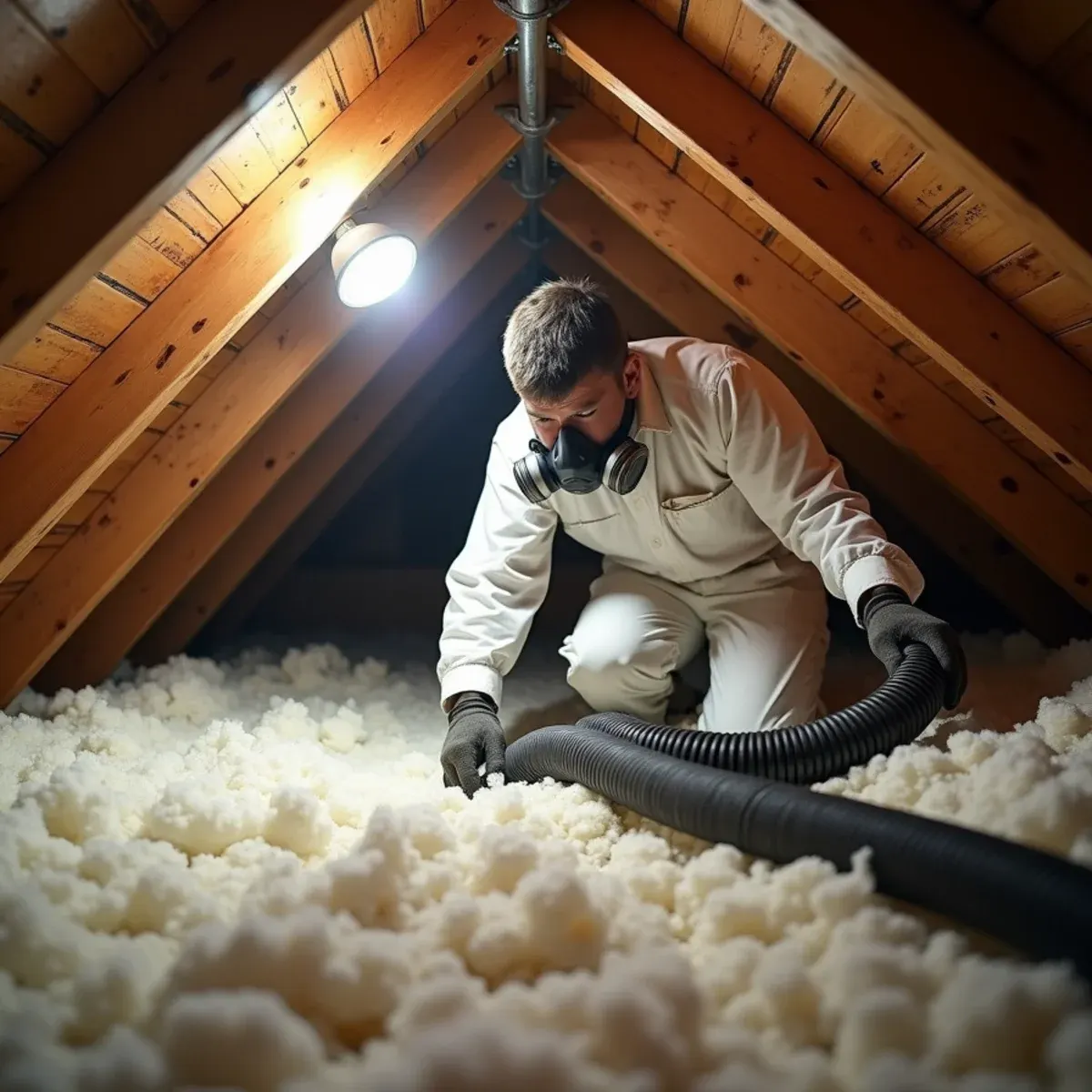
Ross Cortese built roughly 3,500 houses here between 1957 and 1961, off a handful of plans, and the attics repeat just like the elevations do. Single story means the attic covers the entire footprint, a big plane to remove insulation from and a lot of surface to dry. The roofs are shallow-pitch ranch roofs, so there's headroom at the ridge and almost none at the eaves. The last two feet before the top plate is a belly crawl, and that's exactly where wet insulation likes to sit.
Two Rossmoor specifics change the plan. First, a lot of these houses still have their original oak strip flooring under carpet or laminate, and when a ceiling lets go the water lands on it. We dry the floor as a wood assembly, not as a subfloor, because it can usually be saved if we get to it early. Second, Rossmoor is unincorporated, so anything permit-related runs through the County rather than a city building counter. We plan reinstall and any structural repair around that timeline.
What Rossmoor Changes About Attic & Insulation
1The last two feet at the eaves
These shallow ranch roofs leave maybe a foot of clearance where the rafters meet the top plate, and that's where wet insulation collects and where baffles get packed shut. Removal there is done flat on your stomach with a hose, not standing with a machine. It's slow, and we price the time honestly rather than vacuuming the middle of the attic and calling it complete.
2Every duct in the house is overhead
Single-story plans put the entire distribution system in the attic: trunk, branches, boots over every room. When that plane gets wet, the duct insulation wicks and the interior can pick up spores that then get blown through the house. We inspect the ducts and the air handler cabinet as part of the attic scope in Rossmoor, not as an upsell after the fact.
3County permits, not a city counter
Rossmoor is unincorporated, so plan review and inspection for anything beyond like-for-like repair go through the County rather than a city building department. It's not harder, it's just a different desk and a different calendar. We tell your adjuster what the sequence looks like up front so the reinstall isn't sitting on hold while everyone figures out who signs.
How the Work Runs
The method is the same one we use on every attic & insulation job, documented to the IICRC S500:2025 standard. Here it is in short — the full attic water damage & insulation replacement process explains each stage in detail.
- Map the wet area before touching it
- Contain the hatch and protect the path
- Vacuum out the saturated insulation
- HEPA vacuum and treat the plane
- Dry the deck, joists, and top plates
- Reinstall insulation and check the details
The Rossmoor Background Worth Knowing
Plumbing failure is largely a function of time, water chemistry, and installation method — and in Rossmoor all three are effectively identical from house to house. That is why leak calls here tend to arrive in clusters, and why a neighbor's slab leak is genuinely relevant information about your own home.
There is more on the housing stock, drainage and plumbing history of this city on our water damage restoration in Rossmoor page.
Rossmoor at a glance
- Dominant construction era
- 1957–1961
- Foundation type
- slab on grade
- Supply piping found here
- under-slab copper, some galvanized
- Drain line materials
- cast iron
- Terrain and water table
- flat, moderate water table
- Most common local failure
- clustered slab leaks, where one failure on a street reliably predicts the neighbors
- Highest-value local prevention
- treating a neighbor's slab leak as information about your own house and running the meter test
What It Costs in Rossmoor
We do not quote a number over the phone before seeing the property — anyone who does is guessing. The variables that actually move the price on a attic & insulation job are how much of the attic got wet, clearance, access, and layout, the type of insulation up there, and they are broken down in full on the attic water damage & insulation replacement page. The assessment and the written estimate are free anywhere in Rossmoor, day or night, with no obligation.
Attic & Insulation Questions from Rossmoor Homeowners
Often it can, if we get to it before the water sits. The oak here went down over a slab, so it can only dry upward; there's no crawl space underneath to help. Wet strip flooring cups first and may crown later, and controlled drying with floor mats usually brings the shape back. What kills it is a week trapped under wet carpet and pad. Pull the covering early and hold any refinishing decision until moisture content stabilizes.
Only the affected area plus a margin back to dry, lofted material. If the wet section covers a small part of the attic, that is all that comes out. Once it reaches roughly half the plane, replacing the whole field usually costs less than blending old and new to an even depth, and it leaves you with one consistent R-value instead of a patchwork ceiling that performs unevenly room to room.
Most attics take a few days once the wet insulation is out, but we will not promise a number on day one, and you should be careful with anyone who does. Plywood sheathing dries at a different rate than old plank decking, a sealed attic dries faster than a heavily vented one, and marine-layer mornings slow everything down. The daily readings decide when equipment leaves, not the calendar.
Because they were all built between 1957 and 1961 with the same materials and methods. Copper routed through a slab fails from internal erosion and external soil corrosion on a fairly predictable timeline, and when an entire community shares one construction date, it shares one failure window too.