
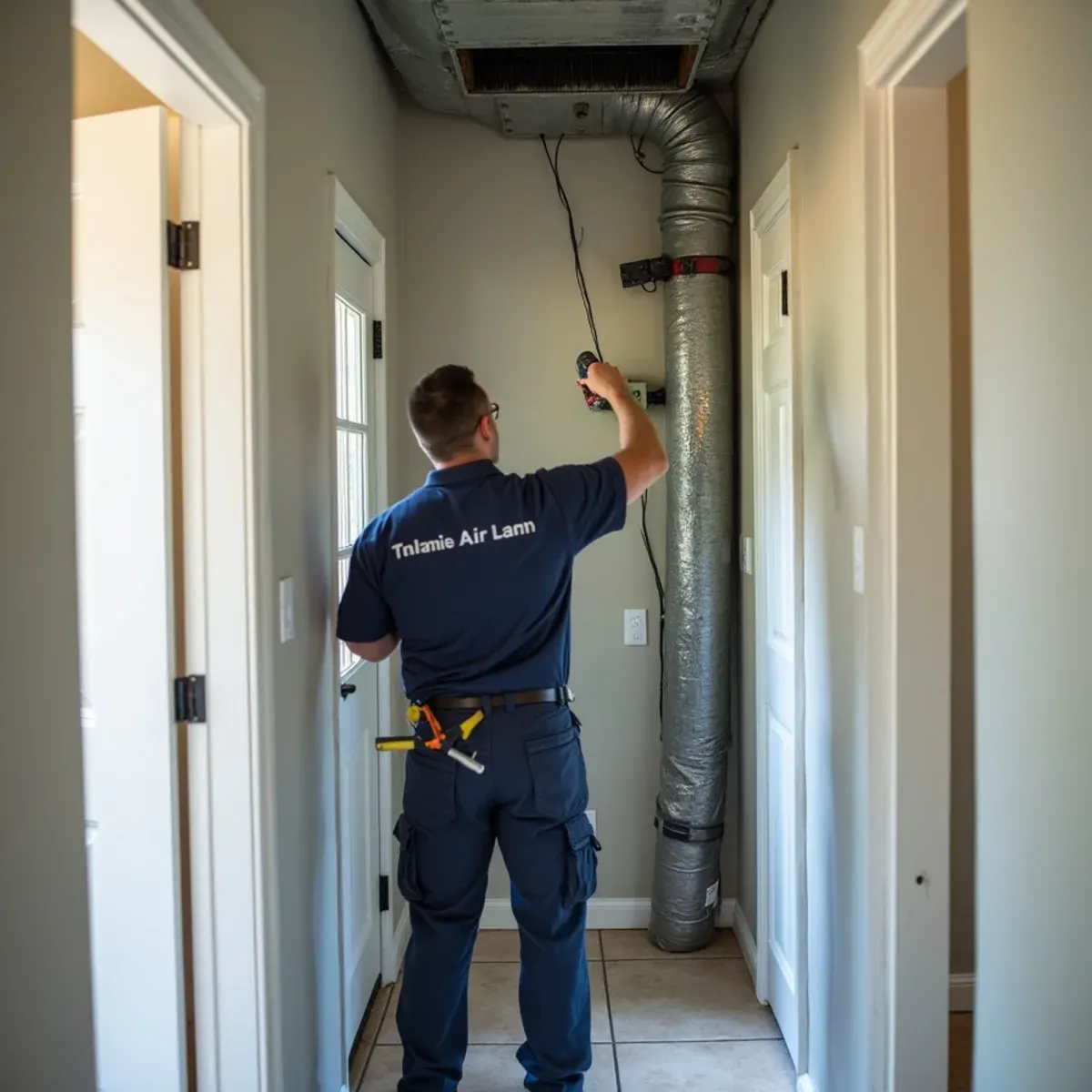
The marine layer adds days to every drying job in Seal Beach, and duct work is where that shows up worst. Outdoor air here is often wetter than the air inside, so the old habit of opening things up and ventilating makes an attic damper rather than drier. A flex run that stays wet through a cool gray week grows exactly what you will smell on the first hot afternoon in July. We dehumidify inside a sealed envelope and keep the system off until the ducting has been cleaned.
Three very different environments share this ZIP. Old Town is dense, 1920s through the 1940s, much of it on raised foundations with tiny attics, and a fair number of those cottages never had a ducted system at all: wall heaters then, mini-splits now. Leisure World is roughly 9,000 attached units from the early 1960s, with attic space running above rows of homes and a mutual and management company who authorize the work. College Park inland is conventional postwar tract.
What Seal Beach Changes About Air Ducts & HVAC
1Leisure World approvals come before tools
Work inside a mutual is not a homeowner decision alone. Scope, access, hours and anything touching common attic space go through the mutual and the management company, and the wrong sequence stalls a job for a week. We put the scope in writing for the board, keep dust containment tight because neighbors share the wall, and work hours that do not wake a building full of retirees.
2Shared attics above attached units
In the attached rows the attic often runs continuous over several homes, so a contaminated run above one unit sits above the neighbors as well. That crosses policies. We document which units' airspace was affected before anyone cuts anything, so the mutual's carrier and the residents' carriers are looking at the same map instead of arguing about it afterward.
3Old Town homes with no ducts to clean
Plenty of Old Town cottages have no ducted system at all. If that is your house, duct cleaning is not the answer and we will say so on the first visit. The equivalent work is the mini-split blower wheel and drain pan, the bath and kitchen exhaust ducting, and the crawl space under the floor, which this close to the water stays damp on its own. Smaller scope, priced like one.
How the Work Runs
The method is the same one we use on every air ducts & hvac job, documented to the IICRC S500:2025 standard. Here it is in short — the full air duct cleaning & hvac restoration process explains each stage in detail.
- Inspect before we quote
- Contain and seal the system
- Clean or replace the ducting
- Clean the air handler and coil
- Replace filters and treat surfaces
- Seal, balance, and verify
The Seal Beach Background Worth Knowing
Structural drying works by creating a vapor pressure differential — dry air pulls moisture out of wet materials. When the surrounding air is already carrying a heavy moisture load, that differential shrinks and everything slows down.
There is more on the housing stock, drainage and plumbing history of this city on our water damage restoration in Seal Beach page.
Seal Beach at a glance
- Dominant construction era
- 1920–1965
- Foundation type
- mixed on grade
- Supply piping found here
- galvanized steel, copper, shared community mains
- Drain line materials
- cast iron, clay
- Terrain and water table
- coastal-flat, shallow water table
- Most common local failure
- losses that cross shared walls between attached units, involving several policies and a mutual at once
- Highest-value local prevention
- documenting each affected unit separately from the first hour
What It Costs in Seal Beach
We do not quote a number over the phone before seeing the property — anyone who does is guessing. The variables that actually move the price on a air ducts & hvac job are cleaning versus replacing flex duct, number of supply runs and returns, what kind of contamination it is, and they are broken down in full on the air duct cleaning & hvac restoration page. The assessment and the written estimate are free anywhere in Seal Beach, day or night, with no obligation.
Air Ducts & HVAC Questions from Seal Beach Homeowners
Usually both are involved, which is why documentation matters more here than almost anywhere. The mutual's coverage typically handles building components, including duct in common attic space, while your policy handles what is yours inside the unit. We scope and photograph before we open anything, itemize by unit and by component, and bill the carriers directly. The same paperwork goes to the management company so nothing stalls waiting on a signature.
Fair question, and often it is an upsell. The honest answer depends on whether contamination actually reached the system. If the HVAC ran during the loss or the demolition, if water got into the attic where the ducting lives, or if the loss involved sewage or fire, the system is in scope. If none of that happened, it probably is not. We run a camera and show you before you decide anything.
It depends on where the moisture is. If the inner liner got damp and the fiberglass behind it stayed dry, cleaning and drying the run works. If water got through a torn jacket into the insulation, that fiberglass is porous, it holds moisture and growth, and there is no reliable way to clean it or verify it is clean. Those runs get replaced. We show you which is which rather than guessing on your behalf.
Coastal marine layer conditions keep ambient humidity high for extended periods, which reduces the vapor pressure differential that drives drying. Jobs near the water need sealed chambers and more dehumidification capacity than an equivalent loss inland, and the equipment stays on longer.