
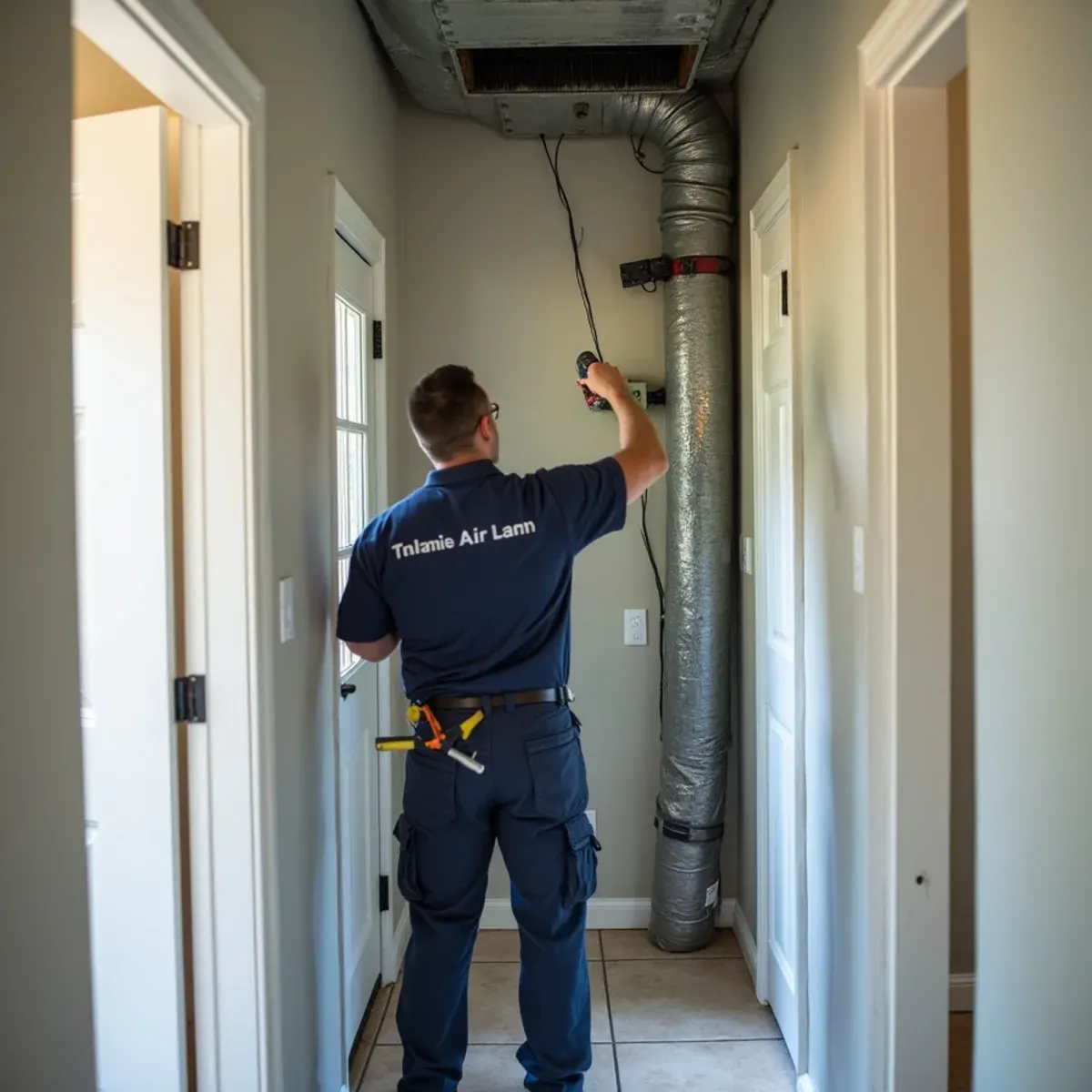
The first thing to do after a loss in Rossmoor is turn the air handler off and leave it off. It feels wrong, because the house is wet and the system moves air, but a Cortese ranch has short, low duct runs sitting inches above the ceiling drywall. If any of that got wet, running the fan pushes it into every room at once. We dry with standalone equipment instead, and the system stays down until somebody has actually looked at the ducting.
About 3,500 homes went up here between 1957 and 1961 to a short list of plans, and the roofs are low slope with very little attic clearance over the middle of the house. Original oak strip flooring is still under the carpet in a lot of them. Rossmoor is unincorporated, so permits and inspections run through Orange County rather than a city counter. The uniformity works in your favor: we know where the trunk turns before we pull the hatch.
What Rossmoor Changes About Air Ducts & HVAC
1Low-slope attics limit what can be cleaned
There is no crawling to the far end of a Cortese attic. Clearance over the center of the house is a few inches, ducts sit directly on the joists, and a technician can reach some of the run and none of the rest. When the sections nobody can reach are the wet ones, replacement from below is honestly cheaper and more certain than pretending to clean what no tool can get to.
2Oak flooring changes the drying plan
Original oak under carpet comes up slowly or not at all, and it needs steady low humidity for days. That is exactly the situation where people are tempted to run the furnace fan to move some air. Do not. Use sealed dehumidification and air movers, keep the ducted system off, and clean or replace the affected duct before it goes back into service.
3County permitting for unincorporated Rossmoor
Rossmoor has no city hall. Anything requiring a permit goes through Orange County, and homeowners are often surprised the process is not what their friends went through in Los Alamitos two miles away. We handle the paperwork and schedule inspections around it. It rarely changes the timeline for duct work, but it changes who signs off, and knowing that early keeps a claim from stalling.
How the Work Runs
The method is the same one we use on every air ducts & hvac job, documented to the IICRC S500:2025 standard. Here it is in short — the full air duct cleaning & hvac restoration process explains each stage in detail.
- Inspect before we quote
- Contain and seal the system
- Clean or replace the ducting
- Clean the air handler and coil
- Replace filters and treat surfaces
- Seal, balance, and verify
The Rossmoor Background Worth Knowing
Plumbing failure is largely a function of time, water chemistry, and installation method — and in Rossmoor all three are effectively identical from house to house. That is why leak calls here tend to arrive in clusters, and why a neighbor's slab leak is genuinely relevant information about your own home.
There is more on the housing stock, drainage and plumbing history of this city on our water damage restoration in Rossmoor page.
Rossmoor at a glance
- Dominant construction era
- 1957–1961
- Foundation type
- slab on grade
- Supply piping found here
- under-slab copper, some galvanized
- Drain line materials
- cast iron
- Terrain and water table
- flat, moderate water table
- Most common local failure
- clustered slab leaks, where one failure on a street reliably predicts the neighbors
- Highest-value local prevention
- treating a neighbor's slab leak as information about your own house and running the meter test
What It Costs in Rossmoor
We do not quote a number over the phone before seeing the property — anyone who does is guessing. The variables that actually move the price on a air ducts & hvac job are cleaning versus replacing flex duct, number of supply runs and returns, what kind of contamination it is, and they are broken down in full on the air duct cleaning & hvac restoration page. The assessment and the written estimate are free anywhere in Rossmoor, day or night, with no obligation.
Air Ducts & HVAC Questions from Rossmoor Homeowners
It might. These houses were built to the same plans in the same four years, with the same under-slab copper and the same duct layout, so failures cluster on a street. If a neighbor's loss reached their attic, yours has identical geometry, the same trunk position, the same boot locations, the same clearances. It does not mean you have a problem. It does mean an inspection is quick, because we already know the layout of your house.
Fair question, and often it is an upsell. The honest answer depends on whether contamination actually reached the system. If the HVAC ran during the loss or the demolition, if water got into the attic where the ducting lives, or if the loss involved sewage or fire, the system is in scope. If none of that happened, it probably is not. We run a camera and show you before you decide anything.
It depends on where the moisture is. If the inner liner got damp and the fiberglass behind it stayed dry, cleaning and drying the run works. If water got through a torn jacket into the insulation, that fiberglass is porous, it holds moisture and growth, and there is no reliable way to clean it or verify it is clean. Those runs get replaced. We show you which is which rather than guessing on your behalf.
Because they were all built between 1957 and 1961 with the same materials and methods. Copper routed through a slab fails from internal erosion and external soil corrosion on a fairly predictable timeline, and when an entire community shares one construction date, it shares one failure window too.