
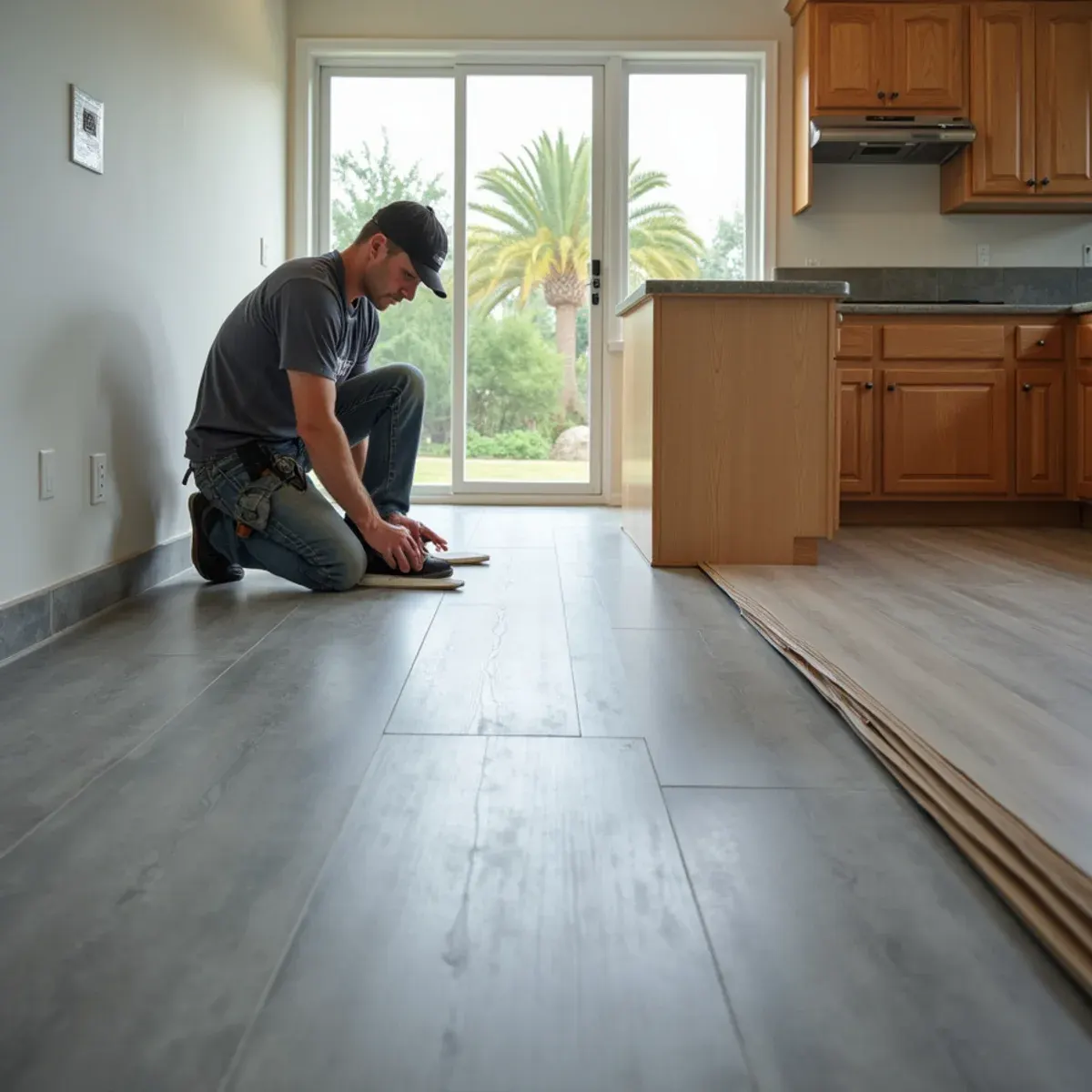
A terrace drain packed with eucalyptus litter is a small problem for eleven months of the year. Then a real storm arrives, the drain backs up, and water that was supposed to be intercepted halfway up your slope comes over the pad instead and finds the lowest slider on the house. Inside, a floating vinyl floor takes it in seconds. The planks stay perfect. The water goes under them and spreads across the level pad, and by the time anyone notices the wall base has gone dark, it is already twenty feet from the door.
Yorba Linda is newer than almost anywhere else we work, largely 1970 through 2005, and built into hills rather than across flats. Larger lots, engineered slopes, retaining walls, terrace drains and heavy irrigation. Parts of the city sit inside the 2008 Freeway Complex Fire footprint, where burn-scar runoff behaved differently for years afterward and some of that landscape is still re-establishing. Newer construction means the plumbing is generally in better shape than it is a few miles west. It also means the water that ruins floors here mostly comes from outside and above.
What Yorba Linda Changes About Vinyl & Laminate Floors
1Exterior water is a different claim
Water from a failed slope drain or an overtopped swale is not the same insurance conversation as a burst supply line, and we would rather say so on day one than after the invoice. We document the source honestly, photograph the entry path and bill directly where coverage applies. Either way the drying work itself is identical, and the floor still has to come off the slab to do it.
2Level pads spread water fast
Homes here are built on cut-and-fill pads that are dead level inside a sloping lot. Once water is under a floating floor on that pad it moves with nothing to stop it, and it travels farthest under long open-plan runs with no thresholds. We meter the perimeter of the entire level before deciding how much of the field comes up, because the visible wet edge is almost never the real boundary.
3Irrigation against the slab edge
Heavy landscaping on these lots keeps soil charged with water right up against the foundation, which keeps the slab perimeter reading high long after the interior has come down. Reinstalling plank over an edge that is still wet is how you get swollen laminate along one wall six weeks later. We ask owners to shut irrigation on the affected side for the duration of the drying.
How the Work Runs
The method is the same one we use on every vinyl & laminate floors job, documented to the IICRC S500:2025 standard. Here it is in short — the full vinyl & laminate floor water damage process explains each stage in detail.
- Map the wet area before lifting anything
- Lift and number the planks
- Strip what sat under the floor
- Dry the slab to a documented standard
- In-situ RH test before anything goes down
- Reinstall or replace, honestly
The Yorba Linda Background Worth Knowing
A hillside lot in Yorba Linda is a drainage system with a house attached. Terrace drains cut across the face of the slope to intercept water before it gains speed. Brow ditches run along the top to keep runoff from ever reaching the slope face. Down-drains carry the collected water to the street or a storm connection. Retaining walls have weep holes and, behind them, a gravel subdrain that relieves pressure on the wall. Every one of those was engineered as part of the pad. Every one of them silts up, roots over, or gets buried by landscaping.
There is more on the housing stock, drainage and plumbing history of this city on our water damage restoration in Yorba Linda page.
Yorba Linda at a glance
- Dominant construction era
- 1970–2005
- Foundation type
- slab on grade
- Supply piping found here
- under-slab copper, later PEX and CPVC
- Drain line materials
- ABS, cast iron
- Terrain and water table
- hillside-mixed, deep water table
- Most common local failure
- exterior water from failed slope drainage, terrace drains and retaining-wall systems rather than from plumbing
- Highest-value local prevention
- clearing terrace and slope drains before the season, since a blocked one turns an engineered hillside into a funnel
What It Costs in Yorba Linda
We do not quote a number over the phone before seeing the property — anyone who does is guessing. The variables that actually move the price on a vinyl & laminate floors job are how much floor has to come up, floating, glue-down, or sheet, whether the planks can be reused, and they are broken down in full on the vinyl & laminate floor water damage page. The assessment and the written estimate are free anywhere in Yorba Linda, day or night, with no obligation.
Vinyl & Laminate Floors Questions from Yorba Linda Homeowners
Probably part of it. Mopping clears what was on top of the planks, which on a waterproof floor is the part that did not matter. What went through the seams and the perimeter expansion gap is sitting on the slab under a lid, and on a level Yorba Linda pad it spreads quickly. We meter before recommending anything. If it is confined to a few feet inside the door, the repair is genuinely small.
Because the plank is waterproof and the space under it is not. Water gets in at the seams and the perimeter, spreads across the slab, and then has no way out, because the plank blocks evaporation. The flooring is usually the only part of the assembly that is fine. Lifting it is how we reach the underlayment and the concrete, which are the parts holding the moisture.
No. That is one of the few places in this work where the answer is flat. The core is compressed wood fiber and glue, and once water breaks that compression the fibers stay expanded. Drying stops it getting worse; it does not reverse it. If only a few boards near the leak have swollen and the rest reads dry, a partial replacement is sometimes possible, though matching an older run is rarely clean.
Seeping from the weep holes is usually the wall doing its job, relieving water pressure from the soil behind it. The concerning version is the opposite: weep holes that stay dry through a storm while the ground above stays soggy, which suggests the subdrain behind the wall is plugged and pressure is building. Also watch for new cracking, bulging, or a wall that has tipped slightly. Those are engineering questions rather than restoration ones, and we will say so.