
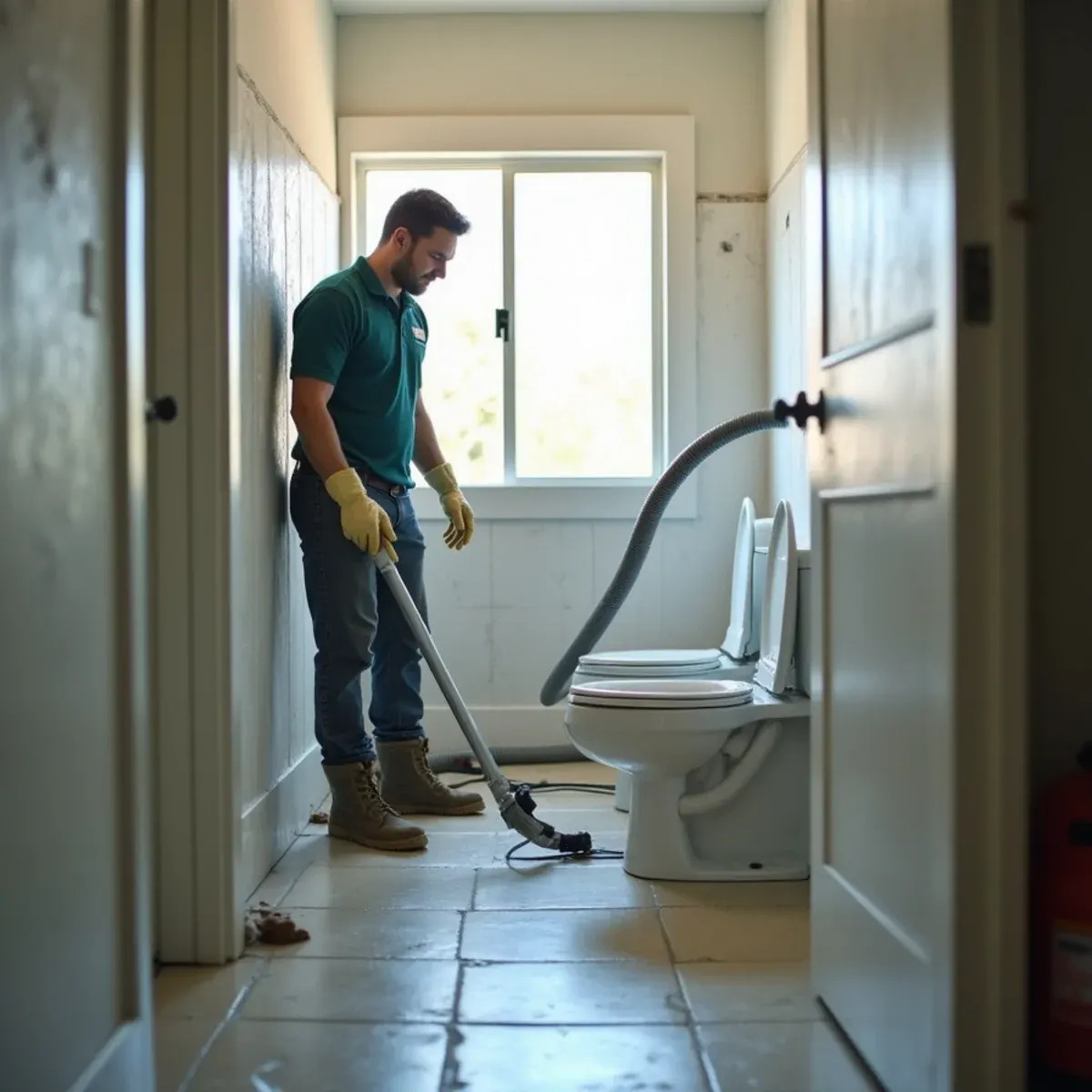
Pico Rivera sits on a strip of ground between two flood-control channels — the San Gabriel River on one side, the Rio Hondo on the other — and that position defines how the whole city drains. The water table is shallow. During a long wet stretch the ground doesn't have much room left to take anything, and older sewer laterals pick up infiltration they were never designed for. That's when the backup calls cluster, and it's why storm season is our busiest window for this service here.
The housing is postwar tract, mostly 1945 to 1965, built before the city itself existed — Pico and Rivera merged in 1958. Single-story slab, small bathrooms, the tub and toilet sharing one short branch out to the lateral. In a house like that, a main-line backup rarely shows up politely at the bowl. It comes up through the tub drain while the toilet gurgles, and by the time anyone notices, the hall carpet on the low side of the room is already wet.
What Pico Rivera Changes About Toilet Overflow
1Rain arrives faster than the ground takes it
Between two channels with groundwater close to the surface, sustained rain loads the older laterals with flow they were never sized for. Marginal blockages that behaved all summer stop behaving. The week before a storm is the right time to have a slow-draining line camera-scoped — not the night it comes up through the tub at two in the morning.
2Shallow groundwater slows slab drying
A slab sitting over damp ground stays cooler and gives up moisture more slowly than the same slab in a hillside city. Flooring adhesives and underlayment hold water longer here, and rushing the reinstall is how you get a bubbled floor six months later. We dry against a control reading taken elsewhere in the same house and we don't call it finished early.
3One branch line, two fixtures backing up
These 1950s bathrooms put the tub and toilet on one short shared run. When both come up at the same time, the blockage is downstream and the water is Category 3 — the whole system's contents, not bowl water. Stop using every drain in the house immediately, including the kitchen sink and the washer, which will push more of it up through the tub.
How the Work Runs
The method is the same one we use on every toilet overflow job, documented to the IICRC S500:2025 standard. Here it is in short — the full toilet overflow cleanup process explains each stage in detail.
- Stop the water, stabilize the room
- Determine the category before scoping
- Extract, then remove only what must go
- Pull the toilet, inspect the flange
- Dry the subfloor and the ceiling below
- Disinfect to category, verify, reset
The Pico Rivera Background Worth Knowing
On a hillside, storm water leaves. In Pico Rivera it soaks in, and when the soil is already near capacity it stops soaking in and simply stands. That is why a yard here can hold water two days after the rain stops while a yard up in the Whittier hills is dry by morning. The lawn is not draining badly. The ground underneath it is full. Once that happens, every path water can take toward your house becomes the path it takes: the garage threshold, the slider track, the gap where a patio slab has settled back toward the wall.
There is more on the housing stock, drainage and plumbing history of this city on our water damage restoration in Pico Rivera page.
Pico Rivera at a glance
- Dominant construction era
- 1945–1965
- Foundation type
- slab on grade
- Supply piping found here
- original galvanized steel, copper
- Drain line materials
- cast iron
- Terrain and water table
- flat, shallow water table
- Most common local failure
- ground saturating fast during sustained storms because the water table between two channels sits high
- Highest-value local prevention
- clearing area drains and confirming downspouts discharge well away from the foundation
What It Costs in Pico Rivera
We do not quote a number over the phone before seeing the property — anyone who does is guessing. The variables that actually move the price on a toilet overflow job are the category of the water, how far it traveled from the base, what your floor is built from, and they are broken down in full on the toilet overflow cleanup page. The assessment and the written estimate are free anywhere in Pico Rivera, day or night, with no obligation.
Toilet Overflow Questions from Pico Rivera Homeowners
In Pico Rivera, usually yes. Gurgling means air is being displaced somewhere it shouldn't be, and in a city sitting between two channels with a shallow water table, wet weather adds infiltration to lines that are already partly restricted. It's the lateral telling you it's near capacity. Get it camera-scoped before the next storm. Clearing a root intrusion costs a fraction of a Category 3 cleanup across a hall and two bedrooms.
Clear water lowers the health risk, not the drying requirement. Clean water still soaks into carpet pad, particle board, and the cut edge of subfloor around the flange, and it still causes swelling and mold growth if it stays. What clean water does change is the scope: no containment, no PPE, usually no demolition. If it stayed on sealed tile and you got it up quickly, you may genuinely be fine. If it reached anything porous, it needs real drying.
Three checks. Did the water rise in the bowl without anyone flushing it? Does another fixture gurgle, drain slowly, or fill up when you run water elsewhere in the house? Is there visible soil or a sewer odor in what came out? Any one of those points at the main line. A stuck fill valve, by contrast, gives you clear water, a bowl that overflows steadily, and a tank you can hear running continuously.
Not in the way people picture it. The channels are engineered, and what we actually see is a groundwater and surface drainage problem rather than a channel overtopping. Because the water table between the two runs high and the ground is flat, soil here reaches saturation faster than it does a few miles inland. Once it does, storm water stops soaking in and starts looking for the lowest opening in your house, which is almost always the garage.