
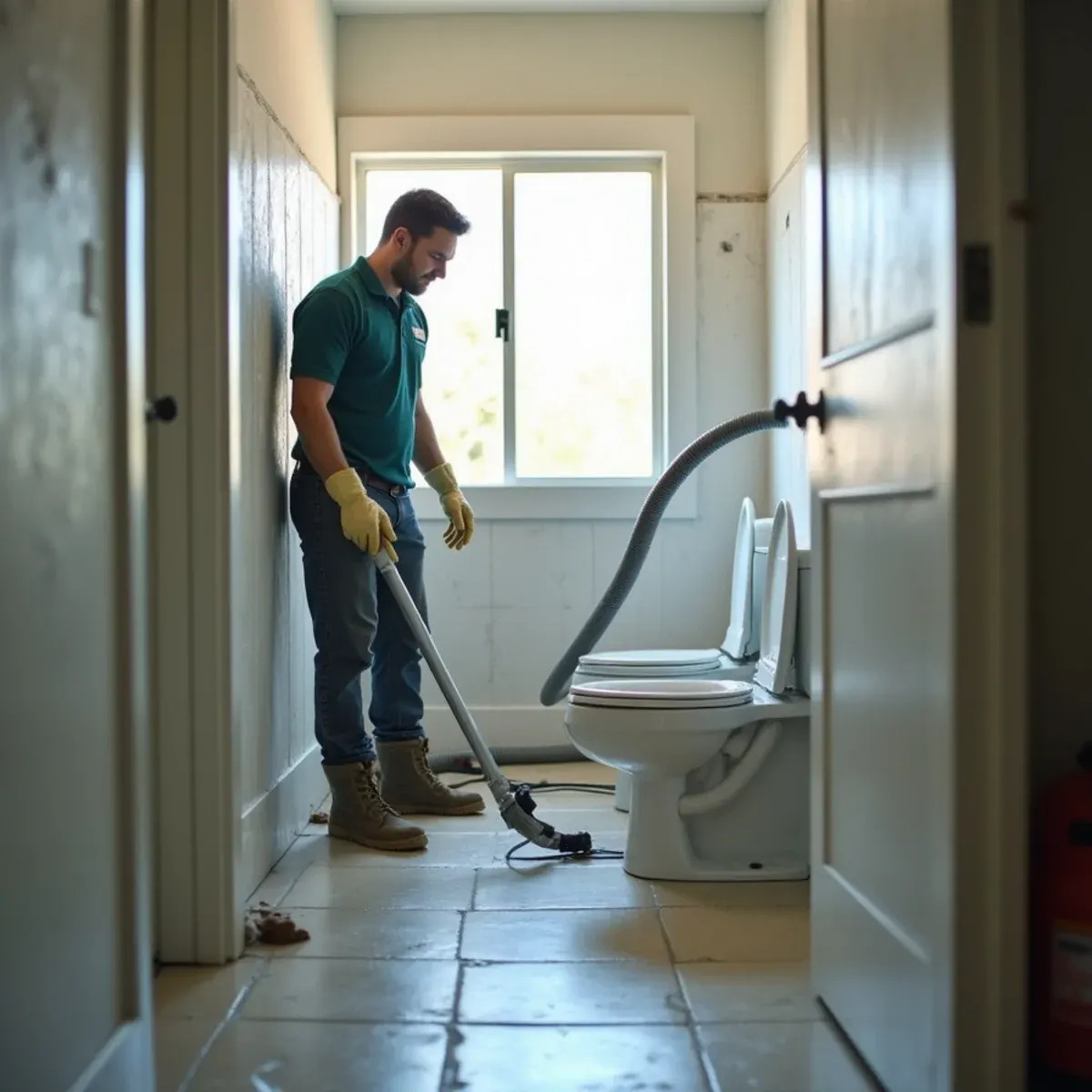
Whittier was founded by Quakers in 1887 and the housing stock still shows every decade since. Uptown around Greenleaf Avenue holds late-Victorian bay windows, Craftsman with deep porches and 1920s Spanish Revival under clay tile — nearly all of it on raised foundations with drainage of the original era still partly in service. A toilet overflow in those blocks isn't a floor job. It's a subfloor and crawl-space job, and the visible water in the bathroom is the smallest part of it.
Climb the hill and the problem changes shape. College Hills was subdivided in 1923 as the city's first planned hillside development, with steep grades and curving streets, and Friendly Hills and the Whittier Hills run up toward Turnbull Canyon. Houses there are multi-level, so water leaving an upstairs bathroom lands on a floor below and sometimes two. East Whittier is conventional postwar slab and behaves like the tract cities south of here. Three neighborhoods, three scopes.
What Whittier Changes About Toilet Overflow
1Uptown crawl spaces and lath plaster
Original Uptown houses have wood floors over joists and lath-and-plaster walls that wick water high and release it slowly. Plaster is not drywall — it often survives, but it dries on its own schedule and more air won't rush it. We work from the crawl space upward, and we're upfront that these dry-outs run longer than a slab house's do.
2Original-era laterals mean Category 3 odds
Drainage lines under the oldest blocks predate most of the city's growth and run beneath century-old street trees. Root intrusion is common, and when a lateral blocks, the backup arrives at the lowest fixture carrying the whole house's waste. That's Category 3 and it doesn't get mopped. It gets contained, removed and disinfected, including the soil it dripped onto below.
3Hillside homes take water down a level
In College Hills and Friendly Hills the floor plans step with the grade, so a bathroom on one level sits over living space on the next. Water follows the joists to the low side of the bay and comes through the ceiling well away from the bathroom. We meter the whole bay and the wall below it rather than opening drywall at the stain.
How the Work Runs
The method is the same one we use on every toilet overflow job, documented to the IICRC S500:2025 standard. Here it is in short — the full toilet overflow cleanup process explains each stage in detail.
- Stop the water, stabilize the room
- Determine the category before scoping
- Extract, then remove only what must go
- Pull the toilet, inspect the flange
- Dry the subfloor and the ceiling below
- Disinfect to category, verify, reset
The Whittier Background Worth Knowing
A leak under a raised foundation does not announce itself the way a slab leak does. There is no puddle on the floor and no warm spot underfoot, because the water drips down into the soil and stays there. What you get instead is a smell that is stronger in the morning, a board that feels slightly soft, and eventually a floor that has been quietly feeding fungal growth for months. By the time an Uptown homeowner calls us about a crawl space leak, the question is rarely how to dry it. It is how much of the joist and subfloor is still doing its job.
There is more on the housing stock, drainage and plumbing history of this city on our water damage restoration in Whittier page.
Whittier at a glance
- Dominant construction era
- 1890–1980
- Foundation type
- mixed on grade
- Supply piping found here
- original turn-of-century piping, galvanized steel, under-slab copper
- Drain line materials
- cast iron, clay
- Terrain and water table
- hillside-mixed, moderate water table
- Most common local failure
- raised-foundation crawl-space leaks in Uptown, and slope drainage failures in the hillside tracts
- Highest-value local prevention
- an annual crawl-space or slope-drain check, depending which Whittier you live in
What It Costs in Whittier
We do not quote a number over the phone before seeing the property — anyone who does is guessing. The variables that actually move the price on a toilet overflow job are the category of the water, how far it traveled from the base, what your floor is built from, and they are broken down in full on the toilet overflow cleanup page. The assessment and the written estimate are free anywhere in Whittier, day or night, with no obligation.
Toilet Overflow Questions from Whittier Homeowners
Not necessarily. Plaster over wood lath is dense and fairly closed at the surface, so contaminated water that only touched the face can often be cleaned rather than removed. The problem is what's behind it — wet lath and the cavity below won't dry through plaster. We usually remove a low band for access and airflow and save the rest, which keeps the original wall texture across most of the room. Full removal is a last resort here.
Clear water lowers the health risk, not the drying requirement. Clean water still soaks into carpet pad, particle board, and the cut edge of subfloor around the flange, and it still causes swelling and mold growth if it stays. What clean water does change is the scope: no containment, no PPE, usually no demolition. If it stayed on sealed tile and you got it up quickly, you may genuinely be fine. If it reached anything porous, it needs real drying.
Three checks. Did the water rise in the bowl without anyone flushing it? Does another fixture gurgle, drain slowly, or fill up when you run water elsewhere in the house? Is there visible soil or a sewer odor in what came out? Any one of those points at the main line. A stuck fill valve, by contrast, gives you clear water, a bowl that overflows steadily, and a tank you can hear running continuously.
It cuts both ways. A crawl space leak hides longer, because the water drips into soil instead of pooling on your floor, so it often runs for months and reaches the framing before anyone notices. The upside is real though: the plumbing is accessible, so locating and repairing it does not mean breaking concrete. On balance, detection is your weak point in Uptown, which is why an annual look under the house is worth doing.