
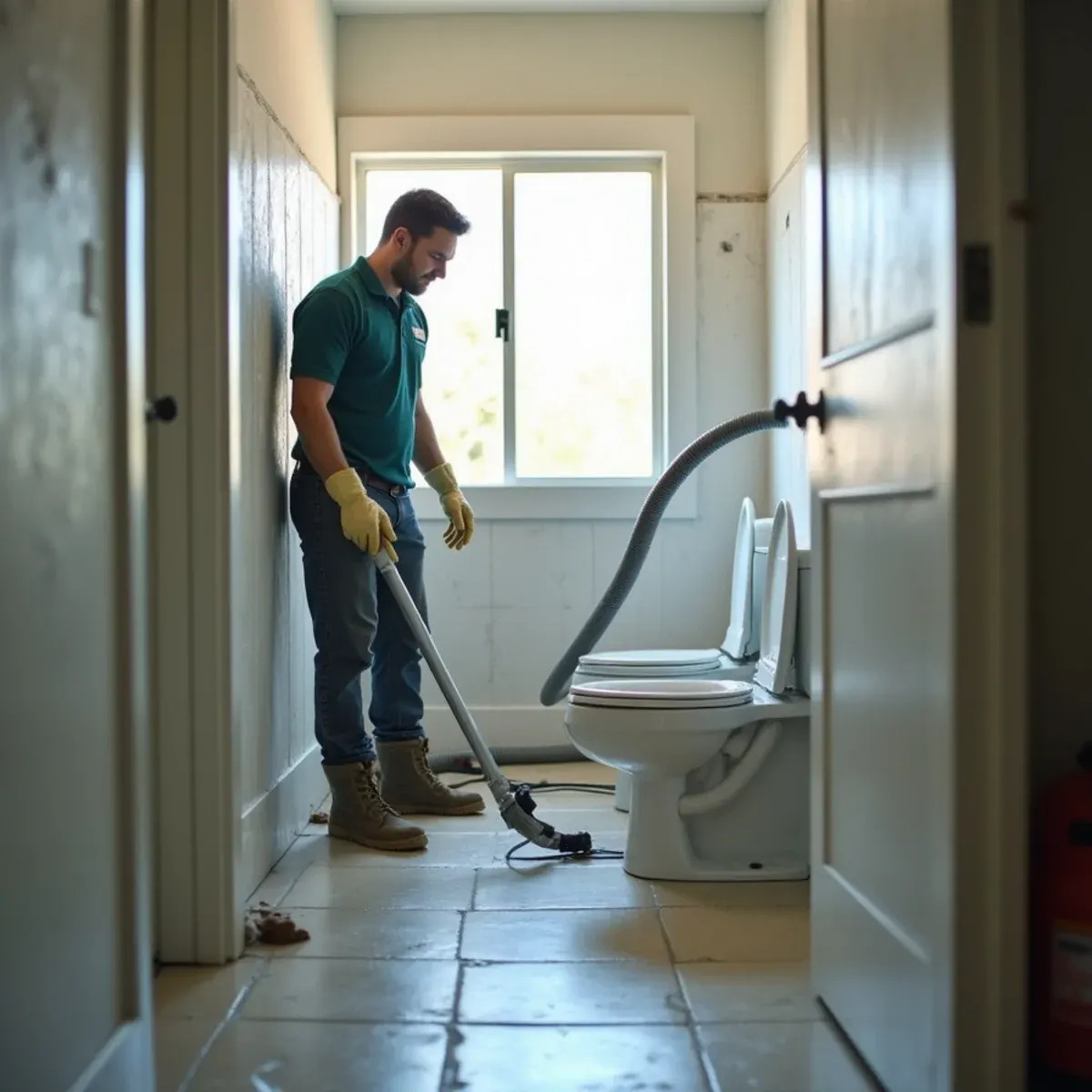
An overflow in a raised-foundation Fullerton house often leaves less evidence than one on a slab, and that is exactly the trap. Water goes through the gap at the closet flange and the sub-floor seams, then drips into the crawl space, wetting soil and the underside of the joists without ever pooling anywhere a homeowner would see it. The bathroom floor looks nearly normal by morning. Meanwhile the old-growth Douglas fir framing beneath it, dense and slow to give moisture back, is holding water tight against the sub-floor sheathing.
That stock runs pre-war Craftsman and Spanish Revival through the older neighborhoods and up into Raymond Hills and Sunny Hills, where sloped lots make crawl-space access awkward on the downhill side and cramped on the uphill side. The other Fullerton pattern is the student rental belt around Cal State Fullerton and Fullerton College. Overflows there get reported late, over a weekend, after a break, sometimes only when a roommate mentions it in passing. Delay alone moves a Category 1 loss into Category 2 or 3, and we will tell you honestly where a few days has put you.
What Fullerton Changes About Toilet Overflow
1Crawl-space inspection is not optional here
On a raised foundation, the absence of standing water upstairs proves nothing. We go under the house, read the joists and sub-floor from below, check the soil directly beneath the bathroom and look for staining along the beams. That inspection takes half an hour and it is the difference between a dry-out and a structural repair discovered a year later.
2Old-growth fir gives moisture back slowly
The Douglas fir framing in Fullerton's pre-war houses is far denser than modern lumber. It absorbs less quickly and it dries much more slowly, so crawl-space drying takes more days than the same volume of new construction would. We set equipment underneath, contain the crawl space, and monitor the framing itself rather than assuming the air reading tells the whole story.
3Delayed reporting in student rentals
Around the two campuses, an overflow that happened Friday often reaches us Monday, or later. Clean water turns to Category 2 within roughly a day or two and keeps degrading from there, and porous material that was salvageable on day one is not on day four. We do not lecture anyone about it. We tell tenants and property owners exactly where the loss now sits and what that changes in the scope.
How the Work Runs
The method is the same one we use on every toilet overflow job, documented to the IICRC S500:2025 standard. Here it is in short — the full toilet overflow cleanup process explains each stage in detail.
- Stop the water, stabilize the room
- Determine the category before scoping
- Extract, then remove only what must go
- Pull the toilet, inspect the flange
- Dry the subfloor and the ceiling below
- Disinfect to category, verify, reset
The Fullerton Background Worth Knowing
The pre-war homes around downtown Fullerton were built with materials that behave completely differently from modern construction. Lath and plaster walls hold several times the water drywall does. Old-growth Douglas fir framing is dense and dries slowly. Original oak and fir flooring is thick, high-quality material that is well worth saving.
There is more on the housing stock, drainage and plumbing history of this city on our water damage restoration in Fullerton page.
Fullerton at a glance
- Dominant construction era
- 1910–1980
- Foundation type
- mixed on grade
- Supply piping found here
- galvanized steel, copper, original pre-war piping
- Drain line materials
- cast iron, clay
- Terrain and water table
- rolling, moderate water table
- Most common local failure
- crawl-space leaks that run undetected for weeks because the water drips away instead of pooling on a floor
- Highest-value local prevention
- posting a shutoff location and emergency contact in every rental, since delayed reporting is the local failure mode
What It Costs in Fullerton
We do not quote a number over the phone before seeing the property — anyone who does is guessing. The variables that actually move the price on a toilet overflow job are the category of the water, how far it traveled from the base, what your floor is built from, and they are broken down in full on the toilet overflow cleanup page. The assessment and the written estimate are free anywhere in Fullerton, day or night, with no obligation.
Toilet Overflow Questions from Fullerton Homeowners
In a raised-foundation Fullerton home, yes. A surface that dries quickly often means the water left, not that it evaporated, and where it went is the crawl space. Wet soil under the bathroom, damp joist ends and saturated sub-floor sheathing produce no visible symptom upstairs until the flooring starts to move or you smell something in the hall closet. A crawl-space inspection settles it. If it is dry down there, you are genuinely done.
Clear water lowers the health risk, not the drying requirement. Clean water still soaks into carpet pad, particle board, and the cut edge of subfloor around the flange, and it still causes swelling and mold growth if it stays. What clean water does change is the scope: no containment, no PPE, usually no demolition. If it stayed on sealed tile and you got it up quickly, you may genuinely be fine. If it reached anything porous, it needs real drying.
Three checks. Did the water rise in the bowl without anyone flushing it? Does another fixture gurgle, drain slowly, or fill up when you run water elsewhere in the house? Is there visible soil or a sewer odor in what came out? Any one of those points at the main line. A stuck fill valve, by contrast, gives you clear water, a bowl that overflows steadily, and a tank you can hear running continuously.
Yes, and they need a different approach. Lath and plaster and old-growth framing hold far more water than modern materials and dry much more slowly, so we plan for seven to fourteen days with higher-capacity equipment. The original material is worth that effort — nothing sold today replaces it.