
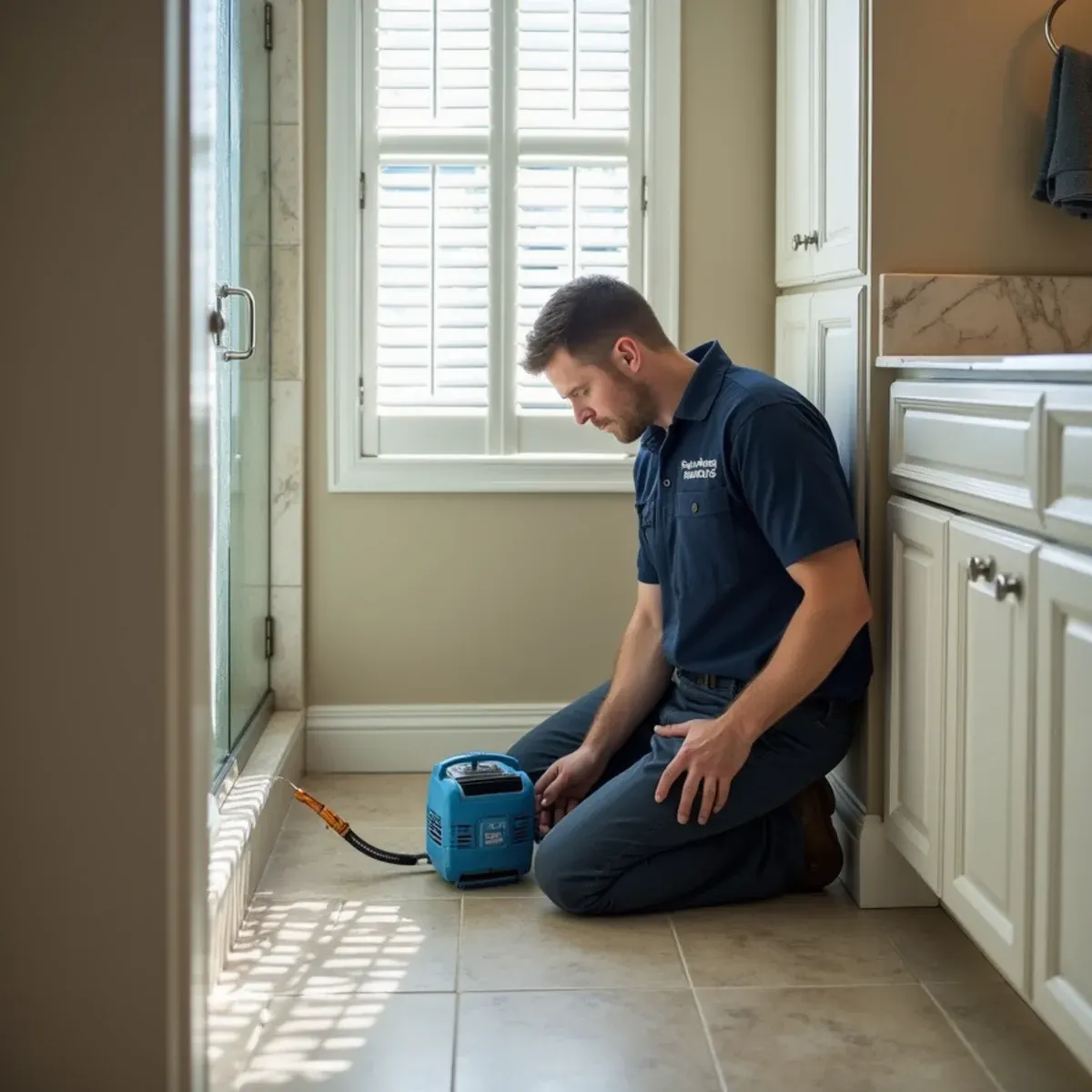
Downey homeowners tend to call about the finishes as much as the water. Jean Vandruff's Cinderella Homes put turrets, pointed rooflines, scalloped trim and interior millwork on ordinary 1950s tract houses, and that detailing is not something you order again. When a shower pan gives way in one of those houses, the fastest repair is to open everything and start over. The right repair is usually not the fastest one. We would rather spend the extra day drying a wall cavity through controlled openings than tear out trim and casing that has been in place since Eisenhower.
Under the gingerbread it is standard 1950s construction: slab foundation, galvanized supply, mortar-bed shower pans over hot-mopped liners built between roughly 1950 and 1965. Same era as the oldest surviving McDonald's on Lakewood Boulevard and the aerospace years that ran out of the site now holding the Columbia Memorial Space Center. Those pans are seventy years old and the galvanized behind them is the same vintage, so the water we find at a wall base can be coming from either. On a slab there is no crawl space to intercept it, so it goes into the bottom plate and out to the adjoining room's flooring.
What Downey Changes About Shower Pan Leaks
1Low-demolition drying around original millwork
Cinderella Home trim, casing and built-ins cannot be matched at a lumberyard. Where moisture readings allow, we dry cavities through small access points, from behind, or from a closet wall rather than the finished side. It takes longer and needs more monitoring. We will tell you honestly when a section is too saturated to save, because pretending otherwise leads to mold behind pretty trim.
2Seventy-year-old pans and galvanized together
A 1950s Downey bath usually still has its original mortar-bed pan and original galvanized supply in the same wall. We flood-test the pan with the water shut off and pressure-check the supply separately, so you know whether you are buying tile work, plumbing, or both before demolition starts.
3Slab construction sends water to the next room
With no crawl space, a failed pan pushes water along the slab into the wall base and out under the flooring of whatever room shares that wall. In these compact 1950s plans that is typically a bedroom. We moisture-map the adjoining rooms first, because the wettest material is often the bedroom carpet pad rather than anything in the bathroom.
How the Work Runs
The method is the same one we use on every shower pan leaks job, documented to the IICRC S500:2025 standard. Here it is in short — the full shower pan & bathroom leak repair process explains each stage in detail.
- Map the moisture first
- Flood test the pan
- Isolate the actual failure
- Open only what has to open
- Dry the structure to standard
- Rebuild the waterproofing correctly
The Downey Background Worth Knowing
The instinct on a wet wall is to open it, and sometimes that is correct. But IICRC S500:2025 is built around restoring rather than replacing wherever the drying goals can genuinely be met, and on a house with original arched casings and applied gingerbread, meeting those goals is worth some patience. We would rather spend three extra days with equipment running than pull a run of trim that would have to be milled from scratch to come back. The standard supports that choice and so does the arithmetic on the estimate, because custom millwork is not cheap and matching a fifties profile is not quick.
There is more on the housing stock, drainage and plumbing history of this city on our water damage restoration in Downey page.
Downey at a glance
- Dominant construction era
- 1950–1965
- Foundation type
- slab on grade
- Supply piping found here
- galvanized steel, under-slab copper
- Drain line materials
- cast iron
- Terrain and water table
- flat, moderate water table
- Most common local failure
- 1950s slab and galvanized failures in houses whose decorative woodwork makes careful, low-demolition drying worth paying for
- Highest-value local prevention
- drying in place wherever readings allow, because the trim and detailing on these houses cannot be bought
What It Costs in Downey
We do not quote a number over the phone before seeing the property — anyone who does is guessing. The variables that actually move the price on a shower pan leaks job are how long the shower kept running, what sits under the shower floor, whether the framing is compromised, and they are broken down in full on the shower pan & bathroom leak repair page. The assessment and the written estimate are free anywhere in Downey, day or night, with no obligation.
Shower Pan Leaks Questions from Downey Homeowners
Often, yes, and it is worth planning the job around that. We map moisture to find exactly which cavities are wet, then dry through the smallest openings that will do the work — the back side of a closet wall, a low access below the baseboard line, or from the shower side where tile is coming out anyway. Trim comes off carefully and gets reinstalled rather than replaced. Where framing or drywall is too far gone we will say so plainly instead of drying around a problem.
Timing is the cleanest clue. A pan leak only produces water when the shower is running, so the symptom appears within hours of use and dries out between uses. A pressurized supply line leaks around the clock, and the damage grows steadily whether anyone is home or not. Shut off every fixture and watch the water meter's low-flow indicator. If it still moves, you have a supply leak, not a pan. We confirm it with a flood test either way.
Sometimes, and we will tell you honestly which case you are in. A leak at the drain clamping ring, or a failed seal where the surround meets the pan, can occasionally be handled with a limited opening. A split or perforated liner cannot. Liquid-applied products sold as pan sealers can buy a few months on a pinhole, but they will not repair a membrane that has failed at a fold or a corner, and we are not going to sell you that as a fix.
Usually, yes. We go into the wall cavity through small ports low on the wall, hidden behind shoe molding or inside a closet, and dry from the inside out rather than taking the finished face off. That takes longer and needs more equipment than gutting the wall would, which is exactly the trade we think is worth making on a house with millwork that cannot be bought. Where it will not work, we tell you early.