
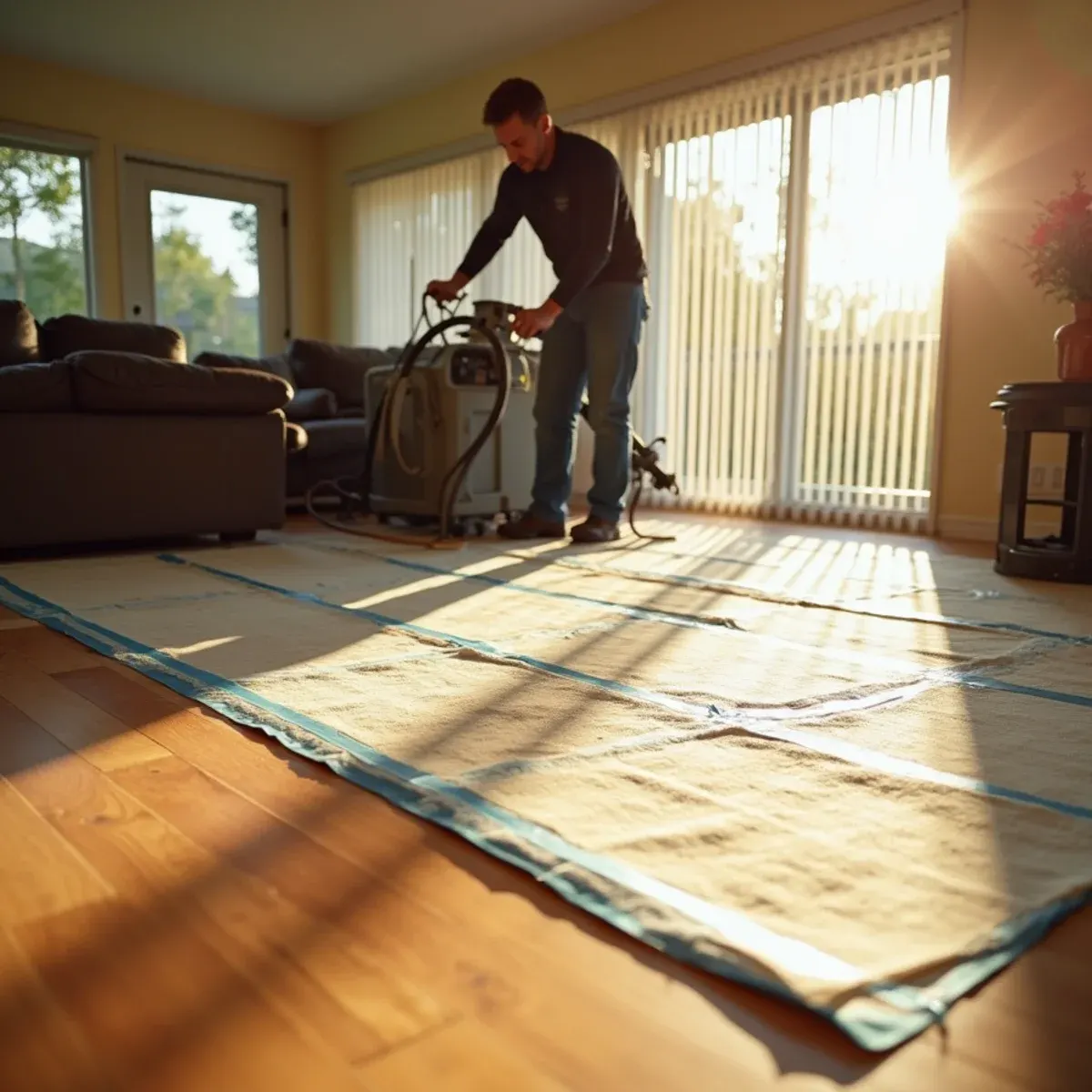
Uptown Whittier's houses around Greenleaf and Philadelphia were built when Douglas fir still came out of old-growth timber — tight vertical grain, dense, nothing like the fir sold today. Those floors are usually the original ones, nailed over a plank subfloor on a raised foundation, and they hold moisture longer than oak does. They also come back flat more often than people expect. We've saved fir that a flooring contractor had already condemned, because slow and tight is a drying problem, not a lost cause.
College Hills is a different job entirely. Subdivided in 1923 as the city's first planned hillside development, it has steep grades and curving streets, and the homes stack across split levels. Water from a failed slope drain or an upper-floor supply line runs down interior stairs and pools at the bottom landing, which is where the wood floor takes the worst of it. East Whittier's postwar slab tract is the third case: retrofit flooring, one drying direction, no crawl space to work from.
What Whittier Changes About Hardwood Floor Drying
1Old-growth fir dries slower than oak
The vertical-grain fir in Uptown houses is dense, tight and old-growth, and it gives up moisture reluctantly. That reads as failure to crews used to modern oak, and floors get condemned that would have come back. We run longer, watch the numbers, and let the fir take the time it needs. The reward is keeping a floor that has already survived a century.
2College Hills stacks water at the landing
Subdivided in 1923 on steep grades, the hillside homes here are split-level or multi-level. Water from an upper-floor line or a failed slope drain runs down the interior stairs and stops at the bottom landing, so the worst-hit flooring is often two levels below the failure. We start reading at the lowest floor and work upward rather than the other way around.
3Uptown crawl spaces, East Whittier slabs
Which half of the city you're in decides the plan. Uptown's raised foundations let us dry from beneath as well as above, which is faster and gentler on old boards. East Whittier's postwar tracts are slab, so it's surface drying only and the timeline stretches. We confirm the foundation type before quoting anything, because the two jobs are not comparable.
How the Work Runs
The method is the same one we use on every hardwood floor drying job, documented to the IICRC S500:2025 standard. Here it is in short — the full hardwood floor water damage drying process explains each stage in detail.
- Measure before deciding anything
- Extract from below the surface
- Control the drying rate deliberately
- Dry the subfloor and any cavity below
- Let it acclimate before judging it
- Sand and refinish only if needed
The Whittier Background Worth Knowing
A leak under a raised foundation does not announce itself the way a slab leak does. There is no puddle on the floor and no warm spot underfoot, because the water drips down into the soil and stays there. What you get instead is a smell that is stronger in the morning, a board that feels slightly soft, and eventually a floor that has been quietly feeding fungal growth for months. By the time an Uptown homeowner calls us about a crawl space leak, the question is rarely how to dry it. It is how much of the joist and subfloor is still doing its job.
There is more on the housing stock, drainage and plumbing history of this city on our water damage restoration in Whittier page.
Whittier at a glance
- Dominant construction era
- 1890–1980
- Foundation type
- mixed on grade
- Supply piping found here
- original turn-of-century piping, galvanized steel, under-slab copper
- Drain line materials
- cast iron, clay
- Terrain and water table
- hillside-mixed, moderate water table
- Most common local failure
- raised-foundation crawl-space leaks in Uptown, and slope drainage failures in the hillside tracts
- Highest-value local prevention
- an annual crawl-space or slope-drain check, depending which Whittier you live in
What It Costs in Whittier
We do not quote a number over the phone before seeing the property — anyone who does is guessing. The variables that actually move the price on a hardwood floor drying job are square footage under the mat system, solid versus engineered wood, what is underneath, and they are broken down in full on the hardwood floor water damage drying page. The assessment and the written estimate are free anywhere in Whittier, day or night, with no obligation.
Hardwood Floor Drying Questions from Whittier Homeowners
More often than people expect. Old-growth fir is dense and slow to release moisture, which is exactly why it gets written off — a crew reads it on day three, sees little movement, and calls it. Given time, mats on top and dehumidified air in the crawl space below, badly cupped fir usually flattens. What we can't fix is a floor that got sanded while still wet, so hold off on the flooring contractor until the readings equalize.
Frequently, yes. Cupping is caused by uneven moisture between the top and bottom of each board, and when the moisture equalizes during controlled drying, much of the deformation reverses. Full flattening can take two to four weeks of acclimation after the equipment comes out, which is why we do not recommend sanding immediately.
Five to ten days under the mat system is typical, which is longer than drywall because wood gives up moisture slowly and has to be dried at a controlled rate. Rushing it causes splitting and permanent gapping, so the extra days are doing real work.
It cuts both ways. A crawl space leak hides longer, because the water drips into soil instead of pooling on your floor, so it often runs for months and reaches the framing before anyone notices. The upside is real though: the plumbing is accessible, so locating and repairing it does not mean breaking concrete. On balance, detection is your weak point in Uptown, which is why an annual look under the house is worth doing.