
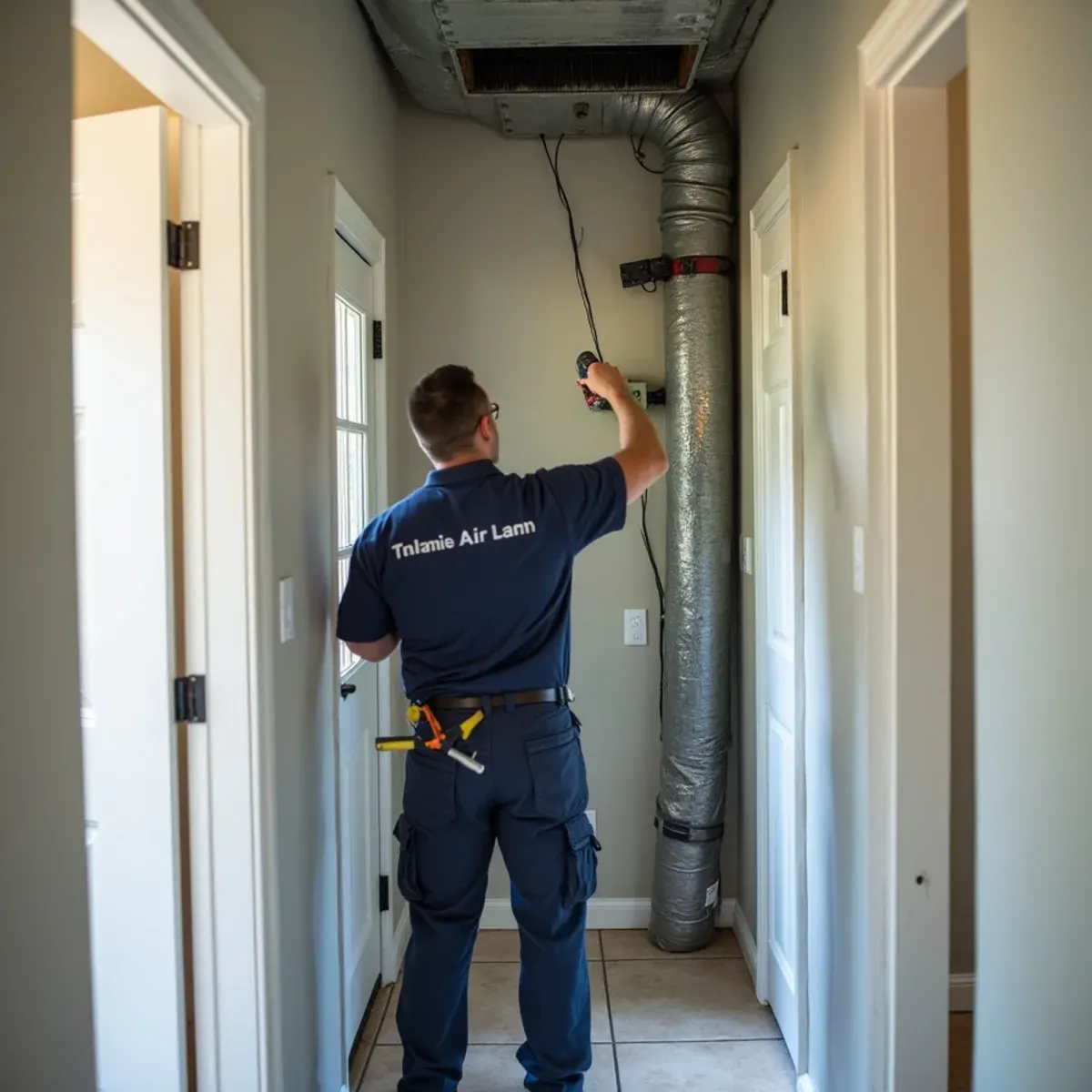
A supply line lets go in an upstairs bathroom in one of La Palma's two-story tracts, and the homeowner finds it two days later as a stain in a downstairs ceiling twenty feet away. What sits in between is the floor assembly, and in most of these plans that assembly carries the supply branches feeding the downstairs rooms. The water does not simply travel through joists on its way down. It travels along the top of ducting that has been in that cavity since the house was built.
La Palma is the smallest city in Orange County by area and one of the most consistent. Homes went up between 1960 and 1980 on slab, the under-slab copper is largely untouched, and owners have stayed for decades and kept things immaculate. That is a compliment with a catch: original ducting is still original. Forty-year-old flex has a paper-thin inner liner and a fiberglass jacket around it, and once that jacket is wet, cleaning the duct is not the same thing as making it right.
What La Palma Changes About Air Ducts & HVAC
1Supply branches inside the floor assembly
On a two-story plan the downstairs registers are usually fed from above, through the cavity between floors. Open that ceiling after an upstairs loss and you find insulated flex sitting in standing water on top of the drywall. It cannot be inspected from an attic hatch and it cannot be dried by running the fan. Somebody has to open it up and look.
2Panned returns in the joist bays
Several plans here pull return air through a framed chase or a joist bay lined with sheet metal rather than through a sealed duct. Get water into that bay and the return is now drawing across wet wood and insulation on every cycle. Sealing and cleaning a panned return is different work from cleaning a round duct, and it is the part most often skipped.
3Original systems in long-owned homes
Owners here tend to be the second family in the house, sometimes still the first. Equipment has been replaced once or twice; ducting almost never has. When we open a return plenum in a La Palma home we are often looking at the installer's original mastic and tape from the 1970s. That is not a criticism of the house. It means the material was at the end of its life before the loss happened.
How the Work Runs
The method is the same one we use on every air ducts & hvac job, documented to the IICRC S500:2025 standard. Here it is in short — the full air duct cleaning & hvac restoration process explains each stage in detail.
- Inspect before we quote
- Contain and seal the system
- Clean or replace the ducting
- Clean the air handler and coil
- Replace filters and treat surfaces
- Seal, balance, and verify
The La Palma Background Worth Knowing
There is a pattern we see repeatedly in La Palma. A homeowner has taken excellent care of a house for thirty years — new roof, dual-pane windows, updated electrical panel, remodeled kitchen. Then a slab leak runs for eight months under the living room and nobody catches it, because there was never anything to see.
There is more on the housing stock, drainage and plumbing history of this city on our water damage restoration in La Palma page.
La Palma at a glance
- Dominant construction era
- 1960–1980
- Foundation type
- slab on grade
- Supply piping found here
- under-slab copper
- Drain line materials
- cast iron, ABS
- Terrain and water table
- flat, moderate water table
- Most common local failure
- second-floor supply and fixture failures that travel through the floor assembly into the ceiling below
- Highest-value local prevention
- knowing where the main shutoff is and confirming it still turns, because two-story losses double in size in minutes
What It Costs in La Palma
We do not quote a number over the phone before seeing the property — anyone who does is guessing. The variables that actually move the price on a air ducts & hvac job are cleaning versus replacing flex duct, number of supply runs and returns, what kind of contamination it is, and they are broken down in full on the air duct cleaning & hvac restoration page. The assessment and the written estimate are free anywhere in La Palma, day or night, with no obligation.
Air Ducts & HVAC Questions from La Palma Homeowners
Usually yes. Opening that ceiling is the expensive part and it is already done. If the flex in there took on water, the fiberglass jacket holds moisture and odor long after the framing reads dry, and closing it back up means paying twice when the smell returns in summer. We photograph the run, show you what is salvageable and what is not, and put replacement of the affected sections into the same scope your carrier is already reviewing.
Fair question, and often it is an upsell. The honest answer depends on whether contamination actually reached the system. If the HVAC ran during the loss or the demolition, if water got into the attic where the ducting lives, or if the loss involved sewage or fire, the system is in scope. If none of that happened, it probably is not. We run a camera and show you before you decide anything.
It depends on where the moisture is. If the inner liner got damp and the fiberglass behind it stayed dry, cleaning and drying the run works. If water got through a torn jacket into the insulation, that fiberglass is porous, it holds moisture and growth, and there is no reliable way to clean it or verify it is clean. Those runs get replaced. We show you which is which rather than guessing on your behalf.
Typically fifteen to twenty minutes. La Palma borders Cypress directly to the north, so it is one of the fastest calls we run and the 60-minute commitment applies in full.