
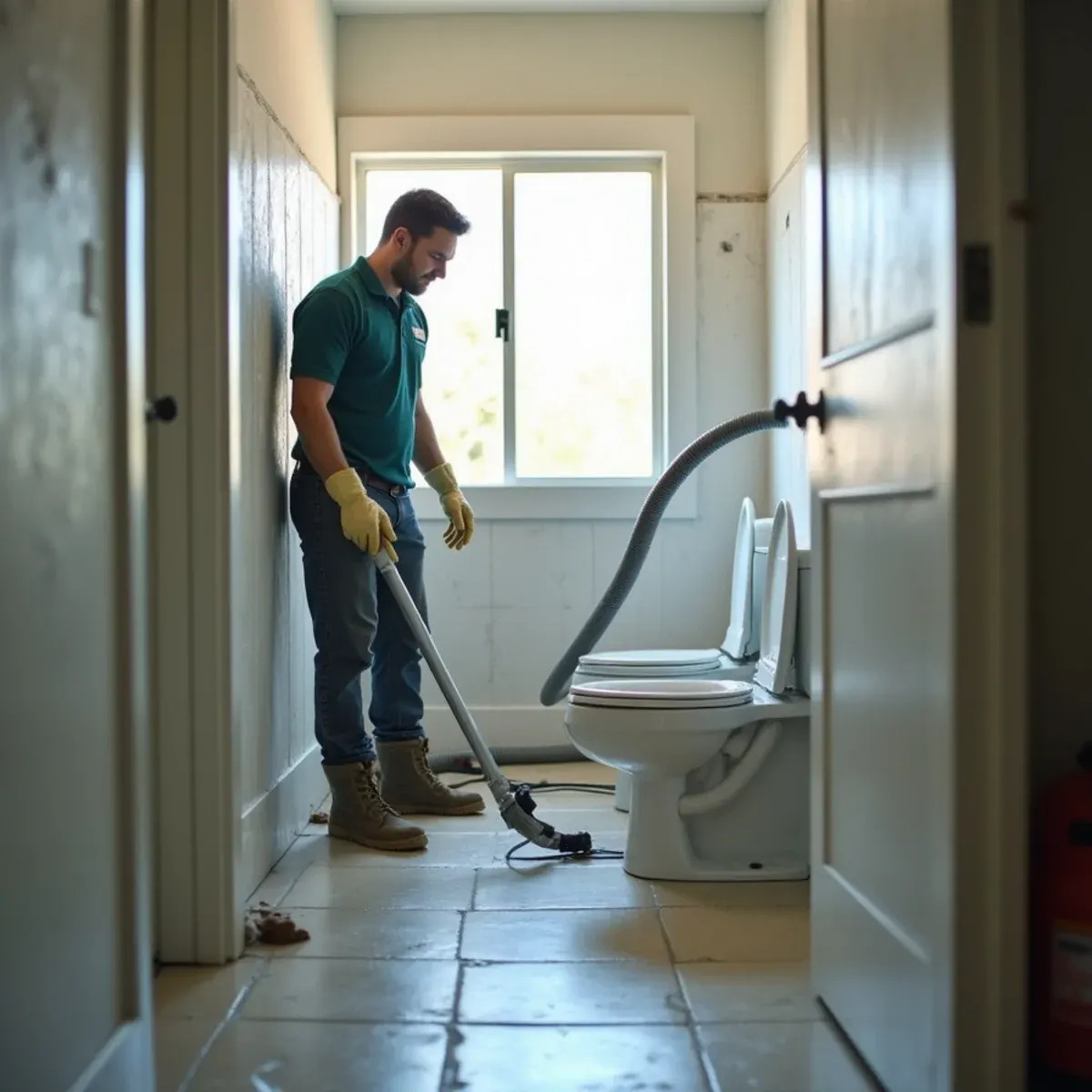
Yorba Linda is the newest housing stock on our service map, and on this particular job that's good news. Most of the city was built between 1970 and 2005 with drainage laid to modern standards, so the Category 3 main-line backups that define our work in the older LA County cities are less common here. We're not going to pretend otherwise. What we do see are clean-water overflows — a stuck fill valve, a blocked trap, a guest bath running unnoticed — in houses tall enough that the water has somewhere to go.
That somewhere is downward. Homes built into these hills run two and three levels, with baths over great rooms, over garages and over each other. Add larger floor plans with several bathrooms and a secondary suite nobody uses for weeks, and an overflow gets found by a ceiling stain rather than by a person. The Land of Gracious Living has big houses and long distances between rooms. On this service that's the whole problem — not slope drainage, not terrace drains, just time.
What Yorba Linda Changes About Toilet Overflow
1Modern drainage, mostly clean-water losses
Post-1970 laterals with fewer joints and better fall don't back up the way 1950s clay and cast iron do. Most Yorba Linda overflows we handle are Category 1 or 2 from a fixture failure, which means drying rather than demolition. That's a faster and cheaper job, and we'd rather tell you so up front than arrive selling containment you don't need.
2Ceilings below upstairs baths
The real damage in a hillside two-story is one floor down. Water crosses the bathroom floor, finds the closet flange penetration or a gap at the tub, and drops into the joist bay. Insulation and blocking trap it there. We check the ceiling below and the wall cavity at the far end of the bay, because water travels along a joist before it comes through drywall.
3Guest wings and seldom-used bathrooms
Large homes here often have a bath in a guest suite or a casita that goes weeks between uses. A fill valve that sticks open in an empty room can run a long time before anyone hears it. If you're leaving town, close the angle stops in the rooms nobody's using. It costs nothing and it prevents most of what we get called for in this city.
How the Work Runs
The method is the same one we use on every toilet overflow job, documented to the IICRC S500:2025 standard. Here it is in short — the full toilet overflow cleanup process explains each stage in detail.
- Stop the water, stabilize the room
- Determine the category before scoping
- Extract, then remove only what must go
- Pull the toilet, inspect the flange
- Dry the subfloor and the ceiling below
- Disinfect to category, verify, reset
The Yorba Linda Background Worth Knowing
A hillside lot in Yorba Linda is a drainage system with a house attached. Terrace drains cut across the face of the slope to intercept water before it gains speed. Brow ditches run along the top to keep runoff from ever reaching the slope face. Down-drains carry the collected water to the street or a storm connection. Retaining walls have weep holes and, behind them, a gravel subdrain that relieves pressure on the wall. Every one of those was engineered as part of the pad. Every one of them silts up, roots over, or gets buried by landscaping.
There is more on the housing stock, drainage and plumbing history of this city on our water damage restoration in Yorba Linda page.
Yorba Linda at a glance
- Dominant construction era
- 1970–2005
- Foundation type
- slab on grade
- Supply piping found here
- under-slab copper, later PEX and CPVC
- Drain line materials
- ABS, cast iron
- Terrain and water table
- hillside-mixed, deep water table
- Most common local failure
- exterior water from failed slope drainage, terrace drains and retaining-wall systems rather than from plumbing
- Highest-value local prevention
- clearing terrace and slope drains before the season, since a blocked one turns an engineered hillside into a funnel
What It Costs in Yorba Linda
We do not quote a number over the phone before seeing the property — anyone who does is guessing. The variables that actually move the price on a toilet overflow job are the category of the water, how far it traveled from the base, what your floor is built from, and they are broken down in full on the toilet overflow cleanup page. The assessment and the written estimate are free anywhere in Yorba Linda, day or night, with no obligation.
Toilet Overflow Questions from Yorba Linda Homeowners
Less than an older neighborhood would, honestly. Yorba Linda's newer laterals have fewer joints for roots to enter and better fall to the main, so full Category 3 backups are the exception here rather than the rule. It still happens — wipes, grease and a shifted section will block any line. But if your toilet overflowed from a running fill valve or a plugged trap, that's clean water and a drying job. The category sets the cost, not the address.
Clear water lowers the health risk, not the drying requirement. Clean water still soaks into carpet pad, particle board, and the cut edge of subfloor around the flange, and it still causes swelling and mold growth if it stays. What clean water does change is the scope: no containment, no PPE, usually no demolition. If it stayed on sealed tile and you got it up quickly, you may genuinely be fine. If it reached anything porous, it needs real drying.
Three checks. Did the water rise in the bowl without anyone flushing it? Does another fixture gurgle, drain slowly, or fill up when you run water elsewhere in the house? Is there visible soil or a sewer odor in what came out? Any one of those points at the main line. A stuck fill valve, by contrast, gives you clear water, a bowl that overflows steadily, and a tank you can hear running continuously.
Seeping from the weep holes is usually the wall doing its job, relieving water pressure from the soil behind it. The concerning version is the opposite: weep holes that stay dry through a storm while the ground above stays soggy, which suggests the subdrain behind the wall is plugged and pressure is building. Also watch for new cracking, bulging, or a wall that has tipped slightly. Those are engineering questions rather than restoration ones, and we will say so.