
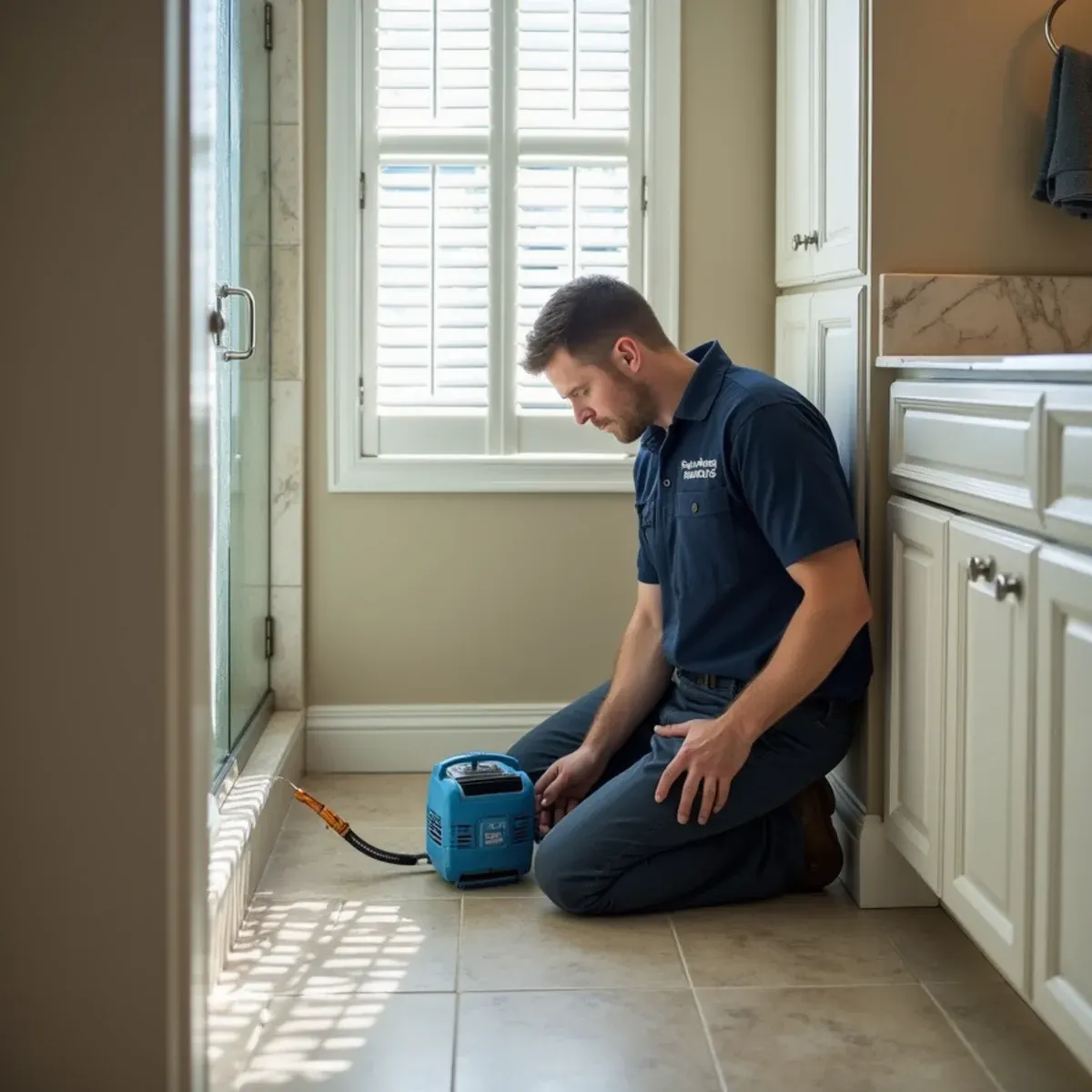
A useful thing to know before you assume the shower is the problem: Pico Rivera sits on the strip of ground between the San Gabriel River and the Rio Hondo, two flood-control channels, with a shallow water table underneath. That position defines how the whole city behaves in wet weather. Ground saturates fast during sustained storms, slabs pick up moisture from below, and floor coverings go dark in ways that look exactly like a plumbing failure. We have arrived at houses where the bathroom was suspected for weeks and the actual driver was groundwater during a long storm cycle.
The reverse is also true, which is why we test rather than argue. This city is postwar tract, roughly 1945 to 1965, built after Pico and Rivera merged in 1958, all on slab with mortar-bed pans of that era. Those liners are old and they do fail. Distinguishing the two comes down to pattern: a failed pan wets a defined zone at the wall base near the shower and tracks with use, while groundwater intrusion is broader, follows the weather, and often shows at multiple points along a perimeter or across a room's center. Flood-testing the pan settles which one you are dealing with.
What Pico Rivera Changes About Shower Pan Leaks
1Shallow water table changes the readings
Slab moisture here starts higher than it does in drier inland cities, so a single elevated reading proves less. We take comparison readings in rooms with no plumbing to establish the baseline for that house, then judge the bathroom against it. Without that step it is easy to condemn a sound pan because the whole slab is damp from the season.
2Storm cycles versus fixture use
Timing is the cleanest separator. Ask whether the wet area grows after heavy rain or after long showers. Between the two channels, sustained storms saturate ground fast and the effect lags days behind the rain. A pan leak does not care about weather. We ask for that history at the assessment because it narrows the work before any equipment comes out.
3Postwar pans reaching end of life
The original hot-mopped liners in these 1950s and 1960s tracts are well past design life, and the usual failure is at a folded corner or where the liner meets the drain. Once we clear groundwater as a factor, we flood-test with the drain plugged and watch the wall base. That either produces a leak or clears the pan outright.
How the Work Runs
The method is the same one we use on every shower pan leaks job, documented to the IICRC S500:2025 standard. Here it is in short — the full shower pan & bathroom leak repair process explains each stage in detail.
- Map the moisture first
- Flood test the pan
- Isolate the actual failure
- Open only what has to open
- Dry the structure to standard
- Rebuild the waterproofing correctly
The Pico Rivera Background Worth Knowing
On a hillside, storm water leaves. In Pico Rivera it soaks in, and when the soil is already near capacity it stops soaking in and simply stands. That is why a yard here can hold water two days after the rain stops while a yard up in the Whittier hills is dry by morning. The lawn is not draining badly. The ground underneath it is full. Once that happens, every path water can take toward your house becomes the path it takes: the garage threshold, the slider track, the gap where a patio slab has settled back toward the wall.
There is more on the housing stock, drainage and plumbing history of this city on our water damage restoration in Pico Rivera page.
Pico Rivera at a glance
- Dominant construction era
- 1945–1965
- Foundation type
- slab on grade
- Supply piping found here
- original galvanized steel, copper
- Drain line materials
- cast iron
- Terrain and water table
- flat, shallow water table
- Most common local failure
- ground saturating fast during sustained storms because the water table between two channels sits high
- Highest-value local prevention
- clearing area drains and confirming downspouts discharge well away from the foundation
What It Costs in Pico Rivera
We do not quote a number over the phone before seeing the property — anyone who does is guessing. The variables that actually move the price on a shower pan leaks job are how long the shower kept running, what sits under the shower floor, whether the framing is compromised, and they are broken down in full on the shower pan & bathroom leak repair page. The assessment and the written estimate are free anywhere in Pico Rivera, day or night, with no obligation.
Shower Pan Leaks Questions from Pico Rivera Homeowners
Both are real here, so we test rather than guess. Groundwater and storm saturation tend to affect a broader area, appear or worsen with sustained rain, and show up in rooms without plumbing too. A failed shower pan concentrates at the wall base near the shower and tracks with how much the bathroom is used. We take baseline readings elsewhere in the house, compare, then flood-test the pan with the supply off. That combination answers it without opening anything.
Timing is the cleanest clue. A pan leak only produces water when the shower is running, so the symptom appears within hours of use and dries out between uses. A pressurized supply line leaks around the clock, and the damage grows steadily whether anyone is home or not. Shut off every fixture and watch the water meter's low-flow indicator. If it still moves, you have a supply leak, not a pan. We confirm it with a flood test either way.
Sometimes, and we will tell you honestly which case you are in. A leak at the drain clamping ring, or a failed seal where the surround meets the pan, can occasionally be handled with a limited opening. A split or perforated liner cannot. Liquid-applied products sold as pan sealers can buy a few months on a pinhole, but they will not repair a membrane that has failed at a fold or a corner, and we are not going to sell you that as a fix.
Not in the way people picture it. The channels are engineered, and what we actually see is a groundwater and surface drainage problem rather than a channel overtopping. Because the water table between the two runs high and the ground is flat, soil here reaches saturation faster than it does a few miles inland. Once it does, storm water stops soaking in and starts looking for the lowest opening in your house, which is almost always the garage.