
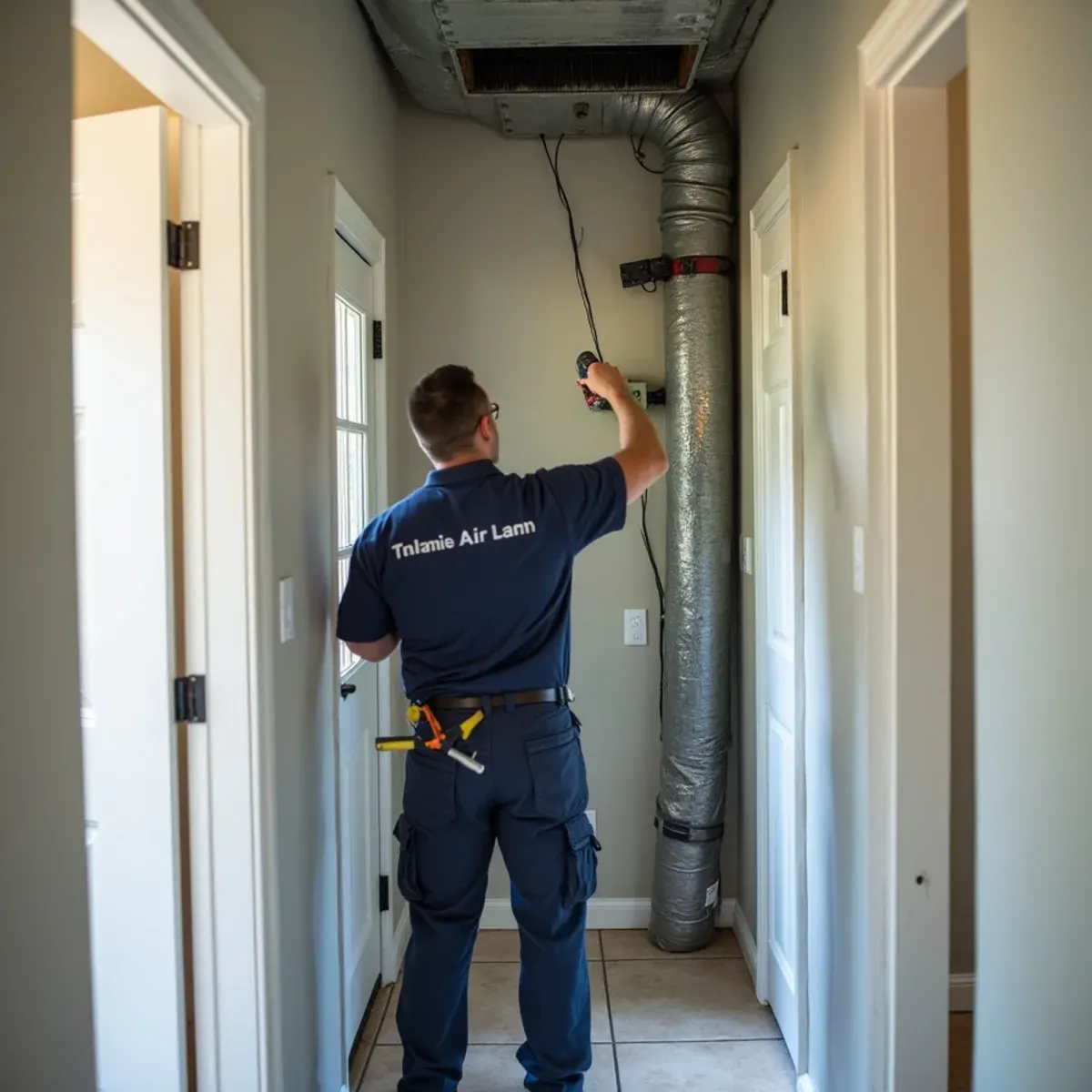
Most Yorba Linda calls don't end in duct replacement, and that's worth saying before anyone quotes you for it. The city was built between 1970 and 2005 into the hills — engineered slopes, retaining walls, terrace drains, larger lots and heavy irrigation. The water that gets into these houses usually arrives from outside and low: a terrace drain packed with silt, a slope shedding toward a lower-level slider, an irrigation line that ran all night against a foundation. Attic ducting fifteen feet above that is frequently untouched.
The exceptions still matter. Homes in the Land of Gracious Living are big enough that two systems are standard, one upstairs and one down, with long trunk runs crossing the whole footprint. Roof failures and second-story supply lines do reach ducting directly. And in the neighborhoods inside the 2008 Freeway Complex Fire footprint, where burn-scar runoff changed behavior for years, systems still carry fine ash and hillside grit that shows up on the filter and the blower wheel long before it shows up anywhere you can see.
What Yorba Linda Changes About Air Ducts & HVAC
1Downstairs water, upstairs system untouched
Slope drainage failures put water at the lowest finished level. The downstairs air handler, its return and its filter cabinet are right there; the upstairs system usually isn't involved at all. We scope them separately and say so in writing, because charging for two full duct cleanings when one system never saw moisture is exactly the kind of thing that gets contractors a reputation here.
2Two systems means two separate verdicts
Large Yorba Linda homes run zoned equipment with independent returns, coils and duct trees. Contamination doesn't migrate between them unless there's a shared chase or a whole-house fan. We map which system serves which rooms before writing anything, then inspect each one on its own merits. Sometimes that means a full scope on one and a filter and coil service on the other.
3Burn-scar grit and irrigation load equipment
Parts of the city sit inside the 2008 Freeway Complex Fire footprint, and years of altered runoff moved a lot of fine material downhill. Combined with the constant irrigation these slopes require, outdoor coils and filter cabinets here carry a heavier baseline load than flatland tracts. That fouling matters after a loss, because a coated coil doesn't release contamination or dry the way a clean one does.
How the Work Runs
The method is the same one we use on every air ducts & hvac job, documented to the IICRC S500:2025 standard. Here it is in short — the full air duct cleaning & hvac restoration process explains each stage in detail.
- Inspect before we quote
- Contain and seal the system
- Clean or replace the ducting
- Clean the air handler and coil
- Replace filters and treat surfaces
- Seal, balance, and verify
The Yorba Linda Background Worth Knowing
A hillside lot in Yorba Linda is a drainage system with a house attached. Terrace drains cut across the face of the slope to intercept water before it gains speed. Brow ditches run along the top to keep runoff from ever reaching the slope face. Down-drains carry the collected water to the street or a storm connection. Retaining walls have weep holes and, behind them, a gravel subdrain that relieves pressure on the wall. Every one of those was engineered as part of the pad. Every one of them silts up, roots over, or gets buried by landscaping.
There is more on the housing stock, drainage and plumbing history of this city on our water damage restoration in Yorba Linda page.
Yorba Linda at a glance
- Dominant construction era
- 1970–2005
- Foundation type
- slab on grade
- Supply piping found here
- under-slab copper, later PEX and CPVC
- Drain line materials
- ABS, cast iron
- Terrain and water table
- hillside-mixed, deep water table
- Most common local failure
- exterior water from failed slope drainage, terrace drains and retaining-wall systems rather than from plumbing
- Highest-value local prevention
- clearing terrace and slope drains before the season, since a blocked one turns an engineered hillside into a funnel
What It Costs in Yorba Linda
We do not quote a number over the phone before seeing the property — anyone who does is guessing. The variables that actually move the price on a air ducts & hvac job are cleaning versus replacing flex duct, number of supply runs and returns, what kind of contamination it is, and they are broken down in full on the air duct cleaning & hvac restoration page. The assessment and the written estimate are free anywhere in Yorba Linda, day or night, with no obligation.
Air Ducts & HVAC Questions from Yorba Linda Homeowners
Probably not the upstairs runs. Water entering at a lower-level slider affects the downstairs system — its return sits at floor level, its air handler is usually in a nearby closet or the garage, and that's the equipment moving damp air around. We'll still inspect the attic runs and take readings, because a roof or upstairs plumbing failure changes the answer, but we're not going to write a whole-house duct replacement because a terrace drain backed up.
Fair question, and often it is an upsell. The honest answer depends on whether contamination actually reached the system. If the HVAC ran during the loss or the demolition, if water got into the attic where the ducting lives, or if the loss involved sewage or fire, the system is in scope. If none of that happened, it probably is not. We run a camera and show you before you decide anything.
It depends on where the moisture is. If the inner liner got damp and the fiberglass behind it stayed dry, cleaning and drying the run works. If water got through a torn jacket into the insulation, that fiberglass is porous, it holds moisture and growth, and there is no reliable way to clean it or verify it is clean. Those runs get replaced. We show you which is which rather than guessing on your behalf.
Seeping from the weep holes is usually the wall doing its job, relieving water pressure from the soil behind it. The concerning version is the opposite: weep holes that stay dry through a storm while the ground above stays soggy, which suggests the subdrain behind the wall is plugged and pressure is building. Also watch for new cracking, bulging, or a wall that has tipped slightly. Those are engineering questions rather than restoration ones, and we will say so.