
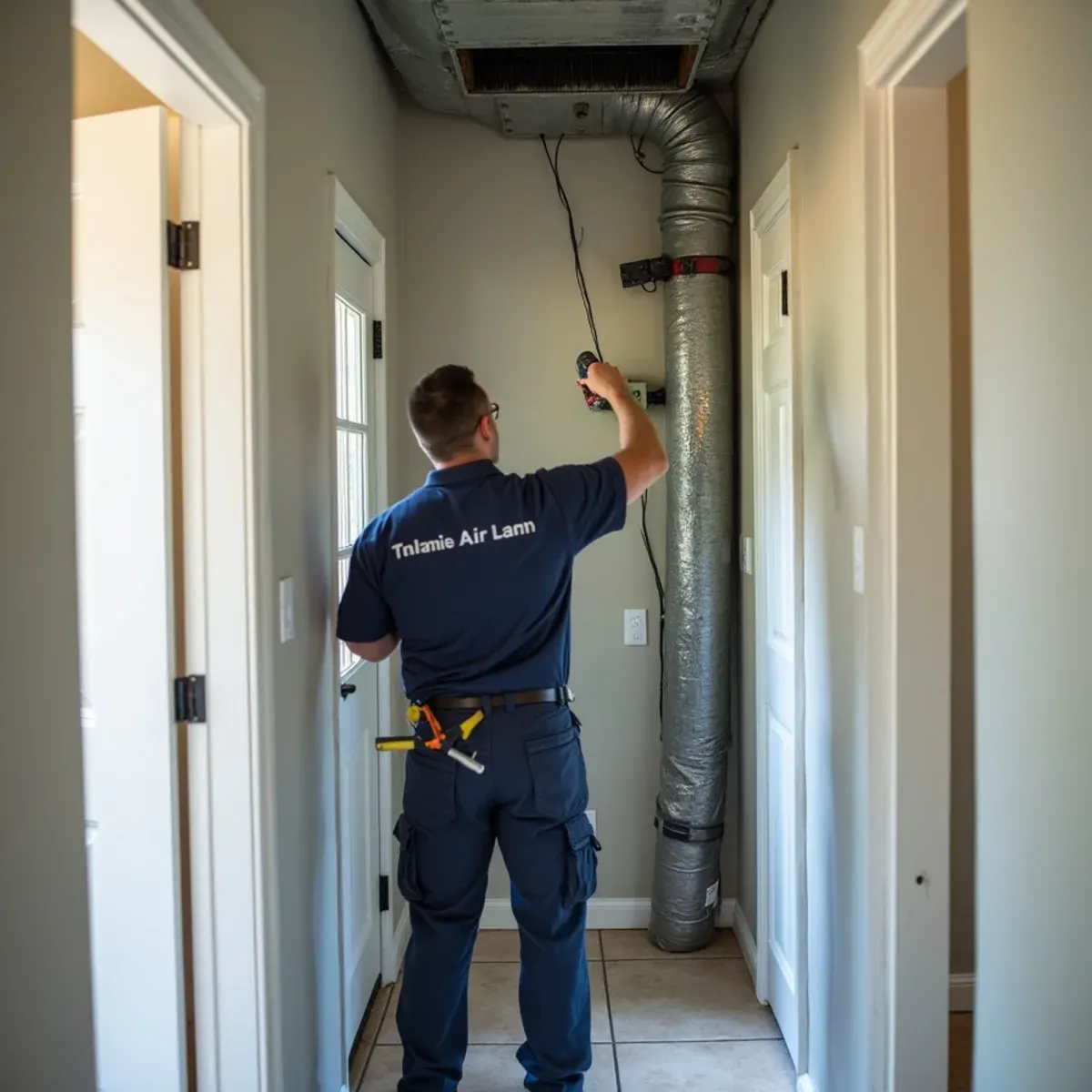
Around 17,500 Lakewood houses went up between 1950 and 1953, some days at a hundred a day, and they were not built with central air. The forced-air systems came later, squeezed into shallow attics over a compact floor plan where the kitchen, bathroom and laundry share plumbing walls in one tight core. That is the whole story of this work here. When seventy-year-old galvanized lets go at a scaled fitting inside that core, the water is instantly in the same few feet of ceiling the duct trunk crosses.
The uniformity cuts both ways. It means a stranger's house tells us where your trunk turns and where the boots land, so inspection is quick and quoting is honest. It also means that when one street starts having failures, the rest of the street is on the same clock. Attic clearance over the middle of these plans is a few inches, so much of the run can be seen but not reached, and replacement from below often beats trying to clean what no tool can get to.
What Lakewood Changes About Air Ducts & HVAC
1One wet core, short runs, fast spread
In this plan the kitchen, bath and laundry back onto each other, and the supply trunk crosses right above them on its way to the bedrooms. A galvanized failure in that core wets insulation and duct in the same hour it wets drywall. There is no long travel path buying you time, which is why calling at the first stain matters more here than it would in a sprawling plan.
2Ceiling and closet furnaces need opening
Plenty of these homes carry the air handler in a hallway closet or on a ceiling platform right at the center of the plan, feet from the wet core. The blower compartment, the return drop and the filter rack take on humidity immediately. We open and inspect the cabinet as a matter of course rather than as an add-on, because it is usually the wettest component and the one people forget about.
3Additions changed the original duct layout
Most of these houses have grown: a back bedroom, a family room, a converted garage. The runs feeding those spaces were spliced in years later, usually longer and less insulated than the originals, and they are where condensation and water collect. When we map a Lakewood system we look for the additions first, because that is the point where the original plan stops predicting anything.
How the Work Runs
The method is the same one we use on every air ducts & hvac job, documented to the IICRC S500:2025 standard. Here it is in short — the full air duct cleaning & hvac restoration process explains each stage in detail.
- Inspect before we quote
- Contain and seal the system
- Clean or replace the ducting
- Clean the air handler and coil
- Replace filters and treat surfaces
- Seal, balance, and verify
The Lakewood Background Worth Knowing
Galvanized steel supply piping was standard when Lakewood was built, and it fails in a specific and predictable way. The zinc coating protecting the steel wears through from the inside, the steel corrodes, and scale builds up on the interior wall — narrowing the pipe over decades. As the diameter shrinks, water velocity and turbulence increase, which accelerates the erosion at elbows and fittings until a thin spot lets go.
There is more on the housing stock, drainage and plumbing history of this city on our water damage restoration in Lakewood page.
Lakewood at a glance
- Dominant construction era
- 1950–1953
- Foundation type
- slab on grade
- Supply piping found here
- original galvanized steel
- Drain line materials
- cast iron
- Terrain and water table
- flat, moderate water table
- Most common local failure
- seventy-year-old galvanized supply lines letting go at a scaled, eroded fitting
- Highest-value local prevention
- repiping while walls are already open for a repair, rather than as a separate project later
What It Costs in Lakewood
We do not quote a number over the phone before seeing the property — anyone who does is guessing. The variables that actually move the price on a air ducts & hvac job are cleaning versus replacing flex duct, number of supply runs and returns, what kind of contamination it is, and they are broken down in full on the air duct cleaning & hvac restoration page. The assessment and the written estimate are free anywhere in Lakewood, day or night, with no obligation.
Air Ducts & HVAC Questions from Lakewood Homeowners
Not usually, but it has to be opened. The cabinet, blower wheel, filter rack and the return drop directly beneath it all take on moisture in that position, and a closed-up cabinet with damp insulation inside will smell every time it fires. We inspect it, clean the blower and coil properly, replace liner and filter media that got wet, and only recommend replacing the unit when the cabinet insulation itself is saturated through.
Fair question, and often it is an upsell. The honest answer depends on whether contamination actually reached the system. If the HVAC ran during the loss or the demolition, if water got into the attic where the ducting lives, or if the loss involved sewage or fire, the system is in scope. If none of that happened, it probably is not. We run a camera and show you before you decide anything.
It depends on where the moisture is. If the inner liner got damp and the fiberglass behind it stayed dry, cleaning and drying the run works. If water got through a torn jacket into the insulation, that fiberglass is porous, it holds moisture and growth, and there is no reliable way to clean it or verify it is clean. Those runs get replaced. We show you which is which rather than guessing on your behalf.
Have it assessed. Seventy-year-old galvanized has exceeded any reasonable service life, and declining pressure or rust-colored water means it is well along. If a repair is already opening walls, that is the cheapest moment you will ever get to repipe — the demolition and patching are already in the scope.