
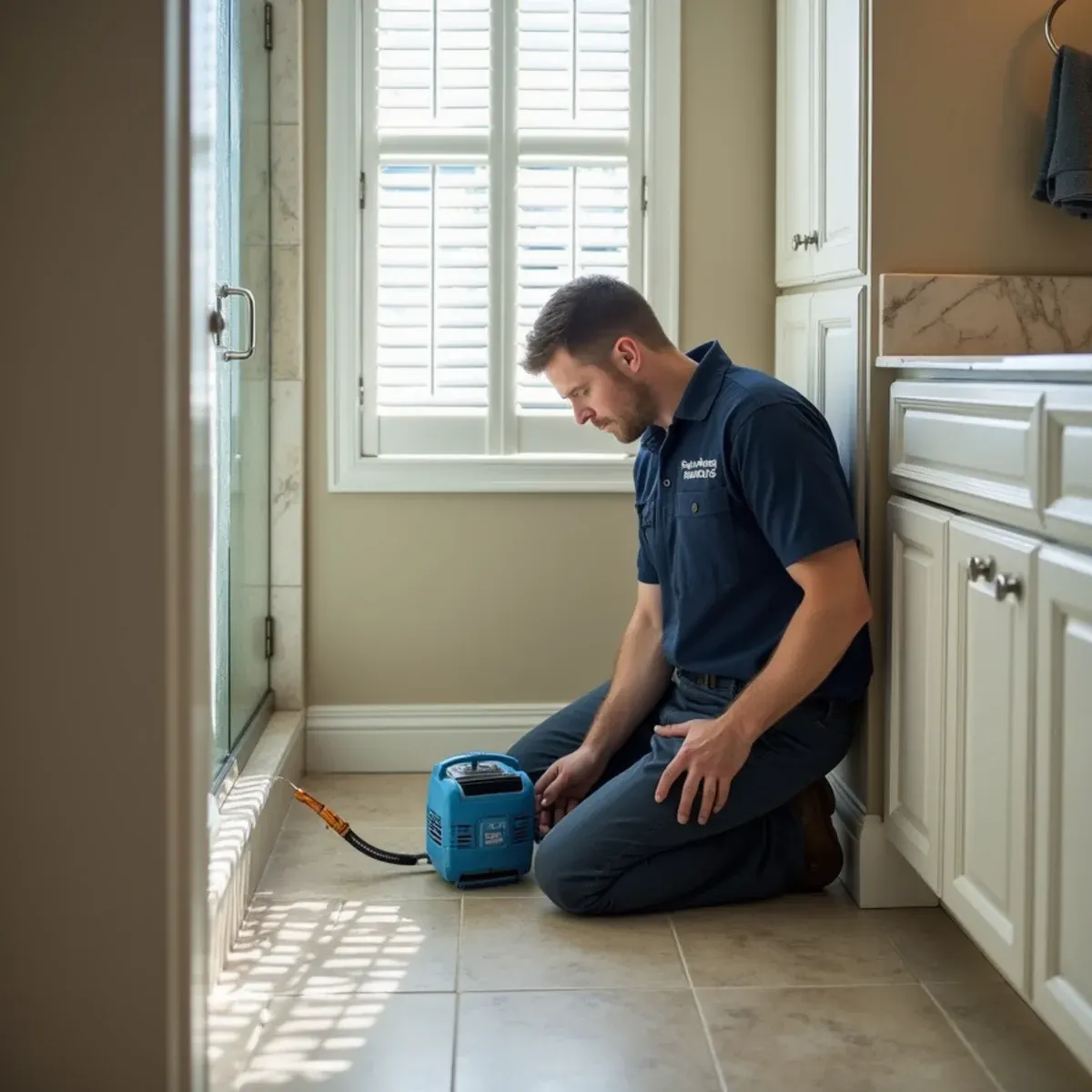
Around seventeen and a half thousand Lakewood homes went up between 1950 and 1953, at times a hundred a day, and the plumbing was laid out for speed. Kitchen, bathroom and laundry share a tight wet core so one set of walls carries everything. That decision is why a shower leak here is rarely a bathroom-only event. Water leaving a pan at the liner soaks into the sole plate of a wall that also has the kitchen sink on the other side, and the first thing a homeowner notices is often a swollen cabinet toe kick rather than anything in the bathroom.
These houses are on slab, so there is no crawl space to drip into and nothing gets hidden underneath. The water goes sideways or it goes nowhere. What sits behind the tile is original galvanized steel in a lot of these homes, seventy-plus years old and scaling from the inside, and a weeping nipple at the shower arm wets the same wall a failed pan does. Original hot-mopped pans are common too, with weep holes long since packed solid. Both are age failures, and telling them apart before demolition is most of the job.
What Lakewood Changes About Shower Pan Leaks
1One wet core, three rooms affected
Because the bath, kitchen and laundry share plumbing walls in these plans, we meter all three on arrival even when only one shows damage. Water in a shared sole plate moves along the wall, not just across the room. Catching the kitchen side early usually means saving a cabinet run, which is the most expensive thing standing in the path of a Lakewood bathroom leak.
2Galvanized behind the valve mimics a pan leak
Seventy years of scale and erosion inside original steel pipe produces slow weeps at threaded fittings, and the shower arm and valve body sit right in the wet wall. The damage pattern is indistinguishable from a leaking pan when you look at it from the outside. We flood-test the pan to rule it in or out before anyone starts pricing tile work.
3Identical plans, faster diagnosis
The extreme uniformity of these tracts means we usually know where the drain runs and which wall carries the supply before we arrive. That cuts the exploratory work considerably. It also means neighbors experience the same failures within a few years of each other, so if the house next door had a wet wall last winter, yours is not a strange coincidence.
How the Work Runs
The method is the same one we use on every shower pan leaks job, documented to the IICRC S500:2025 standard. Here it is in short — the full shower pan & bathroom leak repair process explains each stage in detail.
- Map the moisture first
- Flood test the pan
- Isolate the actual failure
- Open only what has to open
- Dry the structure to standard
- Rebuild the waterproofing correctly
The Lakewood Background Worth Knowing
Galvanized steel supply piping was standard when Lakewood was built, and it fails in a specific and predictable way. The zinc coating protecting the steel wears through from the inside, the steel corrodes, and scale builds up on the interior wall — narrowing the pipe over decades. As the diameter shrinks, water velocity and turbulence increase, which accelerates the erosion at elbows and fittings until a thin spot lets go.
There is more on the housing stock, drainage and plumbing history of this city on our water damage restoration in Lakewood page.
Lakewood at a glance
- Dominant construction era
- 1950–1953
- Foundation type
- slab on grade
- Supply piping found here
- original galvanized steel
- Drain line materials
- cast iron
- Terrain and water table
- flat, moderate water table
- Most common local failure
- seventy-year-old galvanized supply lines letting go at a scaled, eroded fitting
- Highest-value local prevention
- repiping while walls are already open for a repair, rather than as a separate project later
What It Costs in Lakewood
We do not quote a number over the phone before seeing the property — anyone who does is guessing. The variables that actually move the price on a shower pan leaks job are how long the shower kept running, what sits under the shower floor, whether the framing is compromised, and they are broken down in full on the shower pan & bathroom leak repair page. The assessment and the written estimate are free anywhere in Lakewood, day or night, with no obligation.
Shower Pan Leaks Questions from Lakewood Homeowners
It depends on what is wet and what is behind the wall. If the mortar bed is saturated, that bed comes out either way, so the real question is whether the original galvanized supply in that wall is worth reopening later. With seventy-year-old steel already exposed by the demolition, most people take the opportunity. We give you the mitigation scope and the reconstruction scope separately so you can see what is claim-related and what is an upgrade decision.
Timing is the cleanest clue. A pan leak only produces water when the shower is running, so the symptom appears within hours of use and dries out between uses. A pressurized supply line leaks around the clock, and the damage grows steadily whether anyone is home or not. Shut off every fixture and watch the water meter's low-flow indicator. If it still moves, you have a supply leak, not a pan. We confirm it with a flood test either way.
Sometimes, and we will tell you honestly which case you are in. A leak at the drain clamping ring, or a failed seal where the surround meets the pan, can occasionally be handled with a limited opening. A split or perforated liner cannot. Liquid-applied products sold as pan sealers can buy a few months on a pinhole, but they will not repair a membrane that has failed at a fold or a corner, and we are not going to sell you that as a fix.
Have it assessed. Seventy-year-old galvanized has exceeded any reasonable service life, and declining pressure or rust-colored water means it is well along. If a repair is already opening walls, that is the cheapest moment you will ever get to repipe — the demolition and patching are already in the scope.